
Mathematical Reasoning
Get insights from 119 questions on Mathematical Reasoning, answered by students, alumni, and experts. You may also ask and answer any question you like about Mathematical Reasoning
- 119
Questions
- 0
Discussions
- 0
Active Users
- 0
Followers
Have a question about Mathematical Reasoning? Ask our experts
Keep it short & simple. Type complete word. Avoid abusive language.
The contrapositive of the statement “If you will work, you will earn money” is
The contrapositive of the statement “If you will work, you will earn money” is
Statement : “If you will work, you will earn money”
contrapositive : If you will not earn money, you will not work.
 Upvote

Let P1, P2 ., P15 be 15 points on a circle. The number of distinct triangles formed by points Pi, Pj, pk such that i + j + k <!-- [if gte mso 9]><xml>
Let P1, P2 ., P15 be 15 points on a circle. The number of distinct triangles formed by points Pi, Pj, pk such that i + j + k <!-- [if gte mso 9]><xml>
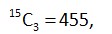
Required number = 
For x2 = x1 + a, a
->3x1 + 2a + b = 15
Coefficient of x15 in
Required number = 455 – 12 = 443
Upvote Negation of the statement <!-- [if gte mso 9]><xml>
Negation of the statement <!-- [if gte mso 9]><xml>
The statement <!-- [if gte mso 9]><xml>
The statement <!-- [if gte mso 9]><xml>
If the truth value of the Boolean expression <!-- [if gte mso 9]><xml>
If the truth value of the Boolean expression <!-- [if gte mso 9]><xml>
Kindly consider the following figure
Upvote 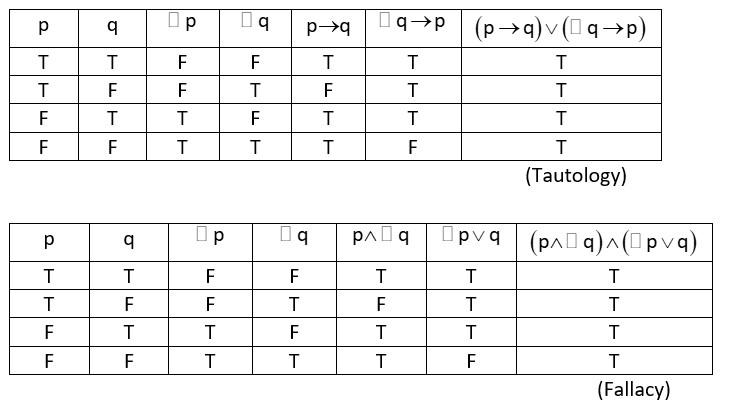
(B)
(C)
(D)
Using Venn diagram we get B as the correct option.
Upvote Truth table
T T F F T T &nbs
Upvote Consider the following statements:
P : Ramu is intelligent.
Q : Ramu is rich.
R : Ramu is not honest.
The negation of the statement “Ramu is intelligent and honest if and only if Ramu is not rich” can be expressed as
Consider the following statements:
P : Ramu is intelligent.
Q : Ramu is rich.
R : Ramu is not honest.
The negation of the statement “Ramu is intelligent and honest if and only if Ramu is not rich” can be expressed as
P : Ramu is intelligent
Q : Ramu is rich
R : Ramu is not honest
Give statement, “Ramu is intelligent and honest if any only if Ramu is not rich”
So, negation of the statement is
Upvote