
Mathematical Reasoning
Get insights from 119 questions on Mathematical Reasoning, answered by students, alumni, and experts. You may also ask and answer any question you like about Mathematical Reasoning
- 119
Questions
- 0
Discussions
- 0
Active Users
- 0
Followers
Have a question about Mathematical Reasoning? Ask our experts
Keep it short & simple. Type complete word. Avoid abusive language.
The proposition p →~ (p ∧~ q) is equivalent to:
<!-- [if !supportLineBreakNewLine]-->
<!--[endif]-->
The proposition p →~ (p ∧~ q) is equivalent to:
<!-- [if !supportLineBreakNewLine]-->
<!--[endif]-->
p →~ (p ∧ ~ q)
=~ p ∨ ~ (p ∧ ~ q)
=~ p ∨ ~ p ∨ q
=~ p ∨ q
 Upvote

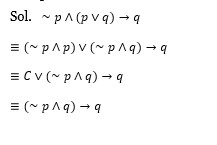
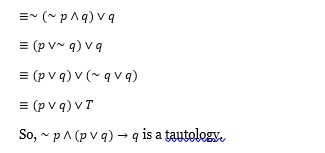
The contrapositive of the statement "If I reach the station in time, then I will catch the train" is:
<!-- [if !supportLineBreakNewLine]-->
<!--[endif]-->
The contrapositive of the statement "If I reach the station in time, then I will catch the train" is:
<!-- [if !supportLineBreakNewLine]-->
<!--[endif]-->
Let p denotes statement
p: I reach the station in time.
q: I will catch the train.
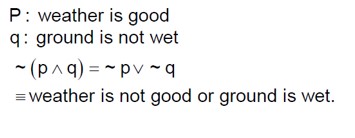
Contrapositive of p→q is q→pq→p: I will not catch the train, then I do not reach the station in time.
Upvote The Boolean [removed]p ⇒ q) ∧ (q ⇒ ¬p) is equivalent to:
<!-- [if !supportLineBreakNewLine]-->
<!--[endif]-->
The Boolean [removed]p ⇒ q) ∧ (q ⇒ ¬p) is equivalent to:
<!-- [if !supportLineBreakNewLine]-->
<!--[endif]-->
(p⇒q)∧ (q⇒¬p) ≡ (¬p∨q)∧ (¬q∨¬p) ≡ ¬p∧ (q∨¬q) ≡ ¬p.
Upvote Let and be four non - empty sets. The contrapositive statement of "If and , then " is:
<!-- [if !supportLineBreakNewLine]-->
<!--[endif]-->
Let and be four non - empty sets. The contrapositive statement of "If and , then " is:
<!-- [if !supportLineBreakNewLine]-->
<!--[endif]-->
If A ⊆ B and B ⊆ D then A ⊆ C
Contrapositive is
If A ⊄ C, then A ⊄ B or B ⊄ D
Upvote 
The compound statement (P ∨ Q) ∧ (¬P) ⇒ Q is equivalent to:
<!-- [if !supportLineBreakNewLine]-->
<!--[endif]-->
The compound statement (P ∨ Q) ∧ (¬P) ⇒ Q is equivalent to:
<!-- [if !supportLineBreakNewLine]-->
<!--[endif]-->
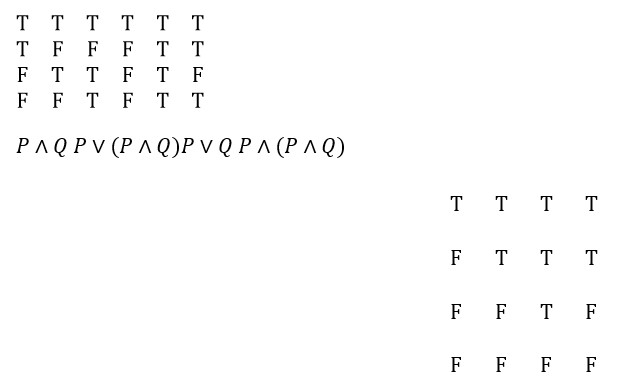
Truth table analysis shows that (P ∨ Q) ∧ (¬P) is equivalent to Q ∧ ¬P.
Then (Q ∧ ¬P) ⇒ Q. This is a tautology.
The provided solution seems to have an error.
Let's check the options. (P ∨ Q) is a tautology. (P ∧ ¬Q) is a contradiction.
~ (P ⇒ Q) ⇔ P ∧ ¬Q is true.
Upvote The statement among the following that is a tautology is:
The statement among the following that is a tautology is:
A | B | A | A -> B | ||||
T | T | T | T | T | T | T | T |
T | F | T | F | T | T | F | F |
F | T | T | F | F | F | T | F |
F | F | F | F | F | F | T | F |
A
Upvote