
Mathematical Reasoning
Get insights from 119 questions on Mathematical Reasoning, answered by students, alumni, and experts. You may also ask and answer any question you like about Mathematical Reasoning
- 119
Questions
- 0
Discussions
- 0
Active Users
- 0
Followers
Have a question about Mathematical Reasoning? Ask our experts
Keep it short & simple. Type complete word. Avoid abusive language.
Let be such that is a tautology. Then is logically equivalent to:
Let be such that is a tautology. Then is logically equivalent to:
Case – I
it can be false if r is false,
so not a tautology
&n
 Upvote

pva
its negation as asked in question
=
=
Upvote mod (7)
…… (i)
Now,
……. (ii)
(i) & (ii)
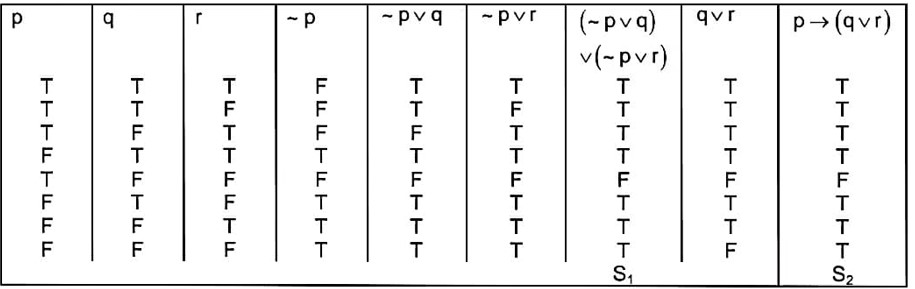
Upvote Let p, q, r be three logical statements. Consider the compound statements
Then, which of the following is NOT true?
Let p, q, r be three logical statements. Consider the compound statements
Then, which of the following is NOT true?

The negation of the statement “If a quadrilateral is a square then it is a rhombus”.
The negation of the statement “If a quadrilateral is a square then it is a rhombus”.
A quadrilateral is a square and it is not a rhombus
Upvote The statement p → (q → p) is equivalent is:
<!-- [if !supportLineBreakNewLine]-->
<!--[endif]-->
The statement p → (q → p) is equivalent is:
<!-- [if !supportLineBreakNewLine]-->
<!--[endif]-->
Kindly consider the following figure
Upvote The negation of the compound proposition p∨(~p∨q) is
<!-- [if !supportLineBreakNewLine]-->
<!--[endif]-->
The negation of the compound proposition p∨(~p∨q) is
<!-- [if !supportLineBreakNewLine]-->
<!--[endif]-->
~ (p v (~ p v q)
= p ^ ( (~p v q) = ~p ^ (p ^ ~q)
Upvote