

Maths
Get insights from 6.5k questions on Maths, answered by students, alumni, and experts. You may also ask and answer any question you like about Maths
Follow Ask QuestionQuestions
Discussions
Active Users
Followers
New answer posted
a year agoContributor-Level 10
49. Given, x3 + x2y + xy2 + y3 = 81.
Differentiating w r t 'x' we get,
=
= - (3x2 + 2xy + y2)
New answer posted
a year agoContributor-Level 10
48. Given, x2 + xy + y2 = 100.
Differentiating w r t 'x' we get,
New answer posted
a year agoContributor-Level 10
43. tanx = √3
We have, tan x = √3
Since tan x is (+) ve the principal solution lies in Ist and IIInd quadrant
Now, tan x = √3 = tan . = tan
Principal solution are x = and
= and
= and .
As tan x = tan
The general solution is.
x = np + , n∈z
New answer posted
a year agoContributor-Level 10
47. Given, xy + y2 = tan x + y Differentiating w r t x we get,
New answer posted
a year agoContributor-Level 10
42. L.H.S. = cos 6x
= cos 3 (2x)
= 4 cos32x – 3 cos 2x [Q cos 3A = 4 cos3A – 3cos A]
= 4 [ (2 cos2x – 1)3] – 3 [ (2 cos2x – 1)] [Q cos 2x = 2 cos2x – 1]
= 4 [ (2 cos2x)3 + 3 [ (2 cos2x)2 (–1) + 3 (2 cos2x) (–1)2 + (–1)3] – 3 (2 cos2x) + 3
{Q (a + b)3= a3 + b3 + 3a2b + 3ab2}
= 4 [8 cos6x – 12 cos4x + 6cos2x – 1] – 6 cos2x + 3.
= 32 cos6x – 48 cos4x + 24 cos2x – 4 – 6cos2x + 3
= 32 cos6x – 48 cos4
New answer posted
a year agoContributor-Level 10
46. Given, ax + by2 = cos y.
Differentiating w r t 'x' we get,
= a + b 2y = - sin y + sin y = -a
=
= 2by
New answer posted
a year agoContributor-Level 10
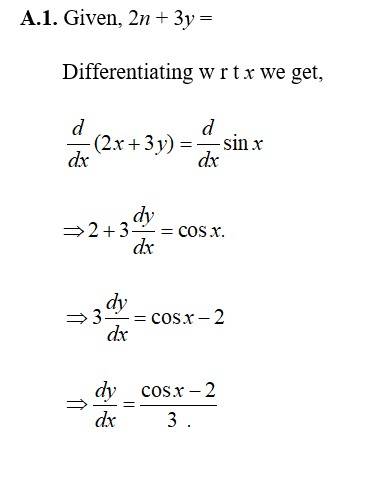
45. Given, 2x + 3y = sin y.
Differentiating w r t x. we get,
=cos y
=
New answer posted
a year agoContributor-Level 10
43. The given f x n is
f(x) = 0 < < 3
At x = 1
L*H*L* =
Hence lines does not exist
Qf is not differentiable at x = 1
At x = 2
L*H*L =

Hence, limit does not exist.
Qf is not differentiable at x = 2
New answer posted
a year agoContributor-Level 10
42. The given f x v is
f(x) = |x- 1|, x ε R
For a differentiable f x v f at x = c,
and are finite & equal.
So, at x = 1. f(1) = |1 - 1| = 0.
Now,
L*H*L* =
=
R*H*L = = - 1.
= 1
Hence, L*H*S ¹ R*H*L*
So, f is not differentiable at x = 2.
Taking an Exam? Selecting a College?
Get authentic answers from experts, students and alumni that you won't find anywhere else
Sign Up on ShikshaOn Shiksha, get access to
- 66k Colleges
- 1.2k Exams
- 711k Reviews
- 1850k Answers