

Maths
Get insights from 6.5k questions on Maths, answered by students, alumni, and experts. You may also ask and answer any question you like about Maths
Follow Ask QuestionQuestions
Discussions
Active Users
Followers
New answer posted
a year agoContributor-Level 9
Let A (α, 0,0), B (0, β, 0), C (0,0, γ), then the centroid is G (α/3, β/3, γ/3) = (1,1,2).
α = 3, β = 3, γ = 6
∴ Equation of plane is x/α + y/β + z/γ = 1
⇒ x/3 + y/3 + z/6 = 1
⇒ 2x + 2y + z = 6
∴ Required line passing through G (1,1,2) and normal to the plane is (x-1)/2 = (y-1)/2 = (z-2)/1.
New answer posted
a year agoContributor-Level 9
A = [cosθ, sinθ], [-sinθ, cosθ]
A² = [cos2θ, sin2θ], [-sin2θ, cos2θ]
⇒ A? = [cos4θ, sin4θ], [-sin4θ, cos4θ]
B = [cos4θ, sin4θ], [-sin4θ, cos4θ] + [cosθ, sinθ], [-sinθ, cosθ]
= [cos4θ + cosθ, sin4θ + sinθ], [- (sin4θ + sinθ), cos4θ + cosθ]
det (B) = (cos4θ + cosθ)² + (sin4θ + sinθ)²
= (cos²4θ + sin²4θ) + (cos²θ + sin²θ) + 2 (cos4θcosθ + sin4θsinθ)
= 1 + 1 + 2cos (4θ - θ)
= 2 + 2cos3θ
Given 3θ = 3π/5
|B| = 2 + 2cos (3π/5)
= 2 + 2 (- (√5-1)/4) = 2 - (√5-1)/2 = (4-√5+1)/2 = (5-√5)/2 ∈ (1,2)
New answer posted
a year agoContributor-Level 9
f' (c) = 1 + lnc = e/ (e-1)
lnc = e/ (e-1) - 1 = (e - (e-1)/ (e-1) = 1/ (e-1)
c = e^ (1/ (e-1)
New answer posted
a year agoContributor-Level 9
Equation of line is x/3 + y/1 = 1
⇒ x + 3y - 3 = 0
The image (x? , y? ) of point (-1, -4) is given by:
(x? - (-1)/1 = (y? - (-4)/3 = -2 (1 (-1) + 3 (-4) - 3) / (1² + 3²)
(x? + 1)/1 = (y? + 4)/3 = -2 (-1 - 12 - 3)/10 = -2 (-16)/10 = 16/5
x? + 1 = 16/5 ⇒ x? = 11/5
(y? + 4)/3 = 16/5 ⇒ y? + 4 = 48/5 ⇒ y? = 28/5
New answer posted
a year agoContributor-Level 9
y = (2/π x - 1)cosec x
dy/dx = (2/π)cosec x - (2/π x - 1)cosec x cot x
⇒ dy/dx + (2/π x - 1)cosec x cot x = 2/π cosec x
⇒ dy/dx + ycot x = 2/π cosec x
This is a linear differential equation. The integrating factor P (x) is the coefficient of y.
⇒ P (x) = cot x
New answer posted
a year agoContributor-Level 9
Applying Rolle's theorem in for function f (x), there exists c such that f' (c) = 0, c ∈ (0,1).
Again applying Rolle's theorem in [0, c] for function f' (x), there exists c? such that f' (c? ) = 0, c? ∈ (0, c).
Option A is correct.
New answer posted
a year agoContributor-Level 9
Given equation is 2x (2x + 1) = 1 ⇒ 4x² + 2x - 1 = 0. Roots of the equation are α and β.
∴ α + β = -2/4 = -1/2 ⇒ β = -1/2 - α
and
4α² + 2α - 1 = 0 ⇒ α² = (1-2α)/4 = 1/4 - α/2
Now
α = 1/2 - 2α²
Substituting into the expression for β:
β = -1/2 - (1/2 - 2α²) = -1 + 2α²
New answer posted
a year agoContributor-Level 9
f (x) = sin²x (λ + sinx)
f' (x) = 2sinxcosx (λ + sinx) + sin²x (cosx) = sinxcosx (2λ + 3sinx)
For extrema, f' (x) = 0
sinx = 0, cosx = 0, or sinx = -2λ/3
For more than 2 points of extrema in the interval, sinx = -2λ/3 must have solutions other than where sinx=0 or cosx=0.
-1 < -2/3 < 1 and -2/3 0
This gives λ ∈ (-3/2, 3/2) - {0}
New answer posted
a year agoContributor-Level 9
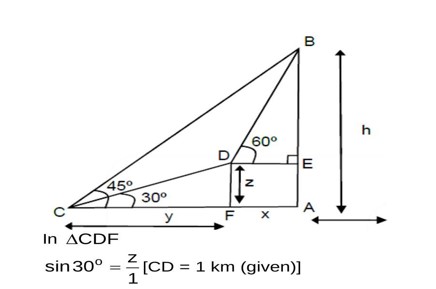
In ΔCDF
sin 30° = z/1 [CD = 1 km (given)]
z = 1/2
cos 30° = y/1 ⇒ y = √3/2
Now in ΔABC
tan 45° = h/ (x+y)
⇒ h = x+y
⇒ x = h - √3/2
Now
In ΔBDE,
tan 60° = (h-z)/x
√3x = h - z
√3 (h - √3/2) = h - 1/2
√3h - 3/2 = h - 1/2
h (√3 - 1) = 1
h = 1/ (√3-1) km
Taking an Exam? Selecting a College?
Get authentic answers from experts, students and alumni that you won't find anywhere else
Sign Up on ShikshaOn Shiksha, get access to
- 67k Colleges
- 1.2k Exams
- 717k Reviews
- 1850k Answers