

Maths
Get insights from 6.5k questions on Maths, answered by students, alumni, and experts. You may also ask and answer any question you like about Maths
Follow Ask QuestionQuestions
Discussions
Active Users
Followers
New answer posted
a year agoContributor-Level 10
max {n (A), n (B)} ≤ n (A U B) ≤ n (U)
⇒ 76 ≤ 76 + 63 - x ≤ 100
⇒ -63 ≤ -x ≤ -39
⇒ 63 ≥ x ≥ 39
New answer posted
a year agoContributor-Level 10
f (x) = ∫ (from 1 to 3) (√x dx)/ (1+x)² = ∫ (from 1 to √3) (t⋅2tdt)/ (1+t²)² (put √x = t)
= [ (-t/ (1+t²)] (from 1 to √3) + [tan? ¹t] (from 1 to √3) [Applying by parts]
= (-√3/4 + 1/2) + (π/3 - π/4)
= (-√3+2)/4 + π/12
New answer posted
a year agoContributor-Level 10
[x]² + 2 [x+2] - 7 = 0
⇒ [x]² + 2 [x] + 4 - 7 = 0
⇒ [x] = 1, -3
⇒ x ∈ [1,2) U [-3, -2)
New answer posted
a year agoContributor-Level 10
Σ (r=30 to 50) 50-rC? =? C? +? C? +? C? + . + ³? C?
=? C? +? C? +? C? + . + (³? C? + ³? C? ) - ³? C?
=? C? +? C? +? C? + . + (³¹C? + ³¹C? ) - ³? C?
=? C? +? C? - ³? C?
=? ¹C? - ³? C?
New answer posted
a year agoContributor-Level 10
A² = (cos2θ isin2θ cos2θ)
Similarly, A? = (cos5θ isin5θ cos5θ) = (a b; c d)
(1) a²+b² = cos²5θ - sin²5θ = cos10θ = cos75°
(2) a²-d² = cos²5θ - cos²5θ = 0
(3) a²-b² = cos²5θ + sin²5θ = 1
(4) a²-c² = cos²5θ + sin²5θ = 1
New answer posted
a year agoContributor-Level 10
∫ (x/ (xsinx+cosx)²dx = ∫ (xcosx⋅xcosx)/ (xsinx+cosx)² dx
= x/cosx (-1/ (xsinx+cosx) + ∫ (cosx-xsinx)/cosx² (1/ (xsinx+cosx) dx
= -xsecx/ (xsinx+cosx) + ∫sec²xdx
= -xsecx/ (xsinx+cosx) + tanx + C
New answer posted
a year agoContributor-Level 10
Since (3,3) lies on x²/a² - y²/b² = 1
9/a² - 9/b² = 1
Now, normal at (3,3) is y-3 = -a²/b² (x-3),
which passes through (9,0) ⇒ b² = 2a²
So, e² = 1 + b²/a² = 3
Also, a² = 9/2
(From (i) and (ii)
Thus, (a², e²) = (9/2, 3)
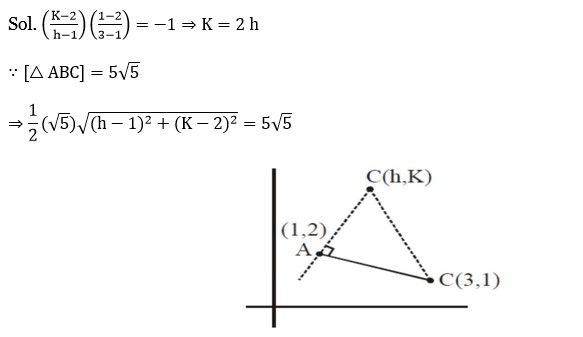
New question posted
a year agoNew answer posted
a year agoContributor-Level 10
u = (2z+i)/ (z-ki)
= (2x² + (2y+1) (y-k)/ (x²+ (y-k)²) + I (x (2y+1) - 2x (y-k)/ (x²+ (y-k)²)
Since Re (u) + Im (u) = 1
⇒ 2x² + (2y+1) (y-k) + x (2y+1) - 2x (y-k) = x² + (y-k)²
P (0, y? )
Q (0, y? )
⇒ y² + y - k - k² = 0 {y? + y? = -1, y? = -k-k²}
∴ PQ = 5
⇒ |y? - y? | = 5 ⇒ k² + k - 6 = 0
⇒ k = -3, 2
So, k = 2 (k > 0)
Taking an Exam? Selecting a College?
Get authentic answers from experts, students and alumni that you won't find anywhere else
Sign Up on ShikshaOn Shiksha, get access to
- 67k Colleges
- 1.2k Exams
- 717k Reviews
- 1850k Answers