
Ncert Solutions Chemistry Class 11th
Get insights from 2k questions on Ncert Solutions Chemistry Class 11th, answered by students, alumni, and experts. You may also ask and answer any question you like about Ncert Solutions Chemistry Class 11th
- 2k
Questions
- 0
Discussions
- 1
Active Users
- 29
Followers
Have a question about Ncert Solutions Chemistry Class 11th? Ask our experts
Keep it short & simple. Type complete word. Avoid abusive language.
The order of screening effect of electrons of s, p, d and f orbitals of a given shell of an atom on its outer shell electrons is:
(i) s > p > d > f
(ii) f > d > p > s
(iii) p < d < s > f
(iv) f > p > s > d
The order of screening effect of electrons of s, p, d and f orbitals of a given shell of an atom on its outer shell electrons is:
(i) s > p > d > f
(ii) f > d > p > s
(iii) p < d < s > f
(iv) f > p > s > d
This is a Multiple Choice Questions as classified in NCERT Exemplar
Option (i)
The orbitals nearer to the nucleus possess more shielding effect.
 Upvote

Which of the following is not an actinoid?
(i) Curium (Z = 96)
(ii) Californium (Z = 98)
(iii) Uranium (Z = 92)
(iv) Terbium (Z = 65)
Which of the following is not an actinoid?
(i) Curium (Z = 96)
(ii) Californium (Z = 98)
(iii) Uranium (Z = 92)
(iv) Terbium (Z = 65)
This is a Multiple Choice Questions as classified in NCERT Exemplar
Option (iv)
Actinoids possess Z=90-103
Terbium is lanthanoid.
Upvote Consider the isoelectronic species, Na+, Mg2+, F– and O2–. The correct order of increasing length of their radii is _________.
(i) F- < O2– < Mg2+ < Na+
(ii) Mg2+ < Na+ < F– < O2–
(iii) O2– < F– < Na+ < Mg2+
(iv) O2– < F– < Mg2+ < Na
Consider the isoelectronic species, Na+, Mg2+, F– and O2–. The correct order of increasing length of their radii is _________.
(i) F- < O2– < Mg2+ < Na+
(ii) Mg2+ < Na+ < F– < O2–
(iii) O2– < F– < Na+ < Mg2+
(iv) O2– < F– < Mg2+ < Na
This is a Multiple Choice Questions as classified in NCERT Exemplar
Option (ii)
All the given ions are isoelectronic species thus their radii depend upon the charge more the negative charge higher would be the atomic radii and higher the positive charge lesser would be the atomic radii.
Upvote Among alkali metals which element do you expect to be least electronegative and why?
Among alkali metals which element do you expect to be least electronegative and why?
This is a Short Answer Type Questions as classified in NCERT Exemplar
The electronegativity of the alkali metals decreases down the group due to the increase of the shells thus Cs (Caesium) is the least electronegative metal in the alkali metals.
Upvote The radius of Na+ cation is less than that of Na atom. Give reason.
The radius of Na+ cation is less than that of Na atom. Give reason.
This is a Short Answer Type Questions as classified in NCERT Exemplar
The radius of Na+ ion is smaller than that of Na is due to the following reasons:-
(i) The effective nuclear charge of Na+
(ii) The disappearance of 3s orbital from its outermost shell electronic configuration.
Upvote How does the metallic and non metallic character vary on moving from left to right in a period?
How does the metallic and non metallic character vary on moving from left to right in a period?
This is a Short Answer Type Questions as classified in NCERT Exemplar
Metallic character- Tendency to lose electrons.
Non-Metallic character- Tendency to accept electrons.
Across the period the metallic character decreases whereas non-metallic character increases across the period.
Upvote Explain the following:
(a) Electronegativity of elements increase on moving from left to right in the periodic table.
(b) Ionisation enthalpy decrease in a group from top to bottom?
Explain the following:
(a) Electronegativity of elements increase on moving from left to right in the periodic table.
(b) Ionisation enthalpy decrease in a group from top to bottom?
This is a Short Answer Type Questions as classified in NCERT Exemplar
(a) As the effective nuclear charge increases and shielding effect decreases across the periods thus the electronegativity increases on moving from left to right in the periodic table.
(b) As the number of shells increases down th
Upvote Explain the deviation in ionisation enthalpy of some elements from the general trend by using Fig. 3.2.
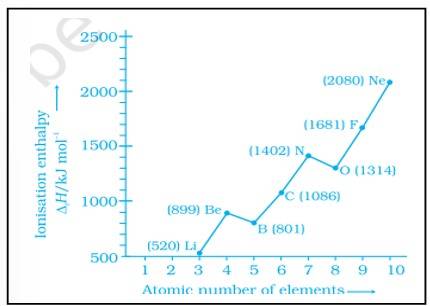
Explain the deviation in ionisation enthalpy of some elements from the general trend by using Fig. 3.2.
The deviation in the ionization enthalpy of some elements from the general trend can be explained by the points as given below:-
(i) The fully filled and half filled orbital provide extra stability due to the symmetry
(ii) The effective nuclear charge
(iii) The e- - e- repulsion which lead to instab
Upvote Arrange the elements N, P, O and S in the order of-
(i) Increasing first ionisation enthalpy.
(ii) Increasing non metallic character.
Give reason for the arrangement assigned.
Arrange the elements N, P, O and S in the order of-
(i) Increasing first ionisation enthalpy.
(ii) Increasing non metallic character.
Give reason for the arrangement assigned.
This is a Short Answer Type Questions as classified in NCERT Exemplar
(i) S
The ionization enthalpy increases across the period and decreases down the group. N possesses a half filled 2p orbital which provides it extra stability due to symmetry.
(ii)P
The non-metallic character increases across
Upvote What do you understand by exothermic reaction and endothermic reaction? Give one example of each type.
What do you understand by exothermic reaction and endothermic reaction? Give one example of each type.
This is a Short Answer Type Questions as classified in NCERT Exemplar
Exothermic reaction- The reaction in which heat is released
For example- CaO + CO2 → CaCO3 + Heat
Endothermic reaction- The reaction in which heat is absorbed.
For example- 2NH3 + heat → N2 +3H2
Upvote