
Ncert Solutions Chemistry Class 11th
Get insights from 2k questions on Ncert Solutions Chemistry Class 11th, answered by students, alumni, and experts. You may also ask and answer any question you like about Ncert Solutions Chemistry Class 11th
- 2k
Questions
- 0
Discussions
- 1
Active Users
- 29
Followers
Have a question about Ncert Solutions Chemistry Class 11th? Ask our experts
Keep it short & simple. Type complete word. Avoid abusive language.
How would you explain the fact that first ionisation enthalpy of sodium is lower than that of magnesium but its second ionisation enthalpy is higher than that of magnesium?
How would you explain the fact that first ionisation enthalpy of sodium is lower than that of magnesium but its second ionisation enthalpy is higher than that of magnesium?
This is a Short Answer Type Questions as classified in NCERT Exemplar
The electronic configuration of Na is [Ne]3s1 while that of Mg is [Ne]3s2 as Mg possesses a fully filled 3s orbital thus its first ionisation enthalpy is higher than that of Na.
After losing one electron Na obtained the electronic c
 Upvote

P-Block elements form acidic, basic and amphoteric oxides. Explain each property by giving two examples and also write the reactions of these oxides with water.
P-Block elements form acidic, basic and amphoteric oxides. Explain each property by giving two examples and also write the reactions of these oxides with water.
This is a Short Answer Type Questions as classified in NCERT Exemplar
In the p block, some elements are metallic some elements are non-metallic while some elements are metalloids in nature. The oxides of metals are basic in nature and that of oxides of nonmetals are acidic in nature.
Acidic oxide SO2
Upvote First member of each group of representative elements (i.e., s and p-block elements) shows anomalous behaviour. Illustrate with two examples.
First member of each group of representative elements (i.e., s and p-block elements) shows anomalous behaviour. Illustrate with two examples.
This is a Short Answer Type Questions as classified in NCERT Exemplar
The anomalous behaviour of the first member of each group of representative elements i.e. of second period can be attributed to their small size, high charge/radius ratio, high electronegativity and absence of vacant d-orbitals to
Upvote Nitrogen has positive electron gain enthalpy whereas oxygen has negative. However, oxygen has lower ionisation enthalpy than nitrogen. Explain.
Nitrogen has positive electron gain enthalpy whereas oxygen has negative. However, oxygen has lower ionisation enthalpy than nitrogen. Explain.
This is a Short Answer Type Questions as classified in NCERT Exemplar
The N possesses a half filled p-orbital which provides it extra stability due to symmetry due to which its electron gain enthalpy is positive and its ionization enthalpy is larger than that of O.
Upvote Illustrate by taking examples of transition elements and non-transition elements that oxidation states of elements are largely based on electronic configuration.
Illustrate by taking examples of transition elements and non-transition elements that oxidation states of elements are largely based on electronic configuration.
This is a Short Answer Type Questions as classified in NCERT Exemplar
The electronic configuration of Cr= 1s2 2s2 2p6 3s2 3p6 4s1 3d10
The electronic configuration of Cr after losing one electron= 1s2 2s2 2p6 3s2 3p6 3d10
The electronic configuration of F= 1s2 2s2 2p6 3s2 3p5
The electronic configuratio
Upvote Choose the correct order of atomic radii of fluorine and neon (in pm) out of the options given below and justify your answer.
(i) 72, 160
(ii) 160, 160
(iii) 72, 72
(iv) 160, 72
Choose the correct order of atomic radii of fluorine and neon (in pm) out of the options given below and justify your answer.
(i) 72, 160
(ii) 160, 160
(iii) 72, 72
(iv) 160, 72
This is a Short Answer Type Questions as classified in NCERT Exemplar
Option (i)
As across the period the atomic radius decreases due to the increase of effective nuclear charge.
Upvote Write four characteristic properties of p-block elements.
Write four characteristic properties of p-block elements.
This is a Short Answer Type Questions as classified in NCERT Exemplar
The characteristics properties of p-block elements are as follows:-
(i) It contain metals, nonmetals and metalloids
(ii) Mostly involved in covalent bonding
(iii) Some elements show variable oxidation state
(iv) It possesses relati
Upvote Among the elements B, Al, C and Si
(i) Which element has the highest first ionisation enthalpy ?
(ii) Which element has the most metallic character? Justify your answer in each case
Among the elements B, Al, C and Si
(i) Which element has the highest first ionisation enthalpy ?
(ii) Which element has the most metallic character? Justify your answer in each case
This is a Short Answer Type Questions as classified in NCERT Exemplar
(i) C has the highest ionization energy among the given elements as along the period ionization enthalpy increases whereas it decreases down the group.
(ii) Al is the most metallic element among the given elements because down the
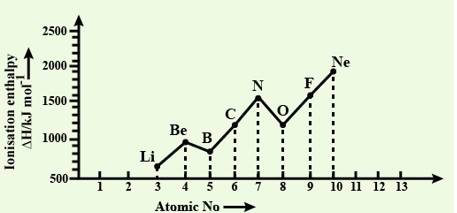
Upvote Ionisation enthalpies of elements of second period are given below :
Ionisation enthalpy/ k cal mol–1 : 520, 899, 801, 1086, 1402, 1314, 1681, 2080.
Match the correct enthalpy with the elements and complete the graph given in Fig. 3.1. Also write symbols of elements with their atomic number.
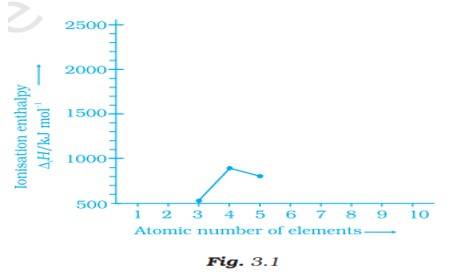
Ionisation enthalpies of elements of second period are given below :
Ionisation enthalpy/ k cal mol–1 : 520, 899, 801, 1086, 1402, 1314, 1681, 2080.
Match the correct enthalpy with the elements and complete the graph given in Fig. 3.1. Also write symbols of elements with their atomic number.
This is a Short Answer Type Questions as classified in NCERT Exemplar
Upvote Identify the group and valency of the element having atomic number 119. Also predict the outermost electronic configuration and write the general formula of its oxide.
Identify the group and valency of the element having atomic number 119. Also predict the outermost electronic configuration and write the general formula of its oxide.
This is a Short Answer Type Questions as classified in NCERT Exemplar
Group | 1 |
Valency | 1 |
Outermost electronic configuration | 8s1 |
Formula of Oxide | M2O |
Upvote