
Ncert Solutions Chemistry Class 11th
Get insights from 2k questions on Ncert Solutions Chemistry Class 11th, answered by students, alumni, and experts. You may also ask and answer any question you like about Ncert Solutions Chemistry Class 11th
- 2k
Questions
- 0
Discussions
- 0
Active Users
- 29
Followers
Have a question about Ncert Solutions Chemistry Class 11th? Ask our experts
Keep it short & simple. Type complete word. Avoid abusive language.
1.22. If the speed of light is 3.0 × 10⁸ms–1, calculate the distance covered by light in 2.00 ns.
1.22. If the speed of light is 3.0 × 10⁸ms–1, calculate the distance covered by light in 2.00 ns.
1.22. Speed = Distance / Time
Or, Distance = Speed x Time = 3.0 * 108ms–1 x 2.00 ns = 3.0 * 108ms–1 x 2.00 x 10-9 s = 6 x 10⁻¹ m = 0.600 m
 Upvote

1.21. The following data were obtained when dinitrogen and dioxygen react together to form compounds: (Beginner)
Mass of dinitrogen Mass of dioxygen
(i) 14 g 16 g
(ii) 14 g 32 g
(iii) 28 g 32 g
(iv) 28 g 80 g
(a) Which law of chemical combination is obeyed by the above experimental data? Give its statement.
(b) Fill in the blanks in the following conversions:
(i) 1 km = . mm = . pm
(ii) 1 mg = . kg = . ng
(iii)1 mL = . L = . dm3
1.21. (a) Fixing the mass of dinitrogen as 28 g, masses of dioxygen combined will be 32,64, 32 and 80 g in the given four oxides. Theseare in the ratio 1: 2: 1: 5 which is a simple whole number ratio. Hence, the given data obeys the law of multiple proportions.
(b)
(i) 1 km = 103 m and 1 m = 103 mm
Upvote 1.20. Round up the following upto three significant figures:
(i) 34.216
(ii) 10.4107
(iii) 0.04597
(iv) 2808
1.20. Round up the following upto three significant figures:
(i) 34.216
(ii) 10.4107
(iii) 0.04597
(iv) 2808
1.20. The values after round up with three significant figures are:
(i) 34.2
(ii) 10.4
(iii) 0.0460
(iv) 2810
Upvote 1.19. How many significant figures are present in the following?
(i) 0.0025
(ii) 208
(iii) 5005
(iv) 126,000
(v) 500.0
(vi) 2.0034
1.19. How many significant figures are present in the following?
(i) 0.0025
(ii) 208
(iii) 5005
(iv) 126,000
(v) 500.0
(vi) 2.0034
1.19. The significant figures in the given values are:
(i) 2 in 0.0025
(ii) 3 in 208
(iii) 4 in 5005
(iv) 3 in 126,000
(v) 4 in 500.0
(vi) 5 in 2.0034
Upvote 1.18. Express the following in scientific notation:
(i) 0.0048
(ii) 234,000
(iii) 8008
(iv) 500.0
(v) 6.0012
1.18. Express the following in scientific notation:
(i) 0.0048
(ii) 234,000
(iii) 8008
(iv) 500.0
(v) 6.0012
1.18. The scientific notation of the given values are:
(i) 4.8*10?3
(ii) 2.34*105
(iii) 8.008*103
(iv) 5.000*102
(v) 6.0012*100
Upvote 1.17. A sample of drinking water was found to be severely contaminated with chloroform, CHCl3 supposed to be carcinogenic in nature. The level of contamination was 15 ppm (by mass).
(i) Express this in percent by mass
(ii) Determine the molality of chloroform in the water sample.
1.17. A sample of drinking water was found to be severely contaminated with chloroform, CHCl3 supposed to be carcinogenic in nature. The level of contamination was 15 ppm (by mass).
(i) Express this in percent by mass
(ii) Determine the molality of chloroform in the water sample.
1.17. 15 ppm means 15 parts per million i.e.15 in 106
So, % by mass = 15/106 x 100 = 15 x 10-4 = 1.5 x 10⁻³%
Molality = No. of moles of solute/Mass of solvent in kg
Percent by mass = 1.5 x 10⁻³ % means 100 g of the sample contain 1.5 x 10⁻³ g chloroform.
So, 1000 g or 1 kg of the sample will conta
Upvote 1.16. Significant figures are meaningful digits which are known with certainty plus one which is estimated or uncertain. The uncertainty in the experimental or the calculated values is indicated by mentioning the number of significant figures
Upvote 1.15. Match the following prefixes with their multiples:
Prefixes
Multiples
(i) micro
106
(ii) deca
109
(iii) mega
10–6
(iv) giga
10–15
(v) femto
10
1.15. Match the following prefixes with their multiples:
|
Prefixes |
Multiples |
|
(i) micro |
106 |
|
(ii) deca |
109 |
|
(iii) mega |
10–6 |
|
(iv) giga |
10–15 |
|
(v) femto |
10 |
1.15. micro = 10–6, deca = 10, mega = 106, giga = 109, femto = 10–15
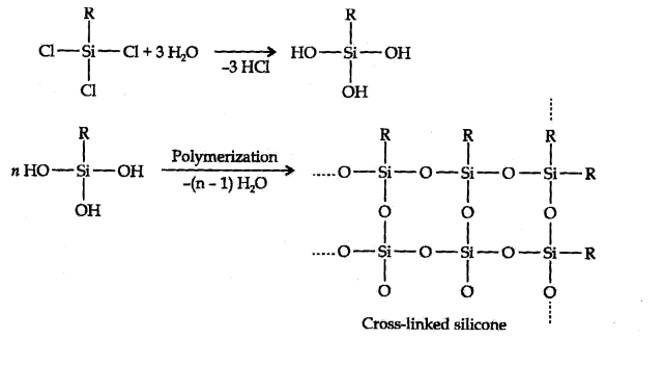
Upvote 11.38. If the starting material for the manufacture of silicones is RSiCl3, write the structure of the product formed. (Advance)
11.38. If the starting material for the manufacture of silicones is RSiCl3, write the structure of the product formed. (Advance)
Hydrolysis of aikyltrichlorosilanes gives cross-linked silicones.
 Upvote
11.37. Elements of group 14
(a) exhibit oxidation state of +4 only (b) exhibit oxidation state of +2 and +4
(c) form M2-and M4+ ions (d) form M2+ and M4+ ions
11.37. Elements of group 14
(a) exhibit oxidation state of +4 only (b) exhibit oxidation state of +2 and +4
(c) form M2-and M4+ ions (d) form M2+ and M4+ ions
Due to inert pair effect, elements of group 14 exhibit oxidation states of +2 and +4. Thus, option (b) is correct.
Upvote