
Ncert Solutions Chemistry Class 11th
Get insights from 2k questions on Ncert Solutions Chemistry Class 11th, answered by students, alumni, and experts. You may also ask and answer any question you like about Ncert Solutions Chemistry Class 11th
- 2k
Questions
- 0
Discussions
- 0
Active Users
- 29
Followers
Have a question about Ncert Solutions Chemistry Class 11th? Ask our experts
Keep it short & simple. Type complete word. Avoid abusive language.
Ethylene glycol (HO – CH2 – CH2 – OH) and terephthalic acid

 Upvote

An average person needs abut 10000 KJ energy per day. The amount of glucose (molar mass = 180.0 g mol-1) needed to meet this energy requirement is_________g.
(Nearest integer)
(Use : <!-- [if gte mso 9]><xml>
An average person needs abut 10000 KJ energy per day. The amount of glucose (molar mass = 180.0 g mol-1) needed to meet this energy requirement is_________g.
(Nearest integer)
(Use : <!-- [if gte mso 9]><xml>
2700 kJ energy released from 180 gm (1 mole) of glucose
1 kJ energy released from
10000 kJ energy released from
Amount of glucose =
Upvote Hydrogen peroxide reacts with iodine in basic medium to give:
Hydrogen peroxide reacts with iodine in basic medium to give:
Hydrogen peroxide reduces iodine to iodide ion is basic medium as;
Upvote Sodium oxide reacts with water to produce sodium hydroxide. 20.0 g of sodium oxide is dissolved in 500 mL of water. Neglecting the change in volume, the concentration of the resulting NaOH solution is __________ × 10-1 M. (Nearest integer)
[Atomic mass : Na = 23.0, O = 16.0, H = 1.0]
Sodium oxide reacts with water to produce sodium hydroxide. 20.0 g of sodium oxide is dissolved in 500 mL of water. Neglecting the change in volume, the concentration of the resulting NaOH solution is __________ × 10-1 M. (Nearest integer)
[Atomic mass : Na = 23.0, O = 16.0, H = 1.0]
w = 20 g
Mole of Na2O=
1 mole of Na2O gives 2 mole of NaOH
mole of Na2O gives moles of NaOH
Molarity of NaOH solution
= 1.29 M
=
Ans. = 13
Upvote Which one of the following is the correct PV vs P plot at constant temperature for an ideal gas? (P and V stand for pressure and volume of the gas respectively)
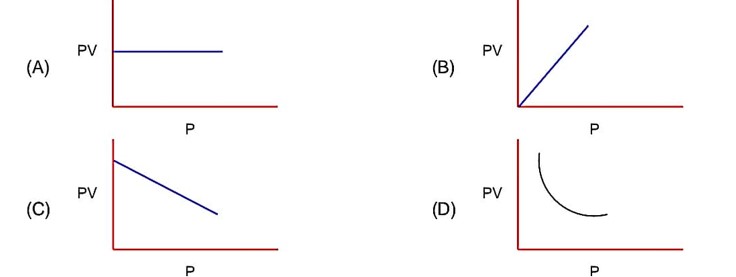
Which one of the following is the correct PV vs P plot at constant temperature for an ideal gas? (P and V stand for pressure and volume of the gas respectively)
PV = nRT PV = constant (at constant T)
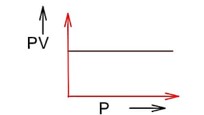
Pressure increases & volume decreases, PV remains constant at constant T.
Upvote BOD values (in ppm) for clean water (A) and polluted water (B) are expected respectively
BOD values (in ppm) for clean water (A) and polluted water (B) are expected respectively
B. O. D. value < 5 ppm for clean water and B.O.D value of polluted water
Upvote Portland cement contains
Dicalcium silicate = 26%
Tricalcium silicate = 51%
Tricalcium aluminate = 11%
Hence major percentage is of tricalcium silicate
Upvote According to the following figure, the magnitude of the enthalpy change of the reaction in KJ mol-1
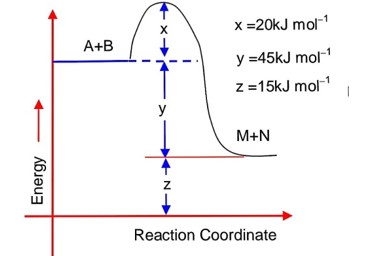
According to the following figure, the magnitude of the enthalpy change of the reaction in KJ mol-1
= x – (x + y) = -y
= -45 KJ/mol
Ans. = 45
Upvote Two flasks I and II shown below are connected by a valve of negligible volume.

When the valve is opened, the final pressure of the system in bar is x × 10-2. The value of x is_______. (Integer answer)
[Assume-Ideal gas; 1 bar = 105 Pa; Molar mass of N2 = 28.0 g mol-1; R = 8.31 J mol-1K-1]
Two flasks I and II shown below are connected by a valve of negligible volume.
When the valve is opened, the final pressure of the system in bar is x × 10-2. The value of x is_______. (Integer answer)
[Assume-Ideal gas; 1 bar = 105 Pa; Molar mass of N2 = 28.0 g mol-1; R = 8.31 J mol-1K-1]
Applying :
Assuming the system attains a final temperature of T (Such that 300 < T < 60)
(Heat lost by N2 of container l) = (Heat gained by N2 of container II)
14 (300 – T) = T – 60
Upvote Data given for the following reaction is as follows:
<!-- [if gte mso 9]><xml>
Substance <!-- [if gte mso 9]><xml>
FeO(s) -266.3 57.49
C(graphite) 0 5.74
Fe(s) 0 27.28
CO(g) -110.5 197.6
The minimum temperature in K at which the reaction becomes spontaneous is______
(Integer answer)
Data given for the following reaction is as follows:
<!-- [if gte mso 9]><xml>
Substance <!-- [if gte mso 9]><xml>
FeO(s) -266.3 57.49
C(graphite) 0 5.74
Fe(s) 0 27.28
CO(g) -110.5 197.6
The minimum temperature in K at which the reaction becomes spontaneous is______
(Integer answer)
Minimum temperature at which reaction becomes spontaneous is,
Upvote