
Ncert Solutions Chemistry Class 11th
Get insights from 2k questions on Ncert Solutions Chemistry Class 11th, answered by students, alumni, and experts. You may also ask and answer any question you like about Ncert Solutions Chemistry Class 11th
- 2k
Questions
- 0
Discussions
- 0
Active Users
- 29
Followers
Have a question about Ncert Solutions Chemistry Class 11th? Ask our experts
Keep it short & simple. Type complete word. Avoid abusive language.
Given below are two statements : one is labelled as Assertion (A) and the other is labelled as Reason (R).
Assertion (A) : Lithium salts are hydrated.
Reason (R) : Lithium has higher polarizing power than other alkali metal group members.
In the light of the above statements, choose the most appropriate answer from the options given below:
Lithium salts are extensively hydrated due to high hydration enthalpy of Li+
(order of polarizing power)
 Upvote

The number of atoms in 8g of sodium is x × 1023. The value of x is_______.
(Nearest integer)
[Given : NA = 6.02 × 10²³ mol-1, Atomic mass of Na = 23.0u]
The number of atoms in 8g of sodium is x × 1023. The value of x is_______.
(Nearest integer)
[Given : NA = 6.02 × 10²³ mol-1, Atomic mass of Na = 23.0u]
Moles of sodium =
Number of atoms =
Upvote The spin-only magnetic moment value of species is________× 10-2 BM. (Nearest integer)
[Given: <!-- [if gte mso 9]><xml>
The spin-only magnetic moment value of species is________× 10-2 BM. (Nearest integer)
[Given: <!-- [if gte mso 9]><xml>
Here, number of unpaired electrons, n = 1
Spin only moment ;
= 173 × 10-2 B.M
Upvote
Zn + 2HCl -> ZnCl2 + H2
It is nearly 0.081%.
Upvote The deposition of X and Y on ground surfaces is referred as wet and dry depositions, respectively, X and Y are:
The deposition of X and Y on ground surfaces is referred as wet and dry depositions, respectively, X and Y are:
Ammonium salt in rain drop resulting wet deposition
Oxides of N & S settle down on ground as dry deposition (SO2).
Upvote
Match List – I with List – II
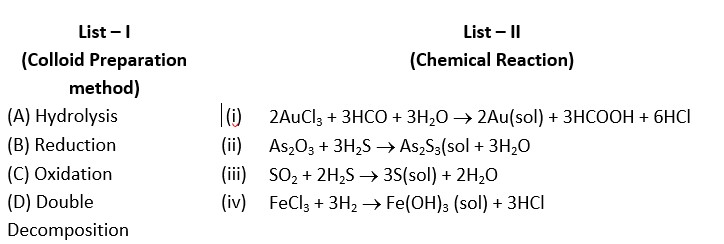
Match List – I with List – II
Electrophilic addition of bromine to an alkene is anti-addition, in which cis-alkene gives two enantiomers and trans – alkene gives meso form
Here; trans-but-2-ene will give meso products
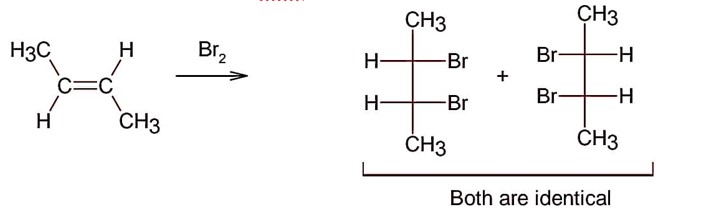
Upvote Electrophilic addition of bromine to an alkene is anti-addition, in which cis-alkene gives two enantiomers and trans – alkene gives meso form
Here; trans-but-2-ene will give meso products
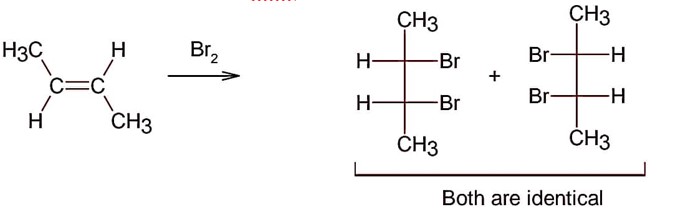
Upvote The stereoisomers that are formed by electrophilic addition of bromine to trans-but-2-ene is/are
The stereoisomers that are formed by electrophilic addition of bromine to trans-but-2-ene is/are
Electrophilic addition of bromine to an alkene is anti-addition, in which cis-alkene gives two enantiomers and trans – alkene gives meso form
Here; trans-but-2-ene will give meso products
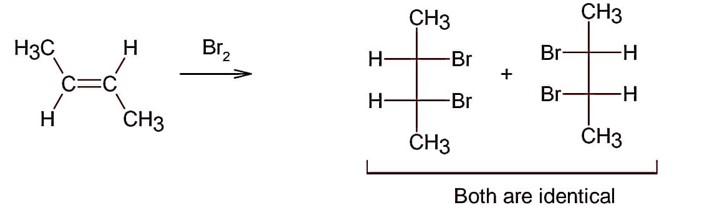
Upvote Arrange the following conformational isomers of n-butane in order of their increasing potential energy:
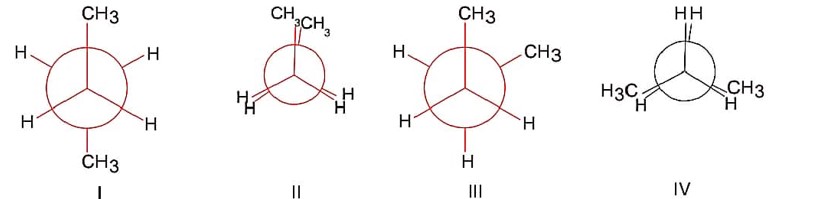
Arrange the following conformational isomers of n-butane in order of their increasing potential energy:
Structure (I) is anti conformer.
Structure (II) is fully eclipsed conformer.
Structure (III) is skew or gauche conformer.
Structure (IV) is partially eclipsed.
order of stability
(I) > (III) > (IV) > (II)
Order of P.E. is (II) > (IV) > (III) > (I).
Upvote