
Ncert Solutions Chemistry Class 11th
Get insights from 2k questions on Ncert Solutions Chemistry Class 11th, answered by students, alumni, and experts. You may also ask and answer any question you like about Ncert Solutions Chemistry Class 11th
- 2k
Questions
- 0
Discussions
- 0
Active Users
- 29
Followers
Have a question about Ncert Solutions Chemistry Class 11th? Ask our experts
Keep it short & simple. Type complete word. Avoid abusive language.
Which of the following compound is added to the sodium extract before addition of silver nitrate for testing of halogens?
Which of the following compound is added to the sodium extract before addition of silver nitrate for testing of halogens?
NaCN converted into HCN and Na2S converted into H2S
 Upvote
The correct order of bond dissociation enthalpy of halogens is
The correct order of bond dissociation enthalpy of halogens is
Bond dissociation enthalpy is the energy required to break 1 mole of bond according to experimental data
Bond energy : Cl2 > Br2 > F2 > l2
Upvote The solubility of Ca(OH)2 in water is:
[Given : The solubility product of Ca(OH)2 in water = 5.5 × 10⁻⁶]
The solubility of Ca(OH)2 in water is:
[Given : The solubility product of Ca(OH)2 in water = 5.5 × 10⁻⁶]
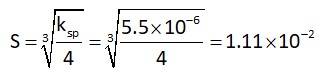
Ca (OH)2
S S 2S
Upvote 
The ionization enthalpy of Na+ formation from Na(g) is 495.8 kJ mol-1, while the electron gain enthalpy of Br is - 325.0 kJ mol-1. Given the lattice enthalpy of NaBr is - 728.4 kJ mol-1. The energy for the formation of NaBr ionic solid is (-) -------------- × 10-1kJ mol-1.
The ionization enthalpy of Na+ formation from Na(g) is 495.8 kJ mol-1, while the electron gain enthalpy of Br is - 325.0 kJ mol-1. Given the lattice enthalpy of NaBr is - 728.4 kJ mol-1. The energy for the formation of NaBr ionic solid is (-) -------------- × 10-1kJ mol-1.
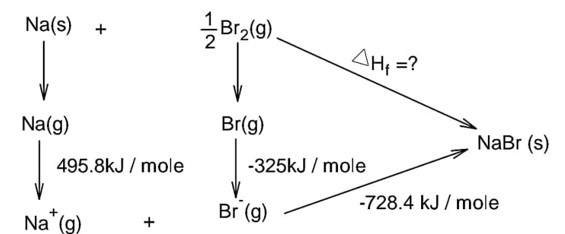
Bond dissociation energy of Br2 = 228 kJ/mole
Note : In question is neglect
Upvote The ionization enthalpy of Na+ formation from Na(g) is 495.8 kJ mol-1, while the electron gain enthalpy of Br is - 325.0 kJ mol-1. Given the lattice enthalpy of NaBr is - 728.4 kJ mol-1. The energy for the formation of NaBr ionic solid is (-) -------------- × 10-1kJ mol-1.
The ionization enthalpy of Na+ formation from Na(g) is 495.8 kJ mol-1, while the electron gain enthalpy of Br is - 325.0 kJ mol-1. Given the lattice enthalpy of NaBr is - 728.4 kJ mol-1. The energy for the formation of NaBr ionic solid is (-) -------------- × 10-1kJ mol-1.
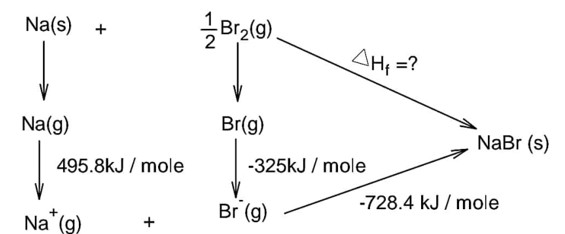
Bond dissociation energy of Br2 = 228 kJ/mole
Note : In question is neglected
Upvote The reaction of cyanamide, NH2CN(s) with oxygen was run in a bomb calorimeter and was found to be -742.24 kJ mol-1. The magnitude of for the reaction
------------- kJ. (Rounded off to the nearest integer)
[Assume ideal gases and R = 8.314 J mol-1 K-1]
The reaction of cyanamide, NH2CN(s) with oxygen was run in a bomb calorimeter and was found to be -742.24 kJ mol-1. The magnitude of for the reaction
------------- kJ. (Rounded off to the nearest integer)
[Assume ideal gases and R = 8.314 J mol-1 K-1]
NH2CN (s) + O2 (g) ® N2 (g) + O2 (g) + H2O (l)
=
So, magnitude of
Upvote Match List I with List II.
List-I List-II
(Process) (Conditions)
A. Isothermal process I. No heat exchange
B. Isochoric process II. Carried out at constant temperature
C. Isobaric process III. Carried out at constant volume
D. Adiabatic process IV. Carried out at constant pressure
Choose the correct answer from the options given below
Match List I with List II.
List-I List-II
(Process) (Conditions)
A. Isothermal process I. No heat exchange
B. Isochoric process II. Carried out at constant temperature
C. Isobaric process III. Carried out at constant volume
D. Adiabatic process IV. Carried out at constant pressure
Choose the correct answer from the options given below
(A) Isothermal process Temperature is constant throughout the process
(B) Isochoric process Volume is constant throughout the process
(C) Isobaric process Pressure is constant throughout the process
(D) Adiabatic process No exchange of heat bet
Upvote For the reaction . At a given time, the composition of reaction mixture is: . Then, which of the following is correct?
For the reaction . At a given time, the composition of reaction mixture is: . Then, which of the following is correct?
At a given time is to be calculated and been compared with .
Upvote