
Ncert Solutions Chemistry Class 11th
Get insights from 2k questions on Ncert Solutions Chemistry Class 11th, answered by students, alumni, and experts. You may also ask and answer any question you like about Ncert Solutions Chemistry Class 11th
- 2k
Questions
- 0
Discussions
- 1
Active Users
- 29
Followers
Have a question about Ncert Solutions Chemistry Class 11th? Ask our experts
Keep it short & simple. Type complete word. Avoid abusive language.
Match the following graphical variation with their description-
A B
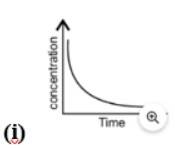
(a) Variation in product concentration with time
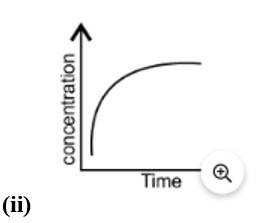
(b) Reaction at equilibrium
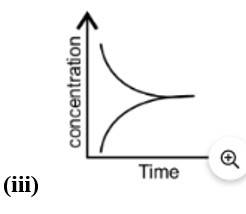
(c) Variation in reactant concentration with time
Match the following graphical variation with their description-
A B
|
|
(a) Variation in product concentration with time |

|
(b) Reaction at equilibrium |
 |
(c) Variation in reactant concentration with time |
This is a Matching Type Questions as classified in NCERT Exemplar
Ans: (i) → (c); (ii) → (a); (iii) → (b).
 Upvote

Match the following species with the corresponding conjugate acid.
Species
Conjugate acid
(i) NH3
(a) CO32–
(ii) HCO3-
(b) NH4
(iii) H2O
(c) H3O+
(iv) HSO4-
(d) H2SO4
(e) H2CO3
Match the following species with the corresponding conjugate acid.
|
Species |
Conjugate acid |
|
(i) NH3 |
(a) CO32– |
|
(ii) HCO3- |
(b) NH4 |
|
(iii) H2O |
(c) H3O+ |
|
(iv) HSO4- |
(d) H2SO4 |
|
|
(e) H2CO3 |
This is a Matching Type Questions as classified in NCERT Exemplar
Ans: (i) → (b); (ii) → (e); (iii) → (c); (iv) → (d)
Upvote Match standard free energy of the reaction with the corresponding equilibrium constant.
(i) ∆Gᶱ > 0
(a) K > 1
(ii) ∆Gᶱ < 0
(b) K = 1
(iii) ∆Gᶱ = 0
(c) K = 0
(d) K < 1
Match standard free energy of the reaction with the corresponding equilibrium constant.
|
(i) ∆Gᶱ > 0 |
(a) K > 1 |
|
(ii) ∆Gᶱ < 0 |
(b) K = 1 |
|
(iii) ∆Gᶱ = 0 |
(c) K = 0 |
|
|
(d) K < 1 |
This is a Matching Type Questions as classified in NCERT Exemplar
Ans: (i) → (d); (ii) → (a); (iii) → (b).
Upvote For the reaction : N2(g) + 3H2(g) ? 2NH3(g)
Equilibrium constant Kc =
Some reactions are written below in Column I and their equilibrium constants in terms of Kc are written in Column II. Match the following reactions with the corresponding equilibrium constant.
Column I (Reaction)
Column II (Equilibrium constant)
(i) 2N2(g) + 6H2(g) ⇌ 4NH3(g)
(a) 2Kc
(ii) 2NH3(g) ⇌N2(g) + 3H2(g)
(b) Kc
(iii) N2(g) + 2H2(g) ⇌ NH3(g)
(c)
(d) K2c
For the reaction : N2(g) + 3H2(g) ? 2NH3(g)
Equilibrium constant Kc =
Some reactions are written below in Column I and their equilibrium constants in terms of Kc are written in Column II. Match the following reactions with the corresponding equilibrium constant.
|
Column I (Reaction) |
Column II (Equilibrium constant) |
|
(i) 2N2(g) + 6H2(g) ⇌ 4NH3(g) |
(a) 2Kc |
|
(ii) 2NH3(g) ⇌N2(g) + 3H2(g) |
(b) Kc |
|
(iii) N2(g) + 2H2(g) ⇌ NH3(g) |
(c) |
|
|
(d) K2c |
This is a Matching Type Questions as classified in NCERT Exemplar
Ans: (i) → (d); (ii) → (c); (iii) → (b)
Upvote This is a short answer type question as classified in NCERT Exemplar
Hydrogen has electronic configuration 1s1. On the one hand, its electronic configuration is similar to that of alkali metals in the first group of the periodic table, which have an outer electronic configuration (ns1). As a result,
Upvote Rohan heard that instructions were given to the laboratory attendant to store a particular chemical i.e., keep it in the dark room, add some urea in it, and keep it away from dust. This chemical acts as an oxidising as well as a reducing agent in both acidic and alkaline media. This chemical is important for use in the pollution control treatment of domestic and industrial effluents.
(i) Write the name of this compound.
(ii) Explain why such precautions are taken for storing this chemical.
Rohan heard that instructions were given to the laboratory attendant to store a particular chemical i.e., keep it in the dark room, add some urea in it, and keep it away from dust. This chemical acts as an oxidising as well as a reducing agent in both acidic and alkaline media. This chemical is important for use in the pollution control treatment of domestic and industrial effluents.
(i) Write the name of this compound.
(ii) Explain why such precautions are taken for storing this chemical.
This is a short answer type question as classified in NCERT Exemplar
(i) The given compound is H2O2.
(ii) Textiles, paper pulp, leather, oils, fats, and other products use it as a bleaching agent. In both acidic and alkaline media, it works as an oxidising and reducing agent. It is therefore kept in
Upvote Match the following equilibria with the corresponding condition.
(i) Liquid ⇌ Vapour
(a) Saturated solution
(ii) Solid ⇌ Liquid
(b) Boiling point
(iii) Solid ⇌ Vapour
(c) Sublimation point
(iv) Solute⇌ Solute(solution)
(d) Melting point
(e) Unsaturated solution
Match the following equilibria with the corresponding condition.
|
(i) Liquid ⇌ Vapour |
(a) Saturated solution |
|
(ii) Solid ⇌ Liquid |
(b) Boiling point |
|
(iii) Solid ⇌ Vapour |
(c) Sublimation point |
|
(iv) Solute⇌ Solute(solution) |
(d) Melting point |
|
(e) Unsaturated solution |
This is a Matching Type Questions as classified in NCERT Exemplar
Ans: (i) → (b); (ii) → (d); (iii) → (c); (iv) → (a).
Upvote At a particular temperature and atmospheric pressure, the solid and liquid phases of a pure substance can exist in equilibrium. Which of the following term defines this temperature?
(i) Normal melting point
(ii) Equilibrium temperature
(iii) Boiling point
(iv) Freezing point
At a particular temperature and atmospheric pressure, the solid and liquid phases of a pure substance can exist in equilibrium. Which of the following term defines this temperature?
(i) Normal melting point
(ii) Equilibrium temperature
(iii) Boiling point
(iv) Freezing point
This is a Multiple Choice Questions as classified in NCERT Exemplar
Ans: options (i) and (iv)
Ice and water are in equilibrium only at particular temperature and pressure. For any pure substance at atmospheric pressure, the temperature at which the solid and liquid phases are at equilibrium is called
Upvote When the first element of the periodic table is treated with dioxygen, it gives a compound whose solid state floats on its liquid state. This compound has an ability to act as an acid as well as a base. What products will be formed when this compound undergoes auto ionization?
When the first element of the periodic table is treated with dioxygen, it gives a compound whose solid state floats on its liquid state. This compound has an ability to act as an acid as well as a base. What products will be formed when this compound undergoes auto ionization?
This is a short answer type question as classified in NCERT Exemplar
The compound is water which undergoes self ionization.
The autoprotolysis (self-ionization) of water takes place as follows:
H2O (l) + H2O (l) &nbs
Upvote In the following questions two or more options may be correct.
For the reaction N2O4 (g) ⇌2NO2 (g), the value of K is 50 at 400 K and 1700 at 500 K. Which of the following options is correct?
(i) The reaction is endothermic
(ii) The reaction is exothermic
(iii) If NO2 (g) and N2O4 (g) are mixed at 400 K at partial pressures 20 bar and 2 bar respectively, more N2O4 (g) will be formed.
(iv) The entropy of the system increases.
In the following questions two or more options may be correct.
For the reaction N2O4 (g) ⇌2NO2 (g), the value of K is 50 at 400 K and 1700 at 500 K. Which of the following options is correct?
(i) The reaction is endothermic
(ii) The reaction is exothermic
(iii) If NO2 (g) and N2O4 (g) are mixed at 400 K at partial pressures 20 bar and 2 bar respectively, more N2O4 (g) will be formed.
(iv) The entropy of the system increases.
This is a Multiple Choice Questions as classified in NCERT Exemplar
Ans:, option (i), (iii) and (iv)
As, K increases with increase in temperature. K increases, it shows that the reaction must be endothermic. No. of molecules increases thus, there is increase in entropy.
Upvote