
Ncert Solutions Chemistry Class 12th
Get insights from 2.6k questions on Ncert Solutions Chemistry Class 12th, answered by students, alumni, and experts. You may also ask and answer any question you like about Ncert Solutions Chemistry Class 12th
- 2.6k
Questions
- 0
Discussions
- 0
Active Users
- 79
Followers
Have a question about Ncert Solutions Chemistry Class 12th? Ask our experts
Keep it short & simple. Type complete word. Avoid abusive language.
Given below are two statements.
Statement I: The choice of reducing agents for metals extraction can be made by using Ellingham diagram, a plot of <!-- [if gte mso 9]><xml>
Given below are two statements.
Statement I: The choice of reducing agents for metals extraction can be made by using Ellingham diagram, a plot of <!-- [if gte mso 9]><xml>
Statement-I is true, because metal reduced by decreasing
 Upvote

A chloro compound “A”
(i) Forms aldehydes on ozonolysis followed by the hydrolysis.
(ii) When vaporized completely 1.53g of A, gives 448 mL of vapour at STP.
The number of carbon atoms in a molecule of compound A is________.
A chloro compound “A”
(i) Forms aldehydes on ozonolysis followed by the hydrolysis.
(ii) When vaporized completely 1.53g of A, gives 448 mL of vapour at STP.
The number of carbon atoms in a molecule of compound A is________.
Weight = 1.53 gm
V = 448 ml (STP)
Mole =
Molecular weight of compound A = 50 × 1.53 = 76.5 gram
Molecular weight 76.5 = CnH2n-1 Cl
or 12 n + 2n – 1 = 41
Molecular formula = C3H5Cl
Number of C- ato
Upvote The major products formed in the following reaction sequence A and B are:
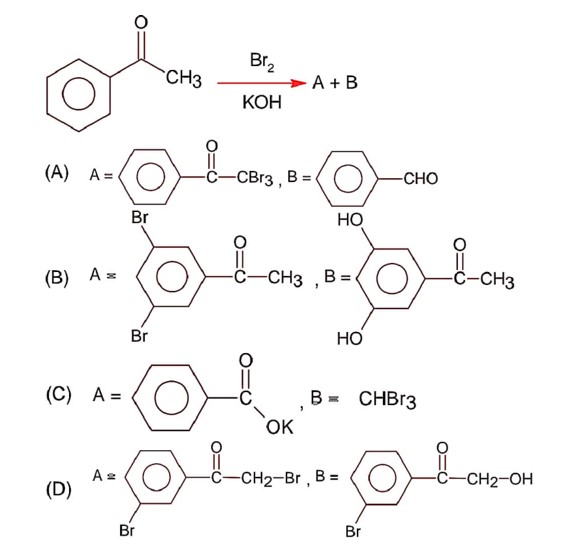
The major products formed in the following reaction sequence A and B are:
Kindly consider the following figure
Upvote Given below are two statements.
Statement I: Frenkel defects are vacancy as well as interstitial defects.
Statement II: Frenkel defect leads to colour in ionic solids due to presence of F-centres.
Choose the most appropriate answer for the statements from the options given below:
Given below are two statements.
Statement I: Frenkel defects are vacancy as well as interstitial defects.
Statement II: Frenkel defect leads to colour in ionic solids due to presence of F-centres.
Choose the most appropriate answer for the statements from the options given below:
In Frenkel defect, cations are inserted in neighbouring site, therefore statement-I is correct, because vacancy developed by missing cations and interstitial sites are equal. Statement II is false because F-centre developed by metal excess defect due to anion vacancies.
Upvote The Ksp for bismuth sulphide (Bi2S3) is 1.08 × 1073. The solubility of Bi2S3 in mol L1 at 298 K is
The Ksp for bismuth sulphide (Bi2S3) is 1.08 × 1073. The solubility of Bi2S3 in mol L1 at 298 K is
For the galvanic cell.
<!-- [if gte mso 9]><xml>
Ecell = ________× 10-2V. (Nearest integer)
For the galvanic cell.
<!-- [if gte mso 9]><xml>
Ecell = ________× 10-2V. (Nearest integer)
Excess of isobutene on reaction with Br2 in presence of light at 125°C gives which one of the following, as the major product?
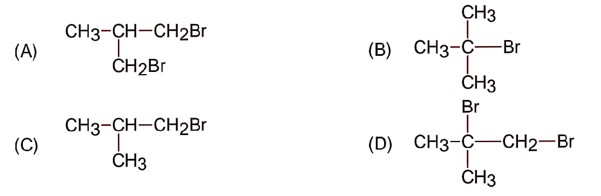
Excess of isobutene on reaction with Br2 in presence of light at 125°C gives which one of the following, as the major product?
Kindly consider the following figure
Upvote Which one of the following when dissolved in water gives coloured solution in nitrogen atmosphere?
Which one of the following when dissolved in water gives coloured solution in nitrogen atmosphere?
Cu2Cl2 + Water -> Insoluble
AgCl + Water -> Insoluble
ZnCl2 + Water -> Colouless solution
CuCl2 + Water -> Coloured solution due to 3d9 electronic configuration.
Upvote In the sulphur estimation, 0.471 g of an organic compound gave 1.44g of barium sulphate The percentage of sulphur in the compound is________%. (Nearest integer)
(Atomic mass of Ba = 137u).
In the sulphur estimation, 0.471 g of an organic compound gave 1.44g of barium sulphate The percentage of sulphur in the compound is________%. (Nearest integer)
(Atomic mass of Ba = 137u).
Molar weight of BaSO4 = 233 gram
233 gm of BaSO4 has 32 gm of S content
Hence 1.44 gm of BaSO4 has
Weight of sulphur = 0.2 gram (the nearest)
Weight of organic sample = 0.471 gram
% of Sulphur =
the nearest = 42%
Upvote The correct sequential addition of reagents in the preparation of 3-nitrobenzoic acid from benzene is:
The correct sequential addition of reagents in the preparation of 3-nitrobenzoic acid from benzene is:
Kindly consider the following figure
Upvote