
Ncert Solutions Chemistry Class 12th
Get insights from 2.6k questions on Ncert Solutions Chemistry Class 12th, answered by students, alumni, and experts. You may also ask and answer any question you like about Ncert Solutions Chemistry Class 12th
- 2.6k
Questions
- 0
Discussions
- 0
Active Users
- 79
Followers
Have a question about Ncert Solutions Chemistry Class 12th? Ask our experts
Keep it short & simple. Type complete word. Avoid abusive language.
Among the following compounds I-IV, which one forms a yellow precipitate on reacting sequentially with (i) NaOH (ii) dil. HNO3 (iii) AgNO3?
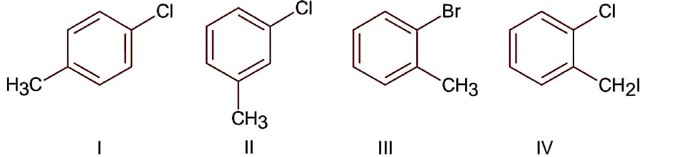
Among the following compounds I-IV, which one forms a yellow precipitate on reacting sequentially with (i) NaOH (ii) dil. HNO3 (iii) AgNO3?
Yellow precipitate is Agl (s) which only produce by structure IV

 Upvote

Which one of the following is correct for the adsorption of a gas at a given temperature on a solid surface?
Which one of the following is correct for the adsorption of a gas at a given temperature on a solid surface?
During adsorption of a gas on solid surface, process is exothermic i.e. and entropy decreased, because gas particle resides on solid surface. Hence
Upvote The major product formed in the following reaction is:
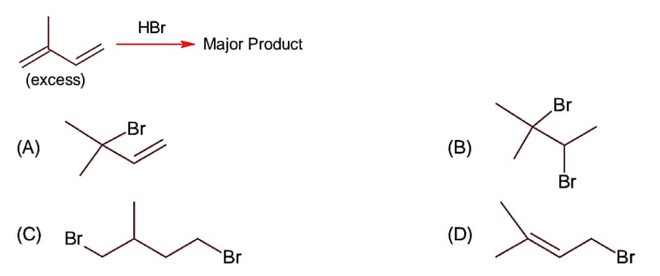
The major product formed in the following reaction is:
Kindly consider the following figure
Upvote Given below are two statements:
Statement I: Sphalerite is a sulphide ore of zinc and copper glance is a sulphide ore of copper.
Statement II: It is possible to separate two sulphide ores by adjusting proportion of oil to water or by using ‘depressants’ in a froth flotation method.
Choose the most appropriate answer from the options given below:
Given below are two statements:
Statement I: Sphalerite is a sulphide ore of zinc and copper glance is a sulphide ore of copper.
Statement II: It is possible to separate two sulphide ores by adjusting proportion of oil to water or by using ‘depressants’ in a froth flotation method.
Choose the most appropriate answer from the options given below:
Sphalerite is the sulphide ore of zinc (ZnS) and copper glance Cu2S is the sulphide ores of copper. Two sulphide ores can be separated by adjusting proportion of oil to water or by using depressant in froth flotation method.
Upvote Given below are two statements: one is labelled as Assertion (A) and the other is labelled as Reason (R).
Assertion (A): Photochemical smog causes cracking of rubber.
Reason (R): Presence of ozone, nitric oxide, acrolein, formaldehyde and peroxyacetyl nitrate in phtochemical smog makes it oxidizing.
Choose the most appropriate answer from the options given below:
Given below are two statements: one is labelled as Assertion (A) and the other is labelled as Reason (R).
Assertion (A): Photochemical smog causes cracking of rubber.
Reason (R): Presence of ozone, nitric oxide, acrolein, formaldehyde and peroxyacetyl nitrate in phtochemical smog makes it oxidizing.
Choose the most appropriate answer from the options given below:
Photo-chemical smog is the mixture of various component like, O3, NO, acrolein formaldehyde and peroxyacetyl nitrate and other oxidizing agents, which causes the cracking of rubber.
Upvote The correct options for the products A and B of the following reactions are
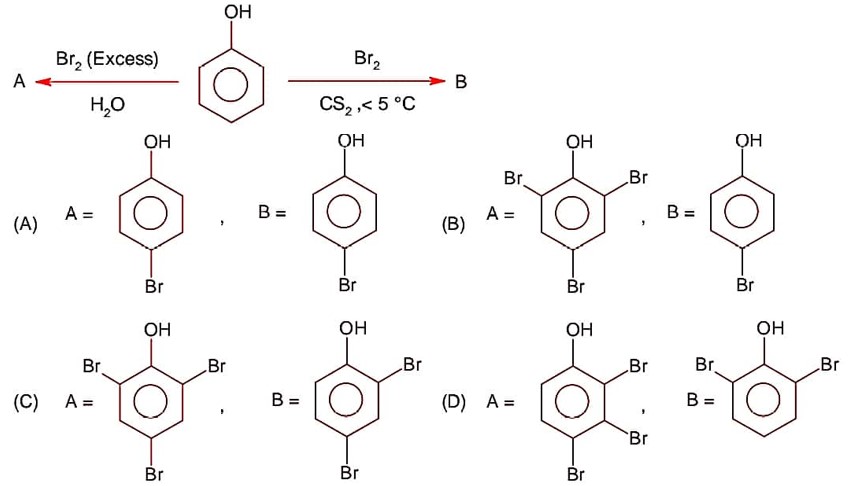
The correct options for the products A and B of the following reactions are
CS2 is non-polar, non-ionisable solvent and produce only para substituted compound due to the production of less Br+ ion, while H2O itself a polar solvent and produce sufficient concentration of Br+ to attack on ortho and para position.
Upvote The polymer formed on heating Novolac with formaldehyde is:
The polymer formed on heating Novolac with formaldehyde is:
Bakelite formed by the condensation reaction of phenol with formaldehyde and it is a thermosetting polymer/ plastics.
Upvote The sol given below with negatively charged colloidal particles is:
The sol given below with negatively charged colloidal particles is:
When AgNO3 added to Kl solution, it form precipitate of Agl (s) which absorb I- ions from Kl and colloidal particles become negatively charged.
Upvote The number of non-ionisable hydrogen atoms present in the final product obtained from the hydrolysis of PCl5 is:
The number of non-ionisable hydrogen atoms present in the final product obtained from the hydrolysis of PCl5 is:
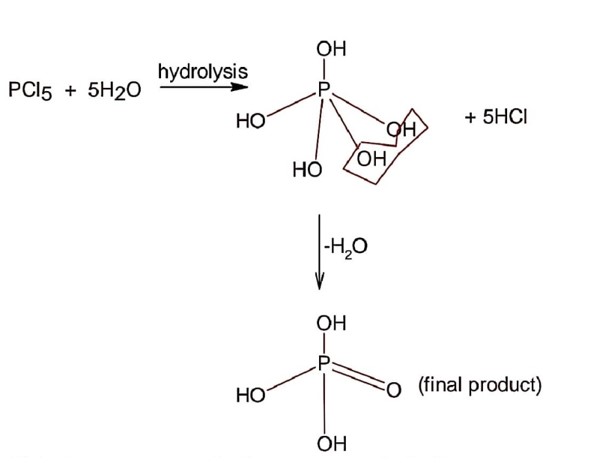
All hydrogens are attached to oxygen are ionisable.
Upvote