
Ncert Solutions Chemistry Class 12th
Get insights from 2.6k questions on Ncert Solutions Chemistry Class 12th, answered by students, alumni, and experts. You may also ask and answer any question you like about Ncert Solutions Chemistry Class 12th
- 2.6k
Questions
- 0
Discussions
- 0
Active Users
- 79
Followers
Have a question about Ncert Solutions Chemistry Class 12th? Ask our experts
Keep it short & simple. Type complete word. Avoid abusive language.
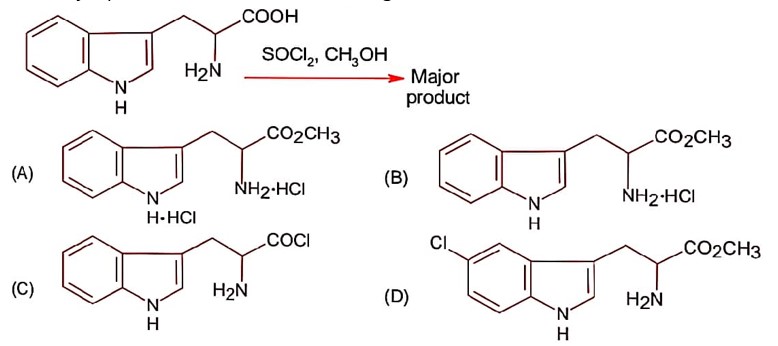
Amongst the following, the major product of the given chemical reaction is
![]()
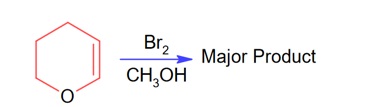
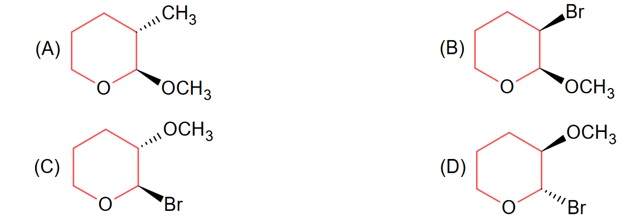
Amongst the following, the major product of the given chemical reaction is
During halogens test, sodium fusion extract is boiled with concentrated HNO3 to
During halogens test, sodium fusion extract is boiled with concentrated HNO3 to
Sodium fusion extract is boiled with conc. HNO3 to remove NaCN and Na2S.
 Upvote

Given below are two statements: one is labeled as Assertion A and the other is labeled as Reason R.
Assertion A: A mixture contains benzoic acid and naphthalene. THE pure benzoic acid can be separated out by the use of benzene.
Reason R: Benzoic acid is soluble in hot water.
In the light of the above statements, choose the most appropriate answer form the options given below:
Benzoic acid & naphthalene can be separated by crystallization. Benzoic acid is soluble is hot water but naphthalene is insoluble.
Assertion is incorrect & Reason is correct.
Upvote The metal ion (in gaseous state) with lowest spin-only magnetic moment value is
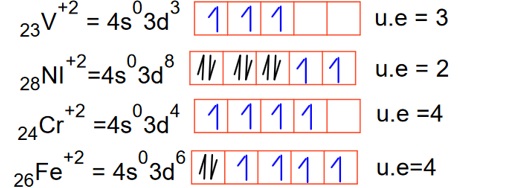
The metal ion (in gaseous state) with lowest spin-only magnetic moment value is
the lowest spin only magnetic moment for Ni+2 because of minimum unpaired electron.
Upvote AB3 is an interhalogen T-shaped molecule. The number of lone pairs of electrons on A is________. (Integer answer)
AB3 is an interhalogen T-shaped molecule. The number of lone pairs of electrons on A is________. (Integer answer)
For AB3 interhalogen compound, which is T-shaped, only two lone pair electrons are available on central atom.
Upvote The number of 4f electrons in the ground state electronic configuration of Gd2+ is_________.
[Atomic number of Gd = 64]
The number of 4f electrons in the ground state electronic configuration of Gd2+ is_________.
[Atomic number of Gd = 64]
Electronic configuration of
Gd is ; Gd64 = [Xe]4f7 5d1 6s2
Hence
Total number of electrons in 4f sub-shell = 7
Ans. = 7
Upvote The ratio of number of water molecules in Mohr’s salt and potash alum is_____× 10-1
(Integer answer)
The ratio of number of water molecules in Mohr’s salt and potash alum is_____× 10-1
(Integer answer)
Molecular formula of Mohr’ salt, FeSO4. (NH4)2SO4.6H2O.
Molecular formula of potash alum = K2SO4.Al2 (SO4)3.24H2O. Overall molecular formula of potash alum = KAl (SO4)2. 12H2O. Ratio of water molecules in Mohr’ salt and Potash alum
Ans. = 5
Upvote Given below are two statements.
Statement I: During electrolytic refining, blister copper deposits precious metals.
Statement II: In the process of obtaining pure copper by electrolysis method, copper blister is used to make the anode.
In the light of the above statements, choose the correct answer form the option given below:
Given below are two statements.
Statement I: During electrolytic refining, blister copper deposits precious metals.
Statement II: In the process of obtaining pure copper by electrolysis method, copper blister is used to make the anode.
In the light of the above statements, choose the correct answer form the option given below:
In electro-refining, impure metal (blister copper) is used as an anode while precious metal like Au, Pt gets deposited as anode mud.
Upvote The major product formed in the following reaction is:
The major product formed in the following reaction is:
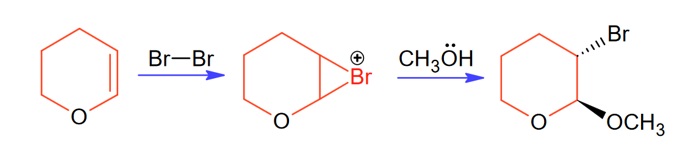
Kindly consider the following figure
Upvote Reactivity order of halogens and inter halogens are F2 > ClF > Cl2 and ClF forms HOCl and HF after the reaction with water.
Upvote