
Ncert Solutions Maths class 11th
Get insights from 1.6k questions on Ncert Solutions Maths class 11th, answered by students, alumni, and experts. You may also ask and answer any question you like about Ncert Solutions Maths class 11th
- 1.6k
Questions
- 0
Discussions
- 0
Active Users
- 83
Followers
Have a question about Ncert Solutions Maths class 11th? Ask our experts
Keep it short & simple. Type complete word. Avoid abusive language.
36. Let A = {9,10,11,12,13} and let f : A→N be defined by f (n) = the highest prime factor of n. Find the range of f.
36. Let A = {9,10,11,12,13} and let f : A→N be defined by f (n) = the highest prime factor of n. Find the range of f.
36. Given, A={9,10,11,12,13}.
f(x)=the highest prime factor of n.
and f: A → N.
Then, f(9)=3 [? prime factor of 9=3]
f (10)=5 [? prime factor of 10=2,5]
f(11)=11 [? prime factor of 11 = 11]
f(12)=3 [? prime factor of 12 = 2, 3]
f(13)=13 [? prime factor of 13 = 13]
?Range of f=set of all image of f(x) = {3,5
 Upvote

35. Let f be the subset of Z × Z defined by f = {(ab, a + b) : a, b _ Z}. Is f a function from Z to Z? Justify your answer.
35. Let f be the subset of Z × Z defined by f = {(ab, a + b) : a, b _ Z}. Is f a function from Z to Z? Justify your answer.
35. Given, f={(ab, a+b): a, b z}
Let a=1 and b=1; a, b z.
So, ab=1 × 1=1
a+b=1+1=2.
So, we have the order pair (1,2).
Now, let a= –1 and b= –1; a, b z
So, ab=(–1) × (–1)=1
a+b=(–1)+(–1)= –2
So, the ordered pair is (1,
Upvote 34. Let A ={1,2,3,4}, B = {1,5,9,11,15,16} and f = {(1,5), (2,9), (3,1), (4,5), (2,11)} Are the following true?
(i) f is a relation from A to B
(ii) f is a function from A to B.
Justify your answer in each case.
34. Let A ={1,2,3,4}, B = {1,5,9,11,15,16} and f = {(1,5), (2,9), (3,1), (4,5), (2,11)} Are the following true?
(i) f is a relation from A to B
(ii) f is a function from A to B.
Justify your answer in each case.
34. Given,
A={1,2,3,4}
B={1,5,9,11,15,16}
f={(1,5),(2,9),(3,1),(4,5),(2,11)}.
(i) As every element of f is an element of A × B
We can clearly say that f A × B.
?f is a relation from A to B.
(ii) As the element 2 of the domain has two image i.e., 9 and 11. f is not a function.
Upvote 69. Find the distance of the line 4x + 7y + 5 = 0 from the point (1, 2) along the line 2x – y = 0.
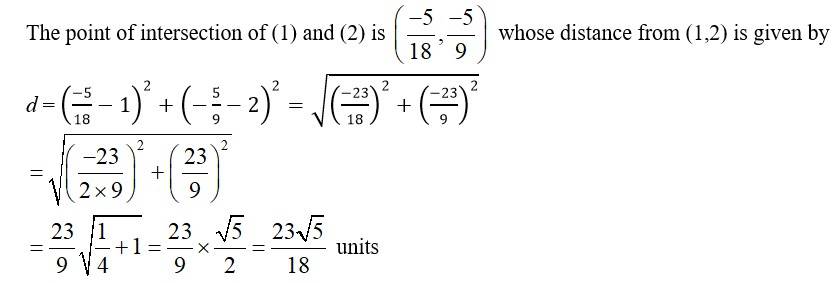
69. Find the distance of the line 4x + 7y + 5 = 0 from the point (1, 2) along the line 2x – y = 0.
69.
The given eqn of the lines are.
4x + 7y + 5 = 0______ (1)
2x - y = 0 ______ (2)
Solving (1) and (2) we get,
4 x + 7 (2 x)+5 = 0
4x +14 x + 5= 0
x =
and y = 2x =
 Upvote
33. Let R be a relation from N to N defined by R = {(a, b) : a, b N and a = b2}. Are the following true?
(i) (a,a) R, for all a _ N
(ii) (a,b) R, implies (b,a) R
(iii) (a,b) R, (b,c) R implies (a,c) R.
Justify your answer in each case.
33. Let R be a relation from N to N defined by R = {(a, b) : a, b N and a = b2}. Are the following true?
(i) (a,a) R, for all a _ N
(ii) (a,b) R, implies (b,a) R
(iii) (a,b) R, (b,c) R implies (a,c) R.
Justify your answer in each case.
33. Given, R= { (a, b): a, b N and a = b2}
(i) Let a = 2 N
Then b = 22 = 4 N
but a ≠ b.
Hence the given statement is not true.
(ii) For a=b2 the inverse b=a2 may not hold true
Example (4,2) R, a=4, b=2 and a=b2
but (2,4) R.
Hence, the given statement is not true.
(iii) I
Upvote 32. Let f = {(1,1), (2,3), (0,–1), (–1, –3)} be a function from Z to Z defined by f(x) = ax + b, for some integers a, b. Determine a, b.
32. Let f = {(1,1), (2,3), (0,–1), (–1, –3)} be a function from Z to Z defined by f(x) = ax + b, for some integers a, b. Determine a, b.
32. Given, f(x) = (ax + b)
= {(1,1),(2,3),(0, – 1),(–1, –3)} .
As (1,1) f.
Then, f(1)=1 [? f(x) = y for (x, y)]
a × 1+b=1
a+b=1…… (1)
and (0, – 1) f .
Then, f(0)= –1
a× 0+b= –1
b= –1…….(2)
Putting value of (2) in (1) we gets
a – 1=1
a=1+1
a=2
So, (a, b)=(2, –1)
Upvote 31. Let f, g : R→R be defined, respectively by f(x) = x + 1, g(x) = 2x – 3. Find f + g, f – g and .
31. Let f, g : R→R be defined, respectively by f(x) = x + 1, g(x) = 2x – 3. Find f + g, f – g and .
31. Given, f(x) = x+1. and g(x) = 2x – 3.
So, (f +g)(x) = f(x)+g(x) = (x+1)+(2x – 3) = x+1+2x – 3 = 3x – 2
(f – g)(x) = f(x) –g(x) = (x+1)–(2x–3) = x+1 – 2x+3 = 4 – x
Upvote 68. In what ratio, the line joining (–1, 1) and (5, 7) is divided by the line x + y = 4?
68. In what ratio, the line joining (–1, 1) and (5, 7) is divided by the line x + y = 4?
68. The given eqn of line is
l1: x + y = 4
Let R divides the line joining two points P (?1,1) and Q (5,7) in ratio k:1. Then,
Co-ordinate of R = ()
As l1 divides line joining PQ, then R lies on l1
i e, =4
5k ?1 + 7k + 1= 4 (k + 1)
12k = 4k + 4
8k = 4
k =
The ratio in which x + y = 4 divides line
Upvote 30. Let be a function from R into R. Determine the range of f.
30. Let be a function from R into R. Determine the range of f.
30. Given, f (x)=
We know that, for x R.
So, x2≥ 0 ⇒
and x2+1>x2
⇒
⇒1 > f (x).
So, 0 ≤ f (x) < 1
∴ Range of f (x) = [0,1).
Upvote 67. Show that the equation of the line passing through the origin and making an angle ø with the line
67. Show that the equation of the line passing through the origin and making an angle ø with the line
67. The given eqn of line is.
l1 : y = mx + c.
Slope of l1 = m
Let m? be the slope of line passing through origin (0, 0) and making angle θ with l1
Thus, (y 0) = m? (x 0)
y = m? x
m? =
______ (1)
And tanθ = =
When, tanθ =
tanθ + m? m tanθ = m’ - m
m + tanθ = m? - m?m tanθ
m' =
When tan θ =
t
Upvote