
Ncert Solutions Maths class 11th
Get insights from 1.6k questions on Ncert Solutions Maths class 11th, answered by students, alumni, and experts. You may also ask and answer any question you like about Ncert Solutions Maths class 11th
- 1.6k
Questions
- 0
Discussions
- 0
Active Users
- 83
Followers
Have a question about Ncert Solutions Maths class 11th? Ask our experts
Keep it short & simple. Type complete word. Avoid abusive language.
66. Find the equation of the line passing through the point of intersection of the lines 4x + 7y – 3 = 0 and 2x – 3y + 1 = 0 that has equal intercepts on the axes.
66. Find the equation of the line passing through the point of intersection of the lines 4x + 7y – 3 = 0 and 2x – 3y + 1 = 0 that has equal intercepts on the axes.
66. The given eqn of the line is.
4x + 7y – 3 = 0 _____ (1)
2x – 3y + 1 = 0 _______ (2)
Solving (1) and (2) using eqn (1) 2 x eqn (2) we get,
(4x + 7y – 3) 2 [ (2x – 3y + 1)] = 0
4x + 7y – 3 – 4x + 6y – 2 = 0
13y = 5
y =
And 2x – 3 + 1 = 0
2x =
 Upvote

65. Find the equation of the lines through the point (3, 2) which make an angle of 45o with the line x – 2y = 3.
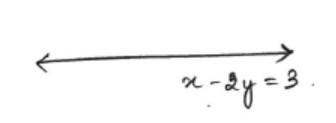
65. Find the equation of the lines through the point (3, 2) which make an angle of 45o with the line x – 2y = 3.
65. x – 2y = 3
y = - ______ (1)
Slope of line (1) is
Let the line through P (3, 2) have slope m
Then, angle between the line =
When, =>2m – 1 = 2 + m=> m = 3.
The eqn of line through (3, 2) is
y – 2 = 3 (x – 3) 3x – y – 7 = 0.
When = – 1=> 2m – 1 = – 2 – m =>3m = –
Upvote 64. If three lines whose equations are y = m1x + c1, y = m2x + c2 and y = m3x + c3 are concurrent, then show that m1(c2 – c3) + m2 (c3 – c1) + m3 (c1 – c2) = 0.
64. If three lines whose equations are y = m1x + c1, y = m2x + c2 and y = m3x + c3 are concurrent, then show that m1(c2 – c3) + m2 (c3 – c1) + m3 (c1 – c2) = 0.
64. The given eqn of the three lines are
y = m1 x + c1 ______ (1)
y = m2 x + c2 ______ (2)
y = m3 x + c3 ______ (3)
The point of intersection of (2) and (3) is given by.
y - y = (m2x + c2) - (m3 x + c3)
(m2 - m3) x = c3 - c2
Hence, y =
As the three lines are concurrent, the point of intersection of (2
Upvote 63. Find the value of p so that the three lines 3x + y – 2 = 0, px + 2 y – 3 = 0 and 2x – y – 3 = 0 may intersect at one point.
63. Find the value of p so that the three lines 3x + y – 2 = 0, px + 2 y – 3 = 0 and 2x – y – 3 = 0 may intersect at one point.
63. The given eqn of the lines are.
3x + y - 2 = 0 _____ (1)
Px + 2y - 3 = 0 ______ (2)
2x - y - 3 = 0 _____ (3)
Point of intersection of (1) and (3) is given by,
(3x + y - 2) + (2x - y - 3) = 0
=> 5x - 5 = 0
=> x =
=> x = 1
So, y = 2 - 3x = 2 -3 (1) = 2 - 3 = 1.
i e, (x, y) = (1, -1).
As the three lines
Upvote 29. Find the domain and the range of the real function f defined by .
29. Find the domain and the range of the real function f defined by .
29. Given, f(x)=|x – 1|.
The given function is defined for all real number x.
Hence, domain of f(x)=R.
As f(x)=|x – 1|, x R is a non-negative no.
Range of f(x)=[0, ?), if positive real numbers.
Upvote 28. Find the domain and the range of the real function f defined by 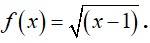
28. Find the domain and the range of the real function f defined by
28. Given, f (x)= 
The given fxn is valid for all x such that x – 1 ≥ 0 ⇒x≥ 1
∴ Domain of f (x)= [1,∞)
As x ≥ 1
⇒ x – 1 ≥ 1 – 1
⇒ x – 1 ≥ 0
⇒ ≥ 0
⇒ f (x) ≥ 0
So, range of f (x)= [0,∞ )
Upvote 62. Find the area of the triangle formed by the lines y – x = 0, x + y = 0 and x – k = 0.
62. Find the area of the triangle formed by the lines y – x = 0, x + y = 0 and x – k = 0.
62.
The given eqn of the lines are
y - x = 0 _____ (1)
x + y = 0 ______ (2)
x - k = 0 ______ (3)
The point of intersection of (1) and (2) is given by
(y - x) - (x + y) = 0
⇒ y - x -x -y = 0
y = 0 and x = 0
ie, (0, 0)
The point of intersection of (2) and (3) is given by
(x + y) – (x – k) = 0
y + k
Upvote 27. Given, f (x)=
The given function is valid if denominator is not zero.
So, if x2 – 8x+12=0.
⇒ x2 – 2x – 6x+12=0
⇒ x (x – 2) –6 (x – 2)=0
⇒ (x – 2) (x – 6)=0
⇒ x=2 and x=6.
So, f (x) will be valid for all real number x except x=2,6.
∴ Domain of f (x)=R – {2,6}
Upvote 61. Find the equation of a line drawn perpendicular to the line through the point, where it meets the y-axis.
61. Find the equation of a line drawn perpendicular to the line through the point, where it meets the y-axis.
61. The given Eqn of the line is = 1 ______ (1)
so, Slope of line = -
The line ⊥ to line (1) say l2 has
Slope of l2 =
Let P (0, y) be the point of on y-axis where it is cut by the line (1)
Then,
y = 6
i.e, the point P has co-ordinate (0, 6)
Eqn of line ⊥ to and cuts y-axis at P (0,6) is
Upvote