
Ncert Solutions Maths class 11th
Get insights from 1.6k questions on Ncert Solutions Maths class 11th, answered by students, alumni, and experts. You may also ask and answer any question you like about Ncert Solutions Maths class 11th
- 1.6k
Questions
- 0
Discussions
- 0
Active Users
- 83
Followers
Have a question about Ncert Solutions Maths class 11th? Ask our experts
Keep it short & simple. Type complete word. Avoid abusive language.
If the solution of the differential equation satisfies y(0) = 0, then the value of y(2) is……….
If the solution of the differential equation satisfies y(0) = 0, then the value of y(2) is……….
Here, I.F.
Solution of the differential equation is
y(0) = 0
 Upvote

If y = y(x) is the solution of the differential equation then the local maximum value of the function z(x) = x2y(x) – ex, x is:
If y = y(x) is the solution of the differential equation then the local maximum value of the function z(x) = x2y(x) – ex, x is:
x = 1 local maxima. Then maximum value is
Upvote The area bounded by the curve y = <!-- [if gte mso 9]><xml>
The area bounded by the curve y = <!-- [if gte mso 9]><xml>
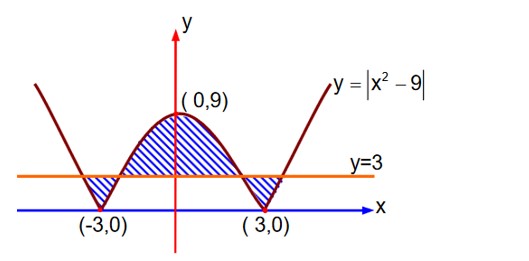
Required area = A
Note : No option in the question paper is correct.
Upvote Let f(x) = min{1, 1 + sin x}, 0 If m is the number of points, where f is not differentiable and n is the number of points, where f is not continuous, then the ordered pair (m, n) is equal to
Let f(x) = min{1, 1 + sin x}, 0 If m is the number of points, where f is not differentiable and n is the number of points, where f is not continuous, then the ordered pair (m, n) is equal to
Now at x = π,
is not differentiable at x = π
(m, n) = (1, 0)
Upvote Let S be the set of all the natural numbers, for which the line <!-- [if gte mso 9]><xml>
Let S be the set of all the natural numbers, for which the line <!-- [if gte mso 9]><xml>
So line always touches the given curve.
Upvote mod (7)
…… (i)
Now,
……. (ii)
(i) & (ii)
Remainder = 5
Upvote 42. Find the derivative of the following functions:
(i)sin x cos x (ii) (iii)5 sec x + 4 cosx
(iv) (v)3cot x + 5 cosec x
(vi) (vii)
42. Find the derivative of the following functions:
(i)sin x cos x (ii) (iii)5 sec x + 4 cosx
(iv) (v)3cot x + 5 cosec x
(vi) (vii)
(i) f(x)=sin x cos x
So,
So,
(iii) Given f(x)=5 sec x+4 cosx.
So,
(v) Given,f(x)=3 cot x+5cosecx.
So,
Upvote 
29.
Given, f (x) = (x-a1) (x-a2)… (x-an)
So,
= (a1-a1) (a1-a2) … (a1-an)
= 0 (a1-a2) … (a1-an)
= 0
And
= (a-a1) (a-a2) … (a-an)
Upvote