
Ncert Solutions Maths class 12th
Get insights from 2.5k questions on Ncert Solutions Maths class 12th, answered by students, alumni, and experts. You may also ask and answer any question you like about Ncert Solutions Maths class 12th
- 2.5k
Questions
- 0
Discussions
- 0
Active Users
- 65
Followers
Have a question about Ncert Solutions Maths class 12th? Ask our experts
Keep it short & simple. Type complete word. Avoid abusive language.
Exercise-1.4
43. Determine whether or not each of the definition of given below gives a binary operation. In the event that * is not a binary operation, give justification for this.
(i) On Z+ , define * by a * b = a − b
(ii) On Z+, define * by a * b = ab
(iii) On R, define * by a * b = ab2
(iv) On Z+, define * by a * b = |a − b|
(v) On Z+, define * by a * b = a
Exercise-1.4
43. Determine whether or not each of the definition of given below gives a binary operation. In the event that * is not a binary operation, give justification for this.
(i) On Z+ , define * by a * b = a − b
(ii) On Z+, define * by a * b = ab
(iii) On R, define * by a * b = ab2
(iv) On Z+, define * by a * b = |a − b|
(v) On Z+, define * by a * b = a
(i) On Z+, * is defined by a * b = a − b.
It is not a binary operation as the image of (1, 2) under * is 1 * 2 = 1 − 2= −1 ∉ Z+.
(ii) On Z+, * is defined by a * b = ab.
It is seen that for each a, b ∈ Z+, there is a unique element ab in Z+.
This means that * carries each pair (a, b) to a unique eleme
 Upvote
42. Let be a function defined as . The inverse of f is map g Range
42. Let be a function defined as . The inverse of f is map g Range
It is given that is defined as
Let y be an arbitrary element of Range f.
Then, there exists such that
let us define g: Range
Thus, g is the inverse of f i.e.,
Hence, the inverse of f is the map g: Range which is given by
The correct answer is
Upvote 41. If be given by , then f of(x) is
(A) 1/x3
(B) x3
(C) x
(D) (3 − x3)
41. If be given by , then f of(x) is
(A) 1/x3
(B) x3
(C) x
(D) (3 − x3)
is given as
The correct answer is C.
Upvote 40. Let f: X → Y be an invertible function. Show that the inverse of f−1 is f, i.e., (f−1)−1 = f.
40. Let f: X → Y be an invertible function. Show that the inverse of f−1 is f, i.e., (f−1)−1 = f.
Let f: X → Y be an invertible function.
Then, there exists a function g: Y → X such that gof = IX and fog = IY.
Here, f−1 = g.
Now, gof = IX and fog = IY
⇒ f−1 of = IX and fof−1 = IY
Hence, f−1 : Y → X is invertible and f is the inverse of f−1
i.e., (f−1)−1 = f.
Upvote 39. Consider f: {1, 2, 3} → {a, b, c} given by f(1) = a, f(2) = b and f(3) = c. Find f−1 and show that (f−1)−1 = f.
39. Consider f: {1, 2, 3} → {a, b, c} given by f(1) = a, f(2) = b and f(3) = c. Find f−1 and show that (f−1)−1 = f.
If we define then we have:
Thus, the inverse of f exists and
is given by,
Let us now find the inverse of i.e., find the inverse of g.
If we define
, then we have
Thus, the inverse of g exists and
It can be noted that h=f.
Hence,
Upvote 38. Let f: X → Y be an invertible function. Show that f has unique inverse.
(Hint: suppose g1 and g2 are two inverses of f. Then for all y ∈ Y, fog1(y) = IY(y) = fog2(y). Use one-one ness of f).
38. Let f: X → Y be an invertible function. Show that f has unique inverse.
(Hint: suppose g1 and g2 are two inverses of f. Then for all y ∈ Y, fog1(y) = IY(y) = fog2(y). Use one-one ness of f).
Let be an invertible function.
Also, suppose f has two inverses (say g1 and g2 ).
Then, for all y ∈ Y, we have:
[f is invertible => f is one-one]
[g is one-one]
Hence, f has a unique inverse.
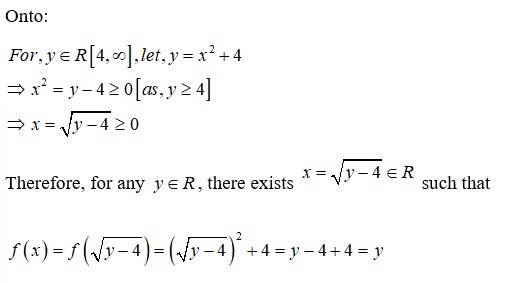
Upvote 36. Consider f: R+ → [4, ∞) given by f(x) = x2 + 4 Show that f is invertible with the inverse f−1 of f given by f−1(y) = √y - 4 where R+ is the set of all non-negative real numbers.
36. Consider f: R+ → [4, ∞) given by f(x) = x2 + 4 Show that f is invertible with the inverse f−1 of f given by f−1(y) = √y - 4 where R+ is the set of all non-negative real numbers.
is given as .
One-one:
is a one-one function.
 Upvote
 35. Consider f : R→ R given by f(x) = 4x + 3 Show that f is invertible. Find the inverse of f.
35. Consider f : R→ R given by f(x) = 4x + 3 Show that f is invertible. Find the inverse of f.
is given by,
f is a one-one function.
Onto:
Therefore, for any , there exists such that
f is onto.
Thus, f is one-one and onto and therefore, exists.
Let us define by
Hence, f is invertible and the inverse of f is given by
Upvote 34. Show that f: [-1, 1] → R given by f(x) = x/x+2 is one-one. Find the inverse of the function f: [-1, 1] → Range f
34. Show that f: [-1, 1] → R given by f(x) = x/x+2 is one-one. Find the inverse of the function f: [-1, 1] → Range f
is given as
f is a one-one function.
It is clear that Range f is onto.
Range f is one-one onto and therefore, the inverse of the function:
Range f exists.
Let g: Range be the inverse of f.
Let y be an arbitrary element of range f.
Since R
Upvote 33. State with reason whether following functions have inverse
(i) f: {1, 2, 3, 4} → {10} with f = {(1, 10), (2, 10), (3, 10), (4, 10)}
(ii) g: {5, 6, 7, 8} → {1, 2, 3, 4} with g = {(5, 4), (6, 3), (7, 4), (8, 2)}
(iii) h: {2, 3, 4, 5} → {7, 9, 11, 13} with h = {(2, 7), (3, 9), (4, 11), (5, 13)}
33. State with reason whether following functions have inverse
(i) f: {1, 2, 3, 4} → {10} with f = {(1, 10), (2, 10), (3, 10), (4, 10)}
(ii) g: {5, 6, 7, 8} → {1, 2, 3, 4} with g = {(5, 4), (6, 3), (7, 4), (8, 2)}
(iii) h: {2, 3, 4, 5} → {7, 9, 11, 13} with h = {(2, 7), (3, 9), (4, 11), (5, 13)}
(i) f: {1, 2, 3, 4} → {10} defined as:
f = { (1, 10), (2, 10), (3, 10), (4, 10)}
From the given definition of f, we can see that f is a many one function as: f (1) = f (2) = f (3) = f (4) = 10
∴f is not one-one.
Hence, function f does not have an inverse.
(ii) g: {5, 6, 7, 8} → {1, 2, 3, 4
Upvote