
Overview
Get insights from 95 questions on Overview, answered by students, alumni, and experts. You may also ask and answer any question you like about Overview
- 95
Questions
- 0
Discussions
- 0
Active Users
- 0
Followers
Have a question about Overview? Ask our experts
Keep it short & simple. Type complete word. Avoid abusive language.
A small elastic ball of mass m is placed at the apex of a inclined plane as shown in the figure below. The ball is allowed to slip without friction down the plane (along the dotted line), hit the ground (as shown) and bounce along it. If the height of the inclined plane is h and the coefficient of restitution between the ball and the ground is 0.5, then the distance AB, as marked on the figure, will be N × h, where N is

A small elastic ball of mass m is placed at the apex of a inclined plane as shown in the figure below. The ball is allowed to slip without friction down the plane (along the dotted line), hit the ground (as shown) and bounce along it. If the height of the inclined plane is h and the coefficient of restitution between the ball and the ground is 0.5, then the distance AB, as marked on the figure, will be N × h, where N is
Block of mass M slides down on frictionless incline as shown. The minimum friction coefficient so that block of mass m does not slide with respect to lower block is close to , the nearest integer to I is Take <!--[endif]--><!--[endif]-->
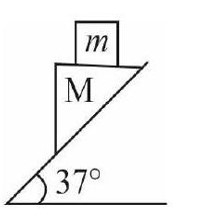
Block of mass M slides down on frictionless incline as shown. The minimum friction coefficient so that block of mass m does not slide with respect to lower block is close to , the nearest integer to I is Take <!--[endif]--><!--[endif]-->
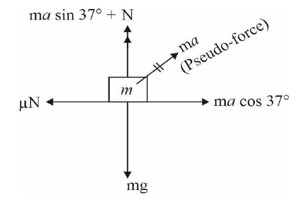
Acceleration of the combined system along the incline is given by
With respect to block M :
 Upvote

A particle of mass 3 kg moving with speed of 3 m/s is acted upon by an impulse. As a result, the particle starts moving in a direction 90° to the original direction with a speed of 4 m/s. Find the impulse acted upon on the particle in SI units.
A particle of mass 3 kg moving with speed of 3 m/s is acted upon by an impulse. As a result, the particle starts moving in a direction 90° to the original direction with a speed of 4 m/s. Find the impulse acted upon on the particle in SI units.
I? = P? – P? = 3 × 4? – 3 × 3î = 12? – 9î |I? | = √12² + 9² = 15kgm/s
Upvote An inverted cone is rotating about its vertical axis. A particle is kept on the inner surface of cone and it is at rest relative to the cone at a height of 0.4 m above its vertex. The coefficient of friction between the surface of cone and the particle is 0.6 and the apex angle of cone is 90°. The maximum angular velocity of revolution of the cone can be: (take g = 10/s2)
<!-- [if !supportLineBreakNewLine]-->
<!--[endif]-->
An inverted cone is rotating about its vertical axis. A particle is kept on the inner surface of cone and it is at rest relative to the cone at a height of 0.4 m above its vertex. The coefficient of friction between the surface of cone and the particle is 0.6 and the apex angle of cone is 90°. The maximum angular velocity of revolution of the cone can be: (take g = 10/s2)
<!-- [if !supportLineBreakNewLine]-->
<!--[endif]-->
N = (mg/√2) + (mω²h/√2)
(mω²h/√2) = (mg/√2) + f?
(mω²h/√2) = (mg/√2) + μ (mg/√2) + (mω²h/√2)
ω = √ (g/h) (1+μ)/ (1-μ) = 10rad/s
Upvote Two blocks of mass 10kg and 2ktg respectively are connected by an ideal string passing over a fixed smooth pulley as shown in figure. A monkey of 8kg started climbing the string with constant acceleration 2ms-2 with respect to string at t = 0. Initially the monkey is 2.4m from the pulley. Find the time taken by the monkey to reach the pulley.
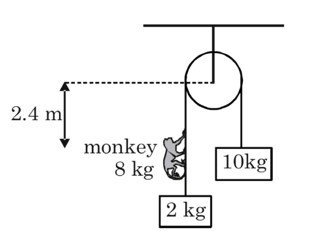
Two blocks of mass 10kg and 2ktg respectively are connected by an ideal string passing over a fixed smooth pulley as shown in figure. A monkey of 8kg started climbing the string with constant acceleration 2ms-2 with respect to string at t = 0. Initially the monkey is 2.4m from the pulley. Find the time taken by the monkey to reach the pulley.
Let the acceleration of string = a
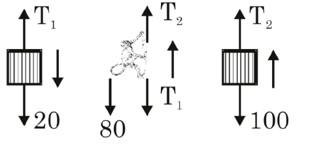
For 2 kg 20 – T1 = 2a ………… (i)
For monkey T2 – 80 – T1 = 8 (2 – a) …. (ii)
For 10 kg T2 – 100 = 10a ……. (iii)
Acceleration of monkey w.r. to ground
= 2 – 0.8 = 1.2 m/s2
Upvote A car goes on a circular horizontal road of radius 100 m. What should be the minimum coefficient of friction between the tyres and the road so that it completes the circle with velocity 10 m/s without slipping? (Take g = 10 m/s2)
<!-- [if !supportLineBreakNewLine]-->
<!--[endif]-->
A car goes on a circular horizontal road of radius 100 m. What should be the minimum coefficient of friction between the tyres and the road so that it completes the circle with velocity 10 m/s without slipping? (Take g = 10 m/s2)
<!-- [if !supportLineBreakNewLine]-->
<!--[endif]-->
Centripetal acceleration is provided by friction force. Maximum friction force should be equal to or greater that mv² / R.
µmg = mv²/R ; µ = 100/ (100*10) ; µ = 1/10 ; µ = 0.1
Upvote A rod of mass m and length L is hinged at its top end. If the rod is in equilibrium making an angle of 30° with the vertical when a horizontal force F is applied as shown in figure, then the value of F is:
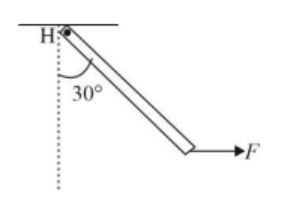
A rod of mass m and length L is hinged at its top end. If the rod is in equilibrium making an angle of 30° with the vertical when a horizontal force F is applied as shown in figure, then the value of F is:
Taking torque at top pt, mg sin30°×L / 2 = F cos30°×L ⇒ F = mg / 2√3
Upvote A particle of mass m with an initial velocity ui + 2uĵ collides with a particle of mass 3m at rest. After collision, the two particles stick together and the combined particle moves with a velocity vî + v'ĵ. Which of the following is incorrect?
A particle of mass m with an initial velocity ui + 2uĵ collides with a particle of mass 3m at rest. After collision, the two particles stick together and the combined particle moves with a velocity vî + v'ĵ. Which of the following is incorrect?
Applying conservation of momentum, m (ui + 2uj) + 3m (0) = 4m (vi +vj)
⇒ v = u / 4 and v' = u / 2
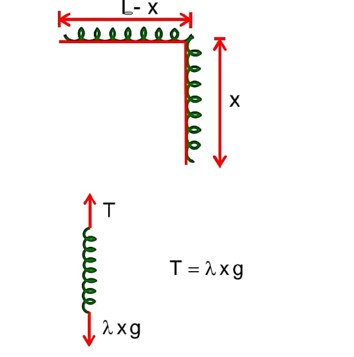
Upvote A uniform chain of 6m length is placed on a table such that a part of its length is hanging over the edge of the table. The system is at rest. The co-efficient of static friction between the chain and the surface of the table is 0.5, the maximum length of the chain hanging from the table is………….m.
A uniform chain of 6m length is placed on a table such that a part of its length is hanging over the edge of the table. The system is at rest. The co-efficient of static friction between the chain and the surface of the table is 0.5, the maximum length of the chain hanging from the table is………….m.
F.B.D. of hanging length
F.B.D. of chain lying on the table
f = T =
x = 2m
Upvote