
Physics Laws of Motion
Get insights from 189 questions on Physics Laws of Motion, answered by students, alumni, and experts. You may also ask and answer any question you like about Physics Laws of Motion
- 189
Questions
- 0
Discussions
- 0
Active Users
- 4
Followers
Have a question about Physics Laws of Motion? Ask our experts
Keep it short & simple. Type complete word. Avoid abusive language.
Two bodies and of same mass undergo completely inelastic one dimensional collision. The body moves with velocity while body is at rest before collision. The velocity of the system after collision is . The ratio is
Two bodies and of same mass undergo completely inelastic one dimensional collision. The body moves with velocity while body is at rest before collision. The velocity of the system after collision is . The ratio is
Sol. Before collision 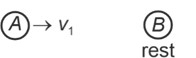
It undergoes completely inelastic collision
Using conservation of linear momentum
Initial momentum = Final momentum
 Upvote

A bullet of ‘4g’ mass is fired from a gun of mass 4kg. If the bullet moves with the muzzle speed of 50 ms-1, the impulse imparted to the gun velocity of recoil of gun are:
A bullet of ‘4g’ mass is fired from a gun of mass 4kg. If the bullet moves with the muzzle speed of 50 ms-1, the impulse imparted to the gun velocity of recoil of gun are:
for bullet
Using conservation of momentum :
Pi = Pt
v = 0.05 m/s
Upvote A sheet block of 10kg rests on a horizontal floor as shown. When three iron cylinders are placed on it as shown, the block and cylinders go down with an acceleration 0.2 m/s2. The normal reaction R’ by the floor if mass of the iron cylinders are equal and of 20kg each, is_________N.
[Take g = 10 m/s2 and <!-- [if gte mso 9]><xml>
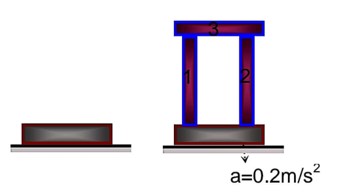
A sheet block of 10kg rests on a horizontal floor as shown. When three iron cylinders are placed on it as shown, the block and cylinders go down with an acceleration 0.2 m/s2. The normal reaction R’ by the floor if mass of the iron cylinders are equal and of 20kg each, is_________N.
[Take g = 10 m/s2 and <!-- [if gte mso 9]><xml>
70 g – N = 70 a = 70 * 0.2 = 14
->N = 700 – 14 = 686 N
Upvote A body of mass ‘m’ is launched up on a rough inclined plane making an angle of 30° with the horizontal. The coefficient of friction between the body and plane is <!-- [if gte mso 9]><xml>
A body of mass ‘m’ is launched up on a rough inclined plane making an angle of 30° with the horizontal. The coefficient of friction between the body and plane is <!-- [if gte mso 9]><xml>
For ascent
For descent
According question, we can write
Upvote Why don't action and reaction forces always result in equal motion?
Why don't action and reaction forces always result in equal motion?
This is because acceleration depends on both force and mass (F = ma).
We know that from Newton's Third Law. While action-reaction forces are always equal, the objects they act on usually have very different masses.
If you consider a falling stone and the Earth as an action-reaction pair. The Third Law
Upvote Is there a cause-effect relation in Newton's third law of motion?
Is there a cause-effect relation in Newton's third law of motion?
The third law of motion by Newton may confuse you into thinking that action causes reaction in sequence. This is incorrect.
In reality, both forces exist at the exact same moment. When you push a wall, your hand pushes the wall. At the same time, the wall pushes back simultaneously. Not one, then the
Upvote Why action and reaction are equal and opposite but even they do not cancel each other?
Why action and reaction are equal and opposite but even they do not cancel each other?
Action-reaction forces act on different objects. That's why they don't or cannot cancel out.
For instance, when you push a wall, you can observe two things.
Your hand pushes the wall (action)
The wall pushes your hand (reaction)
These are equal and opposite. But a close scientific examination will
Upvote