

Physics
Get insights from 5.6k questions on Physics, answered by students, alumni, and experts. You may also ask and answer any question you like about Physics
Follow Ask QuestionQuestions
Discussions
Active Users
Followers
New answer posted
a year agoContributor-Level 10
Yes, optical instruments are used in modern medicine for many purposes including surgery, monitoring, research and diagnosis. Let us take a look at each one by one:
- Many optical instruments are used for visualizing internal structures for diagnosis of a disease and its monitoring. These include Ophthalmoscope, Endoscope, Colposcope and Dermatoscope.
- Optical instruments are also used for precision and minimally invasive surgeries, including Laparoscope, Arthroscope and Surgical Microscopes.
- Lasers are used for cutting, therapy and coagulation since they have precision and minimal invasiveness. CO? Laser, Excimer Laser and Fiber Optic
New answer posted
a year agoContributor-Level 10
If you want the Current Electricity Class 12 important questions, then check the Class 12 Physics previous year question paper pdf. Also, focusing on the Class 12 Physics past 5 years of exam questions to identify the current electricity class 12 important questions. Well, we have framed all the important questions in the NCERT Physics Class 12 Current Electricity solution pdf, which you can easily download through this article.
New answer posted
a year agoContributor-Level 10
Before attempting the NCERT solutions PDF, solve the textbook exercise questions. Hereafter, verify your answer using the NCERT Class 12 Physics Ch 3 solutions pdf. Following a systematic approach to solve a problem will help to score good marks in the CBSE Class 12 board exam.
New answer posted
a year agoContributor-Level 10
Class 12 Physics Chapter 3 Current Electricity is important for the board exam. The weightage of the chapter is 8-10%. When you practice the Current Electricity class 12 NCERT solutions, you get an overview of your preparation. If you are lacking in any concept, then it helps to build the conceptual knowledge.
New answer posted
a year agoContributor-Level 10
The topics focused on while preparing the Current Electricity NCERT solutions are:
Ohm's law
Drift velocity
Resistivity vs temperature
Combination of cells
Kirchhoff's rules and
Wheatstone bridge
New answer posted
a year agoContributor-Level 9
Fundamental harmonic frequency open pipe
(say)
Fundamental harmonic frequency of closed pipe
(say)
New answer posted
a year ago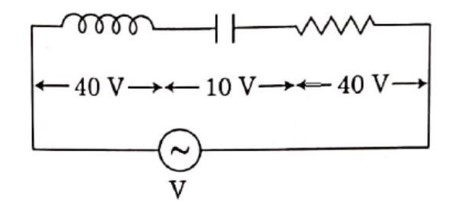
Contributor-Level 10
Diameter = main scale reading + (circular scale reading * least count)
Diameter = 0 + (52 * 0.01 mm) = 0.52 mm = 0.052 cm.
In the RLC circuit:
Given I? = 10√2 A, so I? = I? /√2 = 10 A.
V? = √ [V? ² + (V? - V? )²] = √ [40² + (40 - 10)²] = √ [1600 + 30²] = √ [1600 + 900] = √2500 = 50 V.
Impedance Z = V? / I? = 50 V / 10 A = 5 Ω.
For Hindi: I? = 10√2 A, V? = 50V, Z = V? /I? = 50/ (10√2) = 5/√2 Ω.
Taking an Exam? Selecting a College?
Get authentic answers from experts, students and alumni that you won't find anywhere else
Sign Up on ShikshaOn Shiksha, get access to
- 67k Colleges
- 1.2k Exams
- 718k Reviews
- 1850k Answers