

Physics
Get insights from 5.6k questions on Physics, answered by students, alumni, and experts. You may also ask and answer any question you like about Physics
Follow Ask QuestionQuestions
Discussions
Active Users
Followers
New answer posted
a year agoContributor-Level 9
λ? /λ? = (m? v? ) / (m? v? ) ⇒ m? = m? (v? /v? ) (λ? /λ? ) = m? (1/4) (1/2) = (1/8)m?
New answer posted
a year agoContributor-Level 10
Given the decay equation A = A? e^ (-bt/m):
-bt/m = ln (A/A? )
Solving for b:
b = (-m/t? ) * ln (A/A? ) = (-1 / (2 * 60) * ln (6/12) = 5.775 * 10? ³ kg/s
New answer posted
a year ago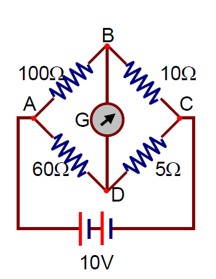
Contributor-Level 10
Let V? = 10V, V? = xV, V? = 0V, and V? = yV.
Applying Kirchhoff's current law at node B:
(x - 10)/100 + (x - y)/15 + (x - 0)/10 = 0 ⇒ 53x - 20y = 30 . (1)
Applying Kirchhoff's current law at node D:
(y - 10)/60 + (y - x)/15 + (y - 0)/5 = 0 ⇒ 17y - 4x = 10 . (2)
Solving equations (1) and (2), we get:
x = 0.865 and y = 0.792
The current i? is:
i? = (x - y) / 15 = 4.87 mA
New answer posted
a year agoContributor-Level 10
The bulk modulus B is calculated as:
B = -ΔP / (ΔV/V) = (ρgh) / (ΔV/V) = (10³ * 9.8 * 2 * 10³) / (1.36 * 10? ²) = 1.44 * 10? N/m²
New answer posted
a year agoContributor-Level 10
The angular frequency ω is calculated as:
ω = 2πf = 2 * 3.14 * 245 = 1.5386 * 10³ rad/s ≈ 1.5 * 10³ rad/s
This continues the solution from number 15 on the previous page.
k = ω / v = (1.53 * 10³) / 300 = 5.1 m? ¹
A = 0.06 / 2 = 0.03m
New answer posted
a year agoContributor-Level 9
In external magnetic field, a magnetic force acts on every small part of the loop in direction perpendicular to the wire. Thus, loop assumes a shape (circular) in which it covers maximum area
New answer posted
a year ago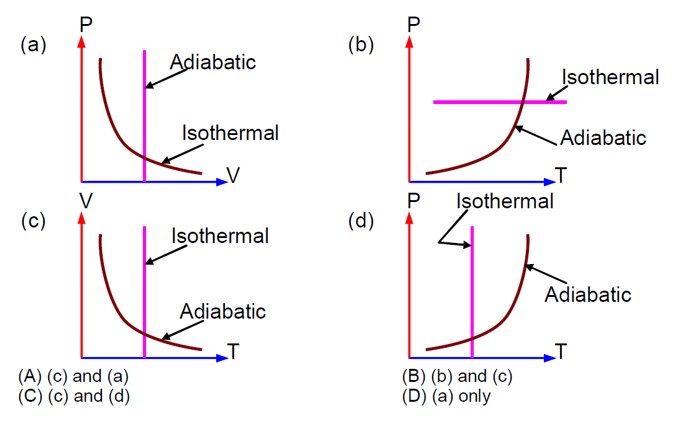
Contributor-Level 10
Pressure decreases with an increase in volume in both isothermal and adiabatic processes. In an adiabatic process, as volume decreases, pressure increases with the increase in temperature.
Taking an Exam? Selecting a College?
Get authentic answers from experts, students and alumni that you won't find anywhere else
Sign Up on ShikshaOn Shiksha, get access to
- 67k Colleges
- 1.2k Exams
- 718k Reviews
- 1850k Answers