

Physics
Get insights from 5.6k questions on Physics, answered by students, alumni, and experts. You may also ask and answer any question you like about Physics
Follow Ask QuestionQuestions
Discussions
Active Users
Followers
New answer posted
a year agoContributor-Level 10
Electric field squared is proportional to the power P of the bulb (E² ∝ P).
(E' / E)² = (60 / 100) ⇒ E' = E * √* (3/5)*
New answer posted
a year agoContributor-Level 9
Power gain = (i_c² R_c) / (i_b² R_B) = (i_c/i_b)² (R_c/R_B) = (10²)² (10? /10³) = 10?
i_c/i_b = 100 ⇒ β = i_c/i_b = 100
New answer posted
a year agoContributor-Level 9
T = 2π√ (l/g) ⇒ g = 4π²l/T²
Percentage error: Δg/g = Δl/l + 2 (ΔT/T) = (0.1/10.0) + 2 (0.005/0.5) = 0.03
Percentage error = (Δg/g) * 100 = 3%
ω = 2πf = 100π rad/s
i_rms = i? /√2
While current changes from its maximum to its rms value, its phase changes by π/4 rad.
t = (π/4)/ω = π/ (4 * 100π) = 2.5 * 10? ³ s = 2.5ms.
New answer posted
a year ago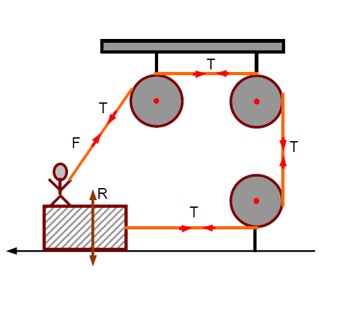
Contributor-Level 10
Assuming the rope in the boy's hand is vertical and using a Free Body Diagram (FBD):
f? = T
R + T = 90 ⇒ R = 90 - T
For the piece of wood not to move, f? ≤ µR:
T ≤ 0.5 (90 - T) ⇒ T ≤ 30N
New answer posted
a year agoContributor-Level 10
Given the refractive index μ = λ? / λ = 3/2 and v = 10m, the object distance is u = - (3/2)v = -15m.
Using the lens maker's formula:
μ/v - 1/u = (μ - 1)/R
(3/2)/10 - 1/ (-15) = (3/2 - 1)/R
This gives the radius of curvature R:
R = -30/13 m
New answer posted
a year agoContributor-Level 9
Resonance frequency is independent of R.
Quality factor = ωL/R ⇒ Quality factor decreases with increase in R.
Bandwidth of resonance circuit = R/L ⇒ increases with increase in R.
New answer posted
a year ago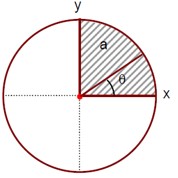
Contributor-Level 10
The x and y coordinates of the center of mass are given by:
x? = y? = 4a / 3π
New answer posted
a year agoContributor-Level 10
The minimum force F? is calculated as:
F? = (μmg) / √* (1 + μ²)* = ( (1/√3) * 1 * 10 ) / √* (1 + (1/√3)²) = 5N
New answer posted
a year ago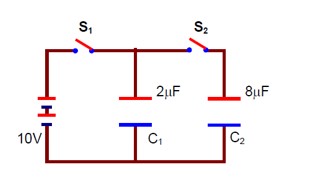
Contributor-Level 10
Let the charge on C? be q µC. For the capacitor network:
q/C? = (C? * 10 - q) / C? ⇒ q/8 = (2 * 10 - q) / 2 ⇒ q = 16
Taking an Exam? Selecting a College?
Get authentic answers from experts, students and alumni that you won't find anywhere else
Sign Up on ShikshaOn Shiksha, get access to
- 67k Colleges
- 1.2k Exams
- 718k Reviews
- 1850k Answers