Physics

Get insights from 5.6k questions on Physics, answered by students, alumni, and experts. You may also ask and answer any question you like about Physics

Follow Ask Question
5.6k

Questions

0

Discussions

24

Active Users

0

Followers

New answer posted

a year ago

0 Follower 13 Views

A
alok kumar singh

Contributor-Level 10

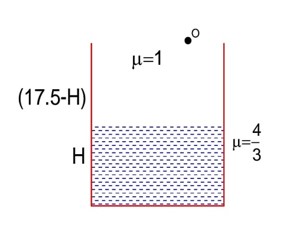
As observer is at O So height of water observed by observer

  ⇒ H μ ω = H ( 4 / 3 ) = 3 H 4

given diagram (17.5 - H) is height of observer

S o 3 H 4 = 1 7 . 5 − H          

7 H 4 = 1 7 . 5            

7H = 70

H = 10


New answer posted

a year ago

0 Follower 9 Views

V
Vishal Baghel

Contributor-Level 10

In SHM sum of kinetic and potential energy will be constant and average kinetic energy & average potential energy in one time will be remains same.

New answer posted

a year ago

0 Follower 5 Views

V
Vishal Baghel

Contributor-Level 10

Thermal resistance of spherical shell = r 2 − r 1 4 π K r 1 r 2  

Rate of heat flow = Δ T R = ( θ 2 − θ 1 ) ( r 2 − r 1 4 π K r 1 r 2 ) = 4 π K r 1 r 2 ( θ 2 − θ 1 ) ( r 2 − r 1 )

New answer posted

a year ago

0 Follower 4 Views

A
alok kumar singh

Contributor-Level 10

( t 1 2 ) x = ( t m e a n ) y
l n 2 λ x = 1 λ y

λ x = ( l n 2 ) λ y              

Given Nx = Ny = N0

So activity A = λ N

A s       λ x < λ y ⇒ A x < A y           

So y will decay faster than x.

New answer posted

a year ago

0 Follower 6 Views

V
Vishal Baghel

Contributor-Level 10

Heisenberg uncertainty principle :

⇒ Δ x Δ p ≥ ? ⇒ Δ x ( m Δ v ) ≥ ?

⇒ Δ x ( m 3 R T m ) ≥ ?

⇒ Δ x ∝ 1 m

New answer posted

a year ago

0 Follower 10 Views

A
alok kumar singh

Contributor-Level 10

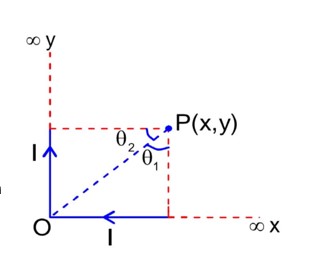
B 1 = μ 0 l 4 π y [ s i n θ 1 + s i n 9 0 ° ] − − − − − − − ( i )

B due to OX wire

B 2 = μ 0 l 4 π x [ s i n θ 2 + s i n 9 0 ° ]       

As in the diagram direction of B1 and B2 are in downward direction

So B = B1 + B2
B = μ 0 l 4 π y ( s i n θ 1 + 1 ) + μ 0 l 4 π x ( s i n θ 2 + 1 )

B = μ 0 l 4 π x y [ ( x + y ) + x 2 + y 2 ]  


New answer posted

a year ago

0 Follower 12 Views

A
alok kumar singh

Contributor-Level 10

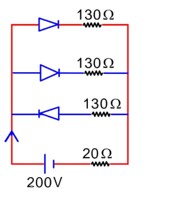
In give diagram Diode 1 and 2 are in forward bias with R = 3 0 Ω and Diode 3 is reverse bias with R = infinite l1 current is flowing through 20 Ω  

So l 1 2 a n d     l 1 2 current will flow through Diode 1 and 2. As resistance is same applying KCl in ABCD Loop − l 1 2 * 1 3 0 − l 1 2 * 1 3 0 − l 1 * 2 0 + 2 0 0 = 0

-100l1 + 200 = 0

l1 = 2

New answer posted

a year ago

0 Follower 3 Views

V
Vishal Baghel

Contributor-Level 10

Acceleration due to gravity at r distance above the surface = G M ( R + r ) 2  

Acceleration due to gravity at r distance below the surface = G M R 3 ( R − r )

So, ratio = ( R − r ) ( R + r ) 2 R 3 = ( R − r ) ( R 2 + r 2 + 2 R r ) R 3 = 1 + r R − r 2 R 2 − r 3 R 3

New answer posted

a year ago

0 Follower 13 Views

V
Vishal Baghel

Contributor-Level 10

Using parallel axis theorem:

l = 2 * [ l c m + m d 2 ]  

l = 2 * [ 2 5 ( 1 . 5 ) ( 0 . 5 ) 2 + ( 1 . 5 ) ( 2 . 5 ) 2 ]

l = 19.05 kgm2

Get authentic answers from experts, students and alumni that you won't find anywhere else

Sign Up on Shiksha

On Shiksha, get access to

  • 67k Colleges
  • 1.2k Exams
  • 718k Reviews
  • 1850k Answers

Share Your College Life Experience

×
×

This website uses Cookies and related technologies for the site to function correctly and securely, improve & personalise your browsing experience, analyse traffic, and support our marketing efforts and serve the Core Purpose. By continuing to browse the site, you agree to Privacy Policy and Cookie Policy.