

Physics
Get insights from 5.6k questions on Physics, answered by students, alumni, and experts. You may also ask and answer any question you like about Physics
Follow Ask QuestionQuestions
Discussions
Active Users
Followers
New answer posted
a year agoContributor-Level 10
The basic unit of energy is a Joule (J), which is equal to one watt of power expended for one second. In the day-to-day scenarios such as household electricity consumption, joule is too small a unit to be convenient. For billing and metering purpose, it is measured in kilowatt-hours (kWh). Electrical energy is measured in kilowatt-hours (kWh) as the commercial unit. 1kWh = 1000 W * 3600 s
For calculating the units consumed, we will be using the following formula
Units = [Power (W) x Time (h)]/1000
New answer posted
a year agoContributor-Level 10
The SI unit of the electrical power is Watt which is symbolized as W. One watt is equal to one joule per second (J/s). In the context of current and voltage, one watt is the power consumed when one ampere of the current flows through the potential difference of one volt.
New answer posted
a year ago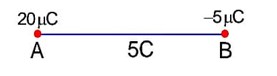
Contributor-Level 9
From observation, we can say that right of
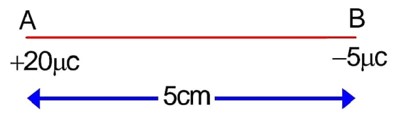
x = 5 cm
New answer posted
a year agoContributor-Level 9
(a) Torque ® ML2T-2 ↑ (iii)
(b) Impulse ® MlT-1 ↑ (i)
(c) Tension ↑ MLT-2 ↑ (iv)
(d) Surface Tension ↑
New answer posted
a year agoContributor-Level 9
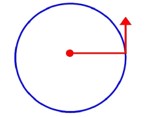
Direction & magnitude both remain same
for particle moving with constant speed.
New answer posted
a year ago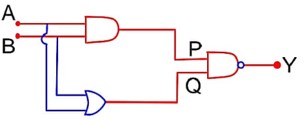
Contributor-Level 9
Input are :
(0, 0) ; (0, 1); (1, 0); (1, 1).
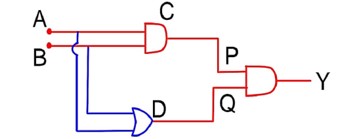
Thus, the output y is : (1, 0) s
A | B | P | Q | Y |
0 | 0 | 0 | 0 | 1 |
0 | 1 | 0 | 1 | 1 |
1 | 0 | 0 | 1 | 1 |
1 | 1 | 1 | 1 | 0 |
New answer posted
a year ago
Taking an Exam? Selecting a College?
Get authentic answers from experts, students and alumni that you won't find anywhere else
Sign Up on ShikshaOn Shiksha, get access to
- 67k Colleges
- 1.2k Exams
- 718k Reviews
- 1850k Answers