

Physics
Get insights from 5.6k questions on Physics, answered by students, alumni, and experts. You may also ask and answer any question you like about Physics
Follow Ask QuestionQuestions
Discussions
Active Users
Followers
New answer posted
a year agoContributor-Level 10
This is a Multiple Choice Questions as classified in NCERT Exemplar
Answer- a, b, d
Explanation- The space-charge regions on both the sides of p-n junction which has immobile ions and entirely lacking of any charge carriers will form a region called depletion region of a diode.
The number of ionized acceptors on the p -side equals the number of ionized donors on the n-side.
New answer posted
a year agoContributor-Level 10
This is a Multiple Choice Questions as classified in NCERT Exemplar
Answer- b, c
Explanation- IC= 10mA
Ic= 95/100 Ie
Ie= = 10.53mA
Ib=Ie-IC= 10.53-10= .53mA
New answer posted
a year ago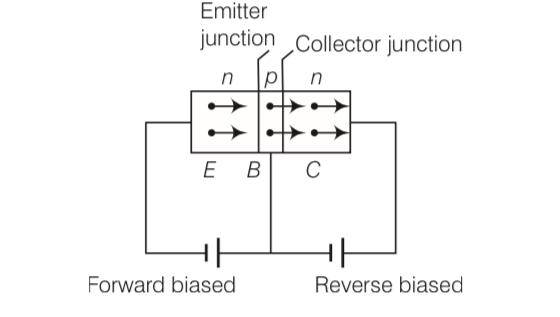
Contributor-Level 10
This is a Multiple Choice Questions as classified in NCERT Exemplar
Answer- a, c
Explanation- Here emitter-base junction is forward biased i.e., the positive pole of emitter base battery is connected to base and its negative pole to emitter. Also, the collector base junction is reverse biased, i.e., the positive pole of the collector base battery is connected to collector and negative pole to base.
Thus, electron move from emmiter to base and cross over from emitter to collector.
New answer posted
a year agoContributor-Level 10
This is a Multiple Choice Questions as classified in NCERT Exemplar
Answer- (a, c)
Explanation- when we apply temperature across semiconductor then electron will starts from lower energy to high energy level that is from valence band to conduction band. When electron goes from lower to higher then holes that is left behind they goes to lower energy levels.
New answer posted
a year ago
Contributor-Level 10
This is a Multiple Choice Questions as classified in NCERT Exemplar
Answer- c
Explanation- C=A.B and D=A'B
E= C+D = (A.B)+ (A'.B)
A | B | A' | C=A.B | D=A'B | E=C+D |
0 | 0 | 1 | 0 | 0 | 0 |
0 | 1 | 1 | 0 | 1 | 1 |
1 | 0 | 0 | 0 | 0 | 0 |
1 | 1 | 0 | 1 | 0 | 1 |
New answer posted
a year ago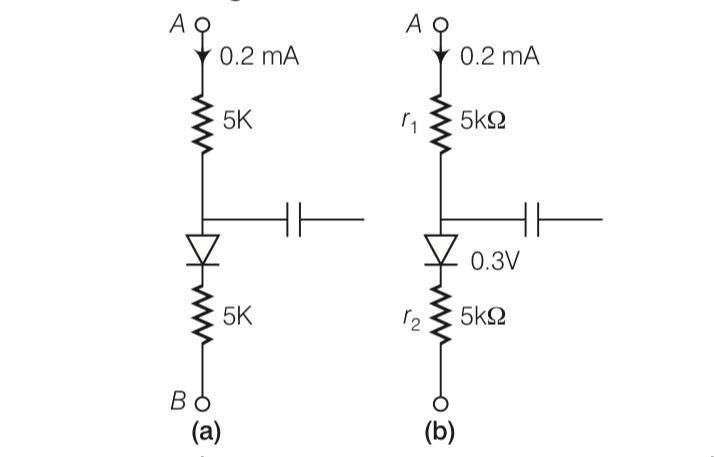
Contributor-Level 10
This is a Multiple Choice Questions as classified in NCERT Exemplar
Answer-b
Explanation- r1=5kohm and r2= 5kohm and both are in series
Then V-0.3 = [ (r1+r2)103] [0.2 10-3]
V-0.3= 2
V= 2.3V
New answer posted
a year ago
Contributor-Level 10
This is a Multiple Choice Questions as classified in NCERT Exemplar
Answer- c
Explanation- due to forward biasing the diffusion current in the circuit is very high and resistance in the circuit is very low. Thus voltage across pn junction is very low but in case of reverse biasing diffusion current very small so resistance becomes very high . and that end making high voltage across pn junction.
New answer posted
a year agoContributor-Level 10
This is a Multiple Choice Questions as classified in NCERT Exemplar
Answer-b
Explanation -when a neutral entity is there it contains both equal number of elctron and holes. Also when electron emit from neutral entity then it leave behind a vacancy that is hole.
New question posted
a year agoNew answer posted
a year ago
Contributor-Level 10
This is a Multiple Choice Questions as classified in NCERT Exemplar
Answer- d
Explanation- as we know that Ev = Eo/ so E0= Ev so net voltage is 220 V
Taking an Exam? Selecting a College?
Get authentic answers from experts, students and alumni that you won't find anywhere else
Sign Up on ShikshaOn Shiksha, get access to
- 67k Colleges
- 1.2k Exams
- 718k Reviews
- 1850k Answers