
Physics Thermodynamics
Get insights from 156 questions on Physics Thermodynamics, answered by students, alumni, and experts. You may also ask and answer any question you like about Physics Thermodynamics
- 156
Questions
- 0
Discussions
- 0
Active Users
- 1
Followers
Have a question about Physics Thermodynamics? Ask our experts
Keep it short & simple. Type complete word. Avoid abusive language.
Two moles of an ideal gas with are mixed with 3 moles of another ideal gas with . The value of for the mixture is:
Two moles of an ideal gas with are mixed with 3 moles of another ideal gas with . The value of for the mixture is:
Under an adiabatic process, the volume of an ideal gas gets doubled. Consequently the mean collision time between the gas molecule changes from to . If for the gas then a good estimate for is given by
<!-- [if !supportLineBreakNewLine]-->
<!--[endif]-->
Under an adiabatic process, the volume of an ideal gas gets doubled. Consequently the mean collision time between the gas molecule changes from to . If for the gas then a good estimate for is given by
<!-- [if !supportLineBreakNewLine]-->
<!--[endif]-->
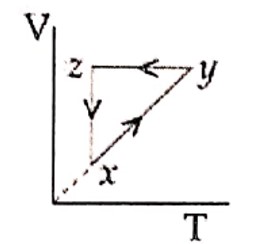
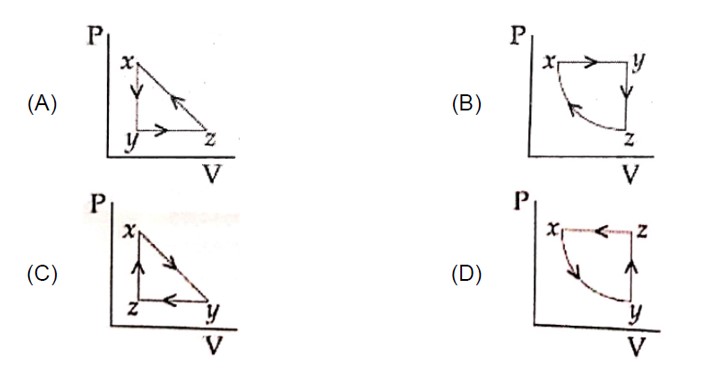
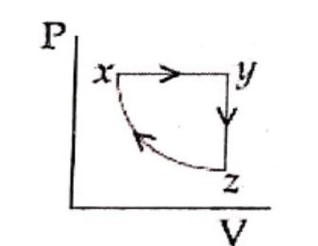
Two ideal Carnot engines operate in cascade (all heat given up by one engine is used by the other engine to produce work) between temperatures, and . The temperature of the hot reservoir of the first engine is and the temperature of the cold reservoir of the second engine is . is temperature of the sink of first engine which is also the source for the second engine. How is related to and , if both the engines perform equal amount of work?
<!-- [if !supportLineBreakNewLine]-->
<!--[endif]-->
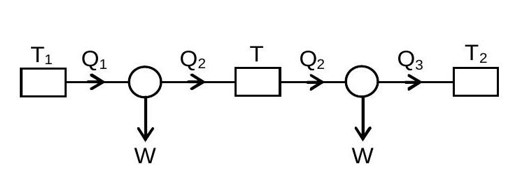
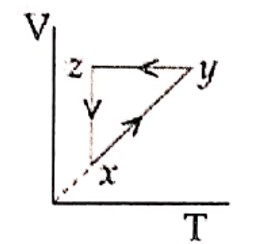
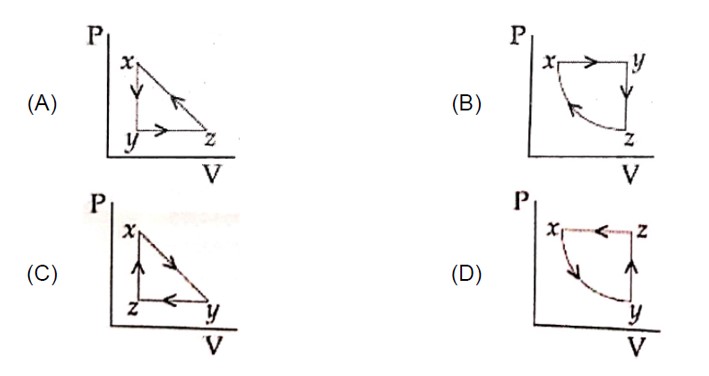
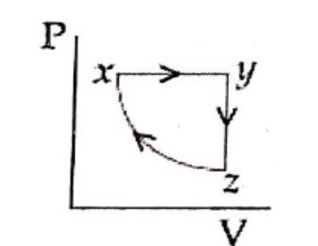
Two Carnot engines A and B operate in series such that engine A absorbs heat at T? and rejects heat to a sink at temperature T. Engine B absorbs half of the heat rejected by Engine A and rejects heat to the sink at T?. When work done in both the cases is equal, the value of T is:
<!-- [if !supportLineBreakNewLine]-->
<!--[endif]-->
η_A = W_A/Q? = 1 - T/T?
η_B = W_B/Q? ' = 1 - T? /T
W_A = Q? (1 - T/T? ) = Q? - Q?
W_B = Q? ' (1 - T? /T) = Q? /2 (1 - T? /T)
Given W_A = W_B
Q? (1 - T/T? ) = (Q? /2) (1 - T? /T)
Q? (T? /T) (1-T/T? ) = (Q? /2) (1-T? /T)
(T? /T - 1) = (1/2) (1-T? /T)
2T? /T - 2 = 1 - T? /T
2T? /T + T? /T = 3
T = (2T? +T? )/3
 Upvote

One mole of an ideal gas is taken through an adiabatic process where the temperature rises from 27°C to 37°C. If the ideal gas is composed of polyatomic molecule that has 4 vibrational modes, which of the following is true? [R = 8.314 J mol⁻¹K⁻¹]
One mole of an ideal gas is taken through an adiabatic process where the temperature rises from 27°C to 37°C. If the ideal gas is composed of polyatomic molecule that has 4 vibrational modes, which of the following is true? [R = 8.314 J mol⁻¹K⁻¹]
Degrees of freedom (f) = 3 translational + 3 rotational + (2 × 4) vibrational = 14
γ = 1 + 2/f = 1 + 2/14 = 8/7
W = nR? T/ (γ-1) = (1 × 8.3 × (310-300)/ (8/7 - 1) = (83)/ (1/7) = 581 J
As W is positive, work is done by the gas. The solution says W<0, work done on the gas. This implies? T is negative. The question states temperature rises, so work is done on the gas. W = -582J.
Upvote A body takes 4 min. to cool from 61°C to 59°C. If the temperature of the surroundings is 30°C, the time taken by the body to cool from 51°C to 49°C is:
<!-- [if !supportLineBreakNewLine]-->
<!--[endif]-->
A body takes 4 min. to cool from 61°C to 59°C. If the temperature of the surroundings is 30°C, the time taken by the body to cool from 51°C to 49°C is:
<!-- [if !supportLineBreakNewLine]-->
<!--[endif]-->
-dT/dt = K [T - Ts]
- (61-59)/4 = K [ (61+59)/2 - 30]
-0.5 = K [60 - 30] = 30K
So, K = -1/60 min? ¹
Again - (51-49)/t = K [ (51+49)/2 - 30]
-2/t = (-1/60) [50-30] = -20/60 = -1/3
t = 6 min
Upvote