Physics Thermodynamics
Get insights from 156 questions on Physics Thermodynamics, answered by students, alumni, and experts. You may also ask and answer any question you like about Physics Thermodynamics
- 156
Questions
- 0
Discussions
- 0
Active Users
- 1
Followers
Have a question about Physics Thermodynamics? Ask our experts
Keep it short & simple. Type complete word. Avoid abusive language.
To raise the temperature of a certain mass of gas by at a constant pressure, 160 calories of heat is required. When the same mass of gas is cooled by at constant volume, 240 calories of heat is released. How many degrees of freedom does each molecule of this gas have (assume gas to be ideal)?
A calorimeter of water equivalent <!-- [if gte msEquation 12]> 20 g of water at <!-- [if gte msEquation 12]> 25 ? C <!-- [if gte msEquation 12]> m 100 ? C is mixed in it till the temperature of the mixture is <!-- [if gte msEquation 12]> 31 ? C
A calorimeter of water equivalent <!-- [if gte msEquation 12]>
Heat lost by steam Heat gained by water and calorimeter.
A balloon filled with helium (32°C and 1.7 atm.) bursts. Immediately afterwards the expansion of helium can be considered as:
<!-- [if !supportLineBreakNewLine]-->
<!--[endif]-->
A balloon filled with helium (32°C and 1.7 atm.) bursts. Immediately afterwards the expansion of helium can be considered as:
<!-- [if !supportLineBreakNewLine]-->
<!--[endif]-->
After burning, heat exchange occurs between helium and atmospheric. Hence, irreversible, isothermal process.
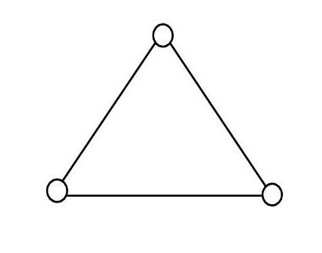
Consider a gas of triatomic molecules. The molecules are assumed to be triangular and made of massless rigid rods whose vertices are occupied by atoms. The internal energy of a mole of the gas at temperature T is:
The internal energy of one mole of an ideal gas is given by U = (f/2)RT, where f is the number of degrees of freedom.
For a non-linear triatomic molecule (assumed to be a rigid rotator), there are:
3 translational degrees of freedom.
3 rotational degrees of freedom.
Vibrational modes are generally not c