
Physics Thermodynamics
Get insights from 156 questions on Physics Thermodynamics, answered by students, alumni, and experts. You may also ask and answer any question you like about Physics Thermodynamics
- 156
Questions
- 0
Discussions
- 0
Active Users
- 1
Followers
Have a question about Physics Thermodynamics? Ask our experts
Keep it short & simple. Type complete word. Avoid abusive language.
A thermodynamic system is taken from an original state D to an intermediate sate E by the linear pressure shown in the figure. Its volume is then reduced to the original volume from E to F by an isobaric process. The total work done by the gas from D to E to F will be
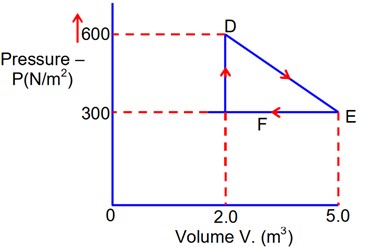
A thermodynamic system is taken from an original state D to an intermediate sate E by the linear pressure shown in the figure. Its volume is then reduced to the original volume from E to F by an isobaric process. The total work done by the gas from D to E to F will be
Wtotal = WD→E + WE→F = Area of triangle DEF
=
 Upvote

The ratio of species heats in terms of degree of freedom (f) is given by:
The ratio of species heats in terms of degree of freedom (f) is given by:
In a carnot engine, the temperature of reservoir is 527°C and that of sink is 200 K. If the work done by the engine when it transfers heat from reservoir to sink is 12000 kJ, the quantity of heat absorbed by the engine from reservoir is___________× 106 J.
In a carnot engine, the temperature of reservoir is 527°C and that of sink is 200 K. If the work done by the engine when it transfers heat from reservoir to sink is 12000 kJ, the quantity of heat absorbed by the engine from reservoir is___________× 106 J.
T2 = 200 k
w = 12000 kJ = 12 × 106 J
Q1 =?
Upvote A mixture of hydrogen and oxygen has volume 2000 cm3, temperature 300K, pressure 100 kPa and mass 0.76g. The ratio of number of moles of hydrogen to number of moles of oxygen in the mixture will be:
[Take gas constant R = 8.3 JK-1 mol-1]
A mixture of hydrogen and oxygen has volume 2000 cm3, temperature 300K, pressure 100 kPa and mass 0.76g. The ratio of number of moles of hydrogen to number of moles of oxygen in the mixture will be:
[Take gas constant R = 8.3 JK-1 mol-1]
T = 300 K
Pa
mT = 8.3 J/K1 mol1
Now, using Ideal gas equation
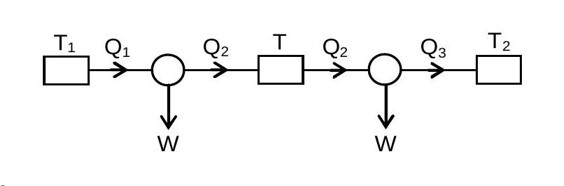
Upvote Two ideal Carnot engines operate in cascade (all heat given up by one engine is used by the other engine to produce work) between temperatures, and . The temperature of the hot reservoir of the first engine is . and the temperature of the cold reservoir of the second engine is . <!--[endif]--><!--[endif]--> is temperature of the sink of first engine which is also the source for the second engine. How is related to and , if both the engines perform equal amount of work?
<!-- [if !supportLineBreakNewLine]-->
<!--[endif]-->
Two ideal Carnot engines operate in cascade (all heat given up by one engine is used by the other engine to produce work) between temperatures, and . The temperature of the hot reservoir of the first engine is . and the temperature of the cold reservoir of the second engine is . <!--[endif]--><!--[endif]--> is temperature of the sink of first engine which is also the source for the second engine. How is related to and , if both the engines perform equal amount of work?
<!-- [if !supportLineBreakNewLine]-->
<!--[endif]-->
A certain amount of gas of volume V at <!-- [if gte mso 9]><xml>
(Use <!-- [if gte mso 9]><xml>
A certain amount of gas of volume V at <!-- [if gte mso 9]><xml>
(Use <!-- [if gte mso 9]><xml>
Let <!-- [if gte mso 9]><xml>
Let <!-- [if gte mso 9]><xml>
<p><strong>A Carnot engine operates between two reservoirs of temperatures <!-- [if gte msEquation 12]><m:oMath><spanstyle='font-size:11.0pt;font-family:"Cambria Math",serif;mso-fareast-font-family:Calibri;mso-fareast-theme-font:minor-latin;mso-bidi-font-family:"Times New Roman";mso-bidi-theme-font:minor-bidi;mso-ansi-language:EN-US;mso-fareast-language:EN-US;mso-bidi-language:AR-SA'><m:r><m:rPr><m:scr m:val="roman"/><m:sty m:val="p"/></m:rPr>900</m:r></span><spanstyle='font-size:11.0pt;font-family:"Georgia",serif;mso-fareast-font-family:Calibri;mso-fareast-theme-font:minor-latin;mso-hansi-font-family:Calibri;mso-hansi-theme-font:minor-latin;mso-bidi-font-family:"Times New Roman";mso-bidi-theme-font:minor-bidi;mso-ansi-language:EN-US;mso-fareast-language:EN-US;mso-bidi-language:AR-SA'><m:r><m:rPr><m:scr m:val="roman"/><m:sty m:val="p"/><m:nor/></m:rPr></m:r></span><span style='font-size:11.0pt;font-family:"Cambria Math",serif;mso-fareast-font-family:Calibri;mso-fareast-theme-font:minor-latin;mso-bidi-font-family:"Times New Roman";mso-bidi-theme-font:minor-bidi;mso-ansi-language:EN-US;mso-fareast-language:EN-US;mso-bidi-language:AR-SA'><m:r><m:rPr><m:scr m:val="roman"/><m:stym:val="p"/></m:rPr>K</m:r></span></m:oMath><![endif]--><!-- [if !msEquation]--> <!--[endif]--> and <!-- [if gte msEquation 12]><m:oMath><spanstyle='font-size:11.0pt;font-family:"Cambria Math",serif;mso-fareast-font-family:Calibri;mso-fareast-theme-font:minor-latin;mso-bidi-font-family:"Times New Roman";mso-bidi-theme-font:minor-bidi;mso-ansi-language:EN-US;mso-fareast-language:EN-US;mso-bidi-language:AR-SA'><m:r><m:rPr><m:scr m:val="roman"/><m:sty m:val="p"/></m:rPr>300</m:r></span><spanstyle='font-size:11.0pt;font-family:"Georgia",serif;mso-fareast-font-family:Calibri;mso-fareast-theme-font:minor-latin;mso-hansi-font-family:Calibri;mso-hansi-theme-font:minor-latin;mso-bidi-font-family:"Times New Roman";mso-bidi-theme-font:minor-bidi;mso-ansi-language:EN-US;mso-fareast-language:EN-US;mso-bidi-language:AR-SA'><m:r><m:rPr><m:scr m:val="roman"/><m:sty m:val="p"/><m:nor/></m:rPr></m:r></span><span style='font-size:11.0pt;font-family:"Cambria Math",serif;mso-fareast-font-family:Calibri;mso-fareast-theme-font:minor-latin;mso-bidi-font-family:"Times New Roman";mso-bidi-theme-font:minor-bidi;mso-ansi-language:EN-US;mso-fareast-language:EN-US;mso-bidi-language:AR-SA'><m:r><m:rPr><m:scr m:val="roman"/><m:stym:val="p"/></m:rPr>K</m:r></span></m:oMath><![endif]--><!-- [if !msEquation]--> <!--[endif]-->. The engine performs <!-- [if gte msEquation 12]><m:oMath><spanstyle='font-size:11.0pt;font-family:"Cambria Math",serif;mso-fareast-font-family:Calibri;mso-fareast-theme-font:minor-latin;mso-bidi-font-family:"Times New Roman";mso-bidi-theme-font:minor-bidi;mso-ansi-language:EN-US;mso-fareast-language:EN-US;mso-bidi-language:AR-SA'><m:r><m:rPr><m:scr m:val="roman"/><m:sty m:val="p"/></m:rPr>1200</m:r></span><spanstyle='font-size:11.0pt;font-family:"Georgia",serif;mso-fareast-font-family:Calibri;mso-fareast-theme-font:minor-latin;mso-hansi-font-family:Calibri;mso-hansi-theme-font:minor-latin;mso-bidi-font-family:"Times New Roman";mso-bidi-theme-font:minor-bidi;mso-ansi-language:EN-US;mso-fareast-language:EN-US;mso-bidi-language:AR-SA'><m:r><m:rPr><m:scr m:val="roman"/><m:sty m:val="p"/><m:nor/></m:rPr></m:r></span><span style='font-size:11.0pt;font-family:"Cambria Math",serif;mso-fareast-font-family:Calibri;mso-fareast-theme-font:minor-latin;mso-bidi-font-family:"Times New Roman";mso-bidi-theme-font:minor-bidi;mso-ansi-language:EN-US;mso-fareast-language:EN-US;mso-bidi-language:AR-SA'><m:r><m:rPr><m:scr m:val="roman"/><m:stym:val="p"/></m:rPr>J</m:r></span></m:oMath><![endif]--><!-- [if !msEquation]--> <!--[endif]--> of work per cycle. The heat energy (in J) delivered by the engine to the low temperature reservoir, in a cycle is</strong></p>
A Block of ice of mass 120g at temperature <!-- [if gte mso 9]><xml>
[Use specific heat capacity of water = 4200Jkg-1K-1, Latent heat of ice = 3.5 × 10⁵Jkg-1]
A Block of ice of mass 120g at temperature <!-- [if gte mso 9]><xml>
[Use specific heat capacity of water = 4200Jkg-1K-1, Latent heat of ice = 3.5 × 10⁵Jkg-1]
Using concept of calorimeter, we can write
Gain in heat = Loss in heat
Upvote