
Physics Thermodynamics
Get insights from 156 questions on Physics Thermodynamics, answered by students, alumni, and experts. You may also ask and answer any question you like about Physics Thermodynamics
- 156
Questions
- 0
Discussions
- 0
Active Users
- 1
Followers
Have a question about Physics Thermodynamics? Ask our experts
Keep it short & simple. Type complete word. Avoid abusive language.
A carnot engine works between temperatures 327°C and 27°C. If the engine takes 1600 J of heat from the higher temperature reservoir, the work done by the engine per cycle (in Joule) is equal to ______.
A carnot engine works between temperatures 327°C and 27°C. If the engine takes 1600 J of heat from the higher temperature reservoir, the work done by the engine per cycle (in Joule) is equal to ______.
(Q? - Q? )/Q? = (T? - T? )/T? ; Q = (300/600) × 1600 = 800 J
work done = Q? - Q? = 1600 – 800 = 800J
 Upvote

If the molar specific heat at constant pressure for a polyatomic non-linear gas is x and the molar specific heat at constant volume for a diatomic gas is y, find the value of x y
If the molar specific heat at constant pressure for a polyatomic non-linear gas is x and the molar specific heat at constant volume for a diatomic gas is y, find the value of x y
x = 8R/2 ; y = 5R/2 ; x/y = 8/5 = 1.6
Upvote An ideal gas undergoes a cyclic process whose indicator diagram is as shown in the figure. Find the work done by the gas in 1 complete cycle.
<!-- [if !supportLineBreakNewLine]-->
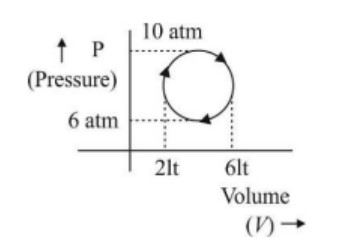
<!--[endif]-->
An ideal gas undergoes a cyclic process whose indicator diagram is as shown in the figure. Find the work done by the gas in 1 complete cycle.
<!-- [if !supportLineBreakNewLine]-->
<!--[endif]-->
Workdone by gas = area enclosed in P-V diagram
= π (2)² lt-atm
Upvote The speed of sound in a particular gas at a temperature 27°C is 340 m/s. Then, the speed of sound in the same gas at a temperature 90°C is:
<!-- [if !supportLineBreakNewLine]-->
<!--[endif]-->
The speed of sound in a particular gas at a temperature 27°C is 340 m/s. Then, the speed of sound in the same gas at a temperature 90°C is:
<!-- [if !supportLineBreakNewLine]-->
<!--[endif]-->
v = √ (γRT/M) ; V? /V? = √ (T? /T? ) ; V? ' = V√ (363/300)
Upvote n mole of perfect gas undergoes a cyclic process ABCA (see figure) consisting of the following processes.
A->B : Isothermal expansion at temperature T so that the volume is doubled from V1 to V2 and Pressure changes from P1 to P2.
B->C : Isobaric compression at pressure P2 to initial volume V1.
C->A : Isobaric change leading to change of pressure from P2 to P1.
Total work done in the complete cycle ABCA is:
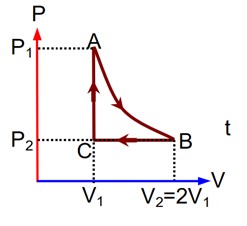
n mole of perfect gas undergoes a cyclic process ABCA (see figure) consisting of the following processes.
A->B : Isothermal expansion at temperature T so that the volume is doubled from V1 to V2 and Pressure changes from P1 to P2.
B->C : Isobaric compression at pressure P2 to initial volume V1.
C->A : Isobaric change leading to change of pressure from P2 to P1.
Total work done in the complete cycle ABCA is:
[At B, 2P2 V1 = nRT]
[CA is isochoric process].
Upvote 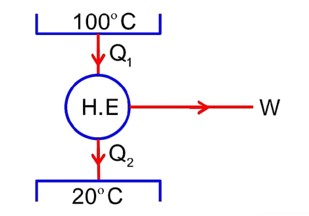
An ideal gas undergoes a thermodynamic process in which internal energy (U) of the gas depends on pressure (P) of the gas as U = aP4, where a is a positive constant. Assuming gas to be monoatomic, the molar heat capacity of the gas for given process will be
An ideal gas undergoes a thermodynamic process in which internal energy (U) of the gas depends on pressure (P) of the gas as U = aP4, where a is a positive constant. Assuming gas to be monoatomic, the molar heat capacity of the gas for given process will be
U = aP?
PV/ (γ-1) = aP?
P? ³V = a (γ - 1)
PV? ¹? ³ = constant
Comparing with PV? = constant
x = -?
C = R/ (γ-1) + R/ (1-x) = R/ (5/3 - 1) + R/ (1 +? ) = 3R/2 + 3R/4
C = 9R/4
Upvote A cup of coffee cools from 90°C to 80°C in t minutes, when the room temperature is 20°C.
The time taken by a similar cup of coffee to cool from 80°C to 60°C at a room temperature same at 20°C is:
A cup of coffee cools from 90°C to 80°C in t minutes, when the room temperature is 20°C.
The time taken by a similar cup of coffee to cool from 80°C to 60°C at a room temperature same at 20°C is:
According to Newton's law of cooling
(T? -T? )/t = K [ (T? +T? )/2 - T? ]
For 1? cup of coffee,
(90-80)/t = K [ (90+80)/2 - 20]
For 2? cup of coffee,
(80-60)/t' = K [ (80+60)/2 - 20]
Divide (1) by (2)
t'/t = 65/50 ⇒ t' = (13/5)t
Upvote