Physics Thermodynamics
Get insights from 156 questions on Physics Thermodynamics, answered by students, alumni, and experts. You may also ask and answer any question you like about Physics Thermodynamics
- 156
Questions
- 0
Discussions
- 0
Active Users
- 1
Followers
Have a question about Physics Thermodynamics? Ask our experts
Keep it short & simple. Type complete word. Avoid abusive language.
A certain amount of gas is taken through a cyclic process (ABCDA) that has Two isobars, one isochore and one isothermal. The cycle can be represented on a P?V indicator diagram as :

A certain amount of gas is taken through a cyclic process (ABCDA) that has Two isobars, one isochore and one isothermal. The cycle can be represented on a P?V indicator diagram as :
P? V indicator diagram for isobaric

P? V indicator diagram for isochoric process

P? V indicator diagram for isothermal process

 Upvote

The temperature of equals masses of three different liquids x, y and z are 10°C, 20°C and 30°C respectively. The temperature of mixture when x is mixed with y is 16°C and that when y is mixed with z is 26°C. Temperature of mixture when x and z are mixed will be:
The temperature of equals masses of three different liquids x, y and z are 10°C, 20°C and 30°C respectively. The temperature of mixture when x is mixed with y is 16°C and that when y is mixed with z is 26°C. Temperature of mixture when x and z are mixed will be:

A hot body is being cooled in air according to Newton's law of cooling, the rate of fall of temperature being K times the difference of its temperature with respect to that of surroundings. The time after which the rate of heat loss of the body will be half of the maximum rate of heat loss is (The time is to be counted from the instant t = 0 ). The value of n is
A hot body is being cooled in air according to Newton's law of cooling, the rate of fall of temperature being K times the difference of its temperature with respect to that of surroundings. The time after which the rate of heat loss of the body will be half of the maximum rate of heat loss is (The time is to be counted from the instant t = 0 ). The value of n is
12gm of gas occupy a volume of 4 × 10⁻³ m3 at a temperature of 7°C. After the gas is heated at constant pressure its density becomes 6 × 10⁻⁴gm/cm3. What is the temperature to which the gas was heated (in kelvin)?
12gm of gas occupy a volume of 4 × 10⁻³ m3 at a temperature of 7°C. After the gas is heated at constant pressure its density becomes 6 × 10⁻⁴gm/cm3. What is the temperature to which the gas was heated (in kelvin)?
P = (RT/M? )ρ ⇒ P/ρT = constant
⇒ (12)/ (4 × 10? ³ × 10? ) × 280 = 6 × 10? × T ⇒ T = 1400K
Upvote The molar specific heat Cv of a diatomic gas is (5/2)R when we treat its molecules to be rigid having no vibrations. But this assumption is not always valid especially at high temperatures. In that case, molecules are treated as non-rigid having vibrational energy also. Cv for diatomic gas with non-rigid gas molecules will be:
<!-- [if !supportLineBreakNewLine]-->
<!--[endif]-->
The molar specific heat Cv of a diatomic gas is (5/2)R when we treat its molecules to be rigid having no vibrations. But this assumption is not always valid especially at high temperatures. In that case, molecules are treated as non-rigid having vibrational energy also. Cv for diatomic gas with non-rigid gas molecules will be:
<!-- [if !supportLineBreakNewLine]-->
<!--[endif]-->
Vibrational energy of a non-rigid gas molecule is K? T so, total energy = (5/2)K? T + K? T = (7/2)K? T
∴ C? = (7/2)R
Upvote Steam at is passed into a calorimeter of water equivalent 10 gm containing 74gm of water and 10gm of ice at <!-- [if gte msEquation 12]>
<!--[endif]-->
Steam at is passed into a calorimeter of water equivalent 10 gm containing 74gm of water and 10gm of ice at <!-- [if gte msEquation 12]>
<!--[endif]-->
Three samples of the same gas A,B and have initially equal volume. Now the volume of each sample is doubled. The process is adiabatic for A, isobaric for B and isothermal for C<!-- [if gte msEquation 12]>
<!-- [if !supportLineBreakNewLine]-->
<!--[endif]-->
Three samples of the same gas A,B and have initially equal volume. Now the volume of each sample is doubled. The process is adiabatic for A, isobaric for B and isothermal for C<!-- [if gte msEquation 12]>
<!-- [if !supportLineBreakNewLine]-->
<!--[endif]-->
For gas initial
For gas B: initial
For gas initial Ratio
Upvote The temperature-entropy diagram of a reversible engine cycle is given in the figure. Its efficiency is:
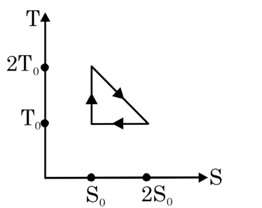
The temperature-entropy diagram of a reversible engine cycle is given in the figure. Its efficiency is: