
Physics Thermodynamics
Get insights from 156 questions on Physics Thermodynamics, answered by students, alumni, and experts. You may also ask and answer any question you like about Physics Thermodynamics
- 156
Questions
- 0
Discussions
- 0
Active Users
- 1
Followers
Have a question about Physics Thermodynamics? Ask our experts
Keep it short & simple. Type complete word. Avoid abusive language.
1 mole of rigid diatomic gas performs a work of <!-- [if gte mso 9]><xml>
[R = universal gas constant]
1 mole of rigid diatomic gas performs a work of <!-- [if gte mso 9]><xml>
[R = universal gas constant]
The volume V of a given mass of monoatomic gas changes with temperature T according to the relation <!-- [if gte mso 9]><xml>
[R = universal gas constant]
The volume V of a given mass of monoatomic gas changes with temperature T according to the relation <!-- [if gte mso 9]><xml>
[R = universal gas constant]
->
Work done =
->n = 60
 Upvote

The internal energy (U), pressure (P) and volume (V) of an ideal gas are related as U = 3PV + 4. The gas is:
The internal energy (U), pressure (P) and volume (V) of an ideal gas are related as U = 3PV + 4. The gas is:
A diatomic gas, having CP is heated at constant pressure. The ratio dU : dQ : dW :
A diatomic gas, having CP is heated at constant pressure. The ratio dU : dQ : dW :
At constant pressure,
dW = nRdT
dU : dQ : dW = 5 : 7 : 2
Upvote A thermally insulated vessel contains an ideal gas of molecular mass M and ratio of specific heats 1.4. Vessel is moving with speed <!-- [if gte vml 1]>
(R = universal gas constant)
A thermally insulated vessel contains an ideal gas of molecular mass M and ratio of specific heats 1.4. Vessel is moving with speed <!-- [if gte vml 1]>
(R = universal gas constant)
The efficiency of a Carnot’s engine, working between stem point and ice point, will be:
The efficiency of a Carnot’s engine, working between stem point and ice point, will be:
Steam point (T1) = 100°C = 273 + 100 = 373 K
Ice point (T2) = 0°C = 273 K
Upvote Given below are two statements:
Statement – I : When moment of an ideal gas undergoes adiabatic change from state to state then work done is w = where R = universal gas constant.
Statement – II : In the above case, when work done on the gas, the temperature of the gas would rise.
Choose the correct answer from the options given below:
Given below are two statements:
Statement – I : When moment of an ideal gas undergoes adiabatic change from state to state then work done is w = where R = universal gas constant.
Statement – II : In the above case, when work done on the gas, the temperature of the gas would rise.
Choose the correct answer from the options given below:
In case of adiabatic process -
for adiabatic process :-
So, when work is done by the gas, temperature decreases and when work is done on the gas, temperature rises.
Upvote Starting with the same initial conditions, an ideal gas expands form volume V1 to V2 in the three different ways. The work done by the gas in W1 if the process is purely isothermal, W2, if the process is purely adiabatic and W3 if the process is purely isobaric. Then, choose the correct option
Starting with the same initial conditions, an ideal gas expands form volume V1 to V2 in the three different ways. The work done by the gas in W1 if the process is purely isothermal, W2, if the process is purely adiabatic and W3 if the process is purely isobaric. Then, choose the correct option
Process-AB Isobaric, &n
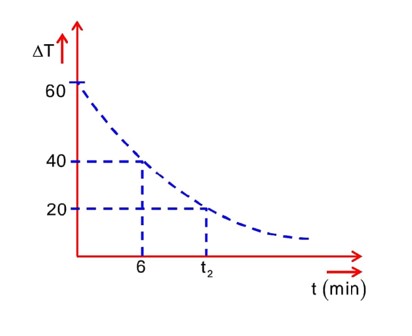
Upvote In an experiment to verigy Newton’s law of cooling, a graph is plotted between, the temperature difference of the water and surrounding and time as shown in figure. The initial temperature of water is taken as The value of t2 as mentioned in the graph will be _______.
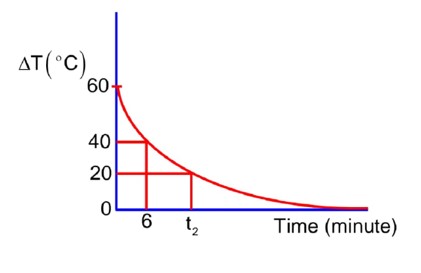
In an experiment to verigy Newton’s law of cooling, a graph is plotted between, the temperature difference of the water and surrounding and time as shown in figure. The initial temperature of water is taken as The value of t2 as mentioned in the graph will be _______.
- (1)
Now
t = 10.257
t2 = 6 + 10.257 = 16.257 minutes
16.25 and or 16
Upvote