
Quantitative Aptitude Prep Tips for MBA
Get insights from 224 questions on Quantitative Aptitude Prep Tips for MBA, answered by students, alumni, and experts. You may also ask and answer any question you like about Quantitative Aptitude Prep Tips for MBA
- 224
Questions
- 0
Discussions
- 0
Active Users
- 9
Followers
Have a question about Quantitative Aptitude Prep Tips for MBA? Ask our experts
Keep it short & simple. Type complete word. Avoid abusive language.
A, B, and C alone can complete a work in 150, 100 and 60 days respectively. In how many days A, B and C together can complete the same work?
A, B, and C alone can complete a work in 150, 100 and 60 days respectively. In how many days A, B and C together can complete the same work?
Let the total work is 300 units (LCM of 150,100 and 60)
A's per day work = 2 units
B's per day work = 3 units
C's per day work = 5 units
(A+ B + C)'s per day work = 2 + 3 + 5 = 10 units
Time taken = 300/10 = 30 Days
 Upvote

Let the sum of three real roots of the equation 2333x – 2 + 2111x + 2 = 2222x + 1 + 1 be m/n, where m and n are relatively prime positive integer. Find m + n.
Let the sum of three real roots of the equation 2333x – 2 + 2111x + 2 = 2222x + 1 + 1 be m/n, where m and n are relatively prime positive integer. Find m + n.
Let y = 2111x then,
y3 – 8y2 +16y – 4 = 0
Let three real roots be a, b and c then abc = and corresponding values of x be x1, x2, and x3\
111 (x1 + x2 + x3) = 2
x1 + x2 + x3 = 2/111
m + n = 2 + 111 = 113
Upvote Let p and q be the roots of the equation x2 – 4ax + 3 = 0. If are the roots of the equation x2 – 2bx + c = 0 then what is the value of ‘c’?
Let p and q be the roots of the equation x2 – 4ax + 3 = 0. If are the roots of the equation x2 – 2bx + c = 0 then what is the value of ‘c’?
p and q are the roots of the equation x2 – 4ax + 3 = 0
pq = 3
Similarly the constant term of x2 – 2bx + c = 0
Product of
Hence, c =
Upvote If f(x) = , for all x > 0, then what is the greatest value of f(x)?
If f(x) = , for all x > 0, then what is the greatest value of f(x)?
f (x) = ………. (1)
Divide by x in numerator and denominator equation (1) can be written as f (x) =
f (x) is maximum, when the denominator is minimum we have to find the minimum value of , so, denomination will also minimum
we know that, AM ≥ GM
The minimum value of i
Upvote Aman, Baman and Daman bought 1, 10 and 25 notebooks in Rs. 14, Rs.130 and Rs. 330 respectively from a stationery shop. In his sales with Aman and Daman, the shopkeeper made a profit of x percent and y percent respectively, where x = 2y. If the shopkeeper bought all the notebooks at the same price, then how much profit percentage did the shopkeeper make in his sales with Baman?
Aman, Baman and Daman bought 1, 10 and 25 notebooks in Rs. 14, Rs.130 and Rs. 330 respectively from a stationery shop. In his sales with Aman and Daman, the shopkeeper made a profit of x percent and y percent respectively, where x = 2y. If the shopkeeper bought all the notebooks at the same price, then how much profit percentage did the shopkeeper make in his sales with Baman?
| Aman | Baman | Daman |
Number of notebook | 1 | 10 | 25 |
Amount | 14 | 130 | 300 |
Profit% | a percent |
| b percent |
For Aman,
SP of 1 book = 14Rs.
CP of 1 book =
For Baman,
SP of 1 book = 12Rs.
CP of 1 book =
Price of all notebooks is same, therefore.
=
100 + 7y = 6a
100 = 12y – 7y; [x=2y]
5y = 100
y = 20
a = 40
CP each notebook = = 10Rs.
In his sales with Daman, he sold 10 books to her for R
Upvote In how many way can 7 identical balls be placed in 4 boxes, A, B, C and D such that boxes C and D have at least one ball each?
In how many way can 7 identical balls be placed in 4 boxes, A, B, C and D such that boxes C and D have at least one ball each?
a + b + c + d = 7
a ³ 0, b³ 0, c ³ 1, d ³ 1
(a, b, c, d are the numbers of balls)
Let c = c' + 1 = 0, 0 ≤ c' ≤ 5
d = d' + 1 = 0, 0 ≤ d' ≤ 5
a + b + c' + d' = 5
Numbers of solution = 5 + 4 – 1C4–1
= 8C3 = 56
Upvote f(x) is a quadratic polynomial with maximum value of 3 at x = 2. If f (0) = 2. Find f (6)
f(x) is a quadratic polynomial with maximum value of 3 at x = 2. If f (0) = 2. Find f (6)
Let f (x) = ax2 + bx + c
f (0)= 2
2 = a (0)2 + b (0) + c
c = 2
f (– 2) = 3
a (–2)2 +b (–2) + 2 = 3
4a – 2b = 1 ………. (1)
The given equation has a maximum value at x = –2
b = 4a
put in equati
Upvote ABCD is a square, having side 12cm, in which ABC and ABD are two quadrant of a circle. If a circle is drawn touching both the quadrants and the square as shown in figure as show in figure given below, then find the area of circle.
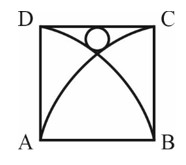
ABCD is a square, having side 12cm, in which ABC and ABD are two quadrant of a circle. If a circle is drawn touching both the quadrants and the square as shown in figure as show in figure given below, then find the area of circle.
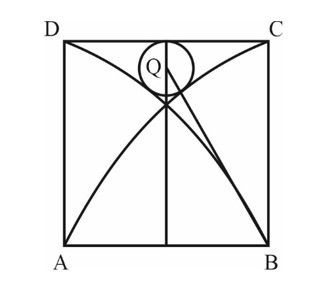
Let the radius of circle be ‘r’
In D QPB
OP = 12 – r
PB = 6
QB = 12 + r
(12+r)2 = (12–r)2 + 62
r = ¾
Area of circle = pr2
= 22/7 × 3/4 × 3/4
=
Upvote If P1 + P2 + P3 = 59, where P1, P2 and P3 are prime numbers and P1 < P2 < P3, then how many values can P3 take?
If P1 + P2 + P3 = 59, where P1, P2 and P3 are prime numbers and P1 < P2 < P3, then how many values can P3 take?
P1 + P2 + P3 = 59
P1 and P2 → minimize
Then P3 → minimum i.e. 47
P1 | P2 | P3 |
5 | 7 | 47 |
5 | 11 | 43 |
3 | 13 | 43 |
5 | 13 | 41 |
5 | 17 | 37 |
3 | 19 | 37 |
5 | 23 | 31 |
7 | 23 | 29 |
So, only possible value of P3 can take → 29, 31, 37, 41, 43, and 47
Total 6 values
Upvote How many pairs of positive integers x, y satisfy , where y is a two digit odd integer?
How many pairs of positive integers x, y satisfy , where y is a two digit odd integer?
______equation 1
i.e. y = 90+y,
1≤ y1 ≤9
y1 is odd
Equation 1 becomes
y1 can take 1,3,5,9
y=91, 93, 95, 99
Upvote