
Quantitative Aptitude Prep Tips for MBA
Get insights from 224 questions on Quantitative Aptitude Prep Tips for MBA, answered by students, alumni, and experts. You may also ask and answer any question you like about Quantitative Aptitude Prep Tips for MBA
- 224
Questions
- 0
Discussions
- 0
Active Users
- 9
Followers
Have a question about Quantitative Aptitude Prep Tips for MBA? Ask our experts
Keep it short & simple. Type complete word. Avoid abusive language.
Divide Rs. 12540 among A, B and C so that A may receive 3/7 of as much as B and C together and B may receive 2/9 of as much as A and C together. What is C’s share?
Divide Rs. 12540 among A, B and C so that A may receive 3/7 of as much as B and C together and B may receive 2/9 of as much as A and C together. What is C’s share?
(c): A + B + C = 12540 .… (1)
So, A’s Share =
So, B’s Share =
 Upvote

A square is cut from a piece of cardboard in the shape of a right triangle, with two perpendicular sides 16 cm and 24 cm. Find the side of the largest possible square the can be cut.
A square is cut from a piece of cardboard in the shape of a right triangle, with two perpendicular sides 16 cm and 24 cm. Find the side of the largest possible square the can be cut.
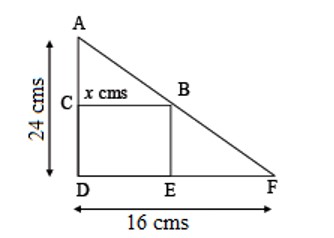
ABC and BFE are similar triangles, AC = 24? x cm
EF = 16? x cm
x2 = (16? x) (24? x) = x = 9.6 cm
Upvote Twenty five litres of a 40% wine solution is mixed with 30 litres of a 20% wine solution. What is the % of wine--e in the resultant mixture?
Twenty five litres of a 40% wine solution is mixed with 30 litres of a 20% wine solution. What is the % of wine--e in the resultant mixture?
(c):Let x be the percentage of water in the resultant mixture.
Using the alligation rule, we have
6 (x – 20) = 5 (40 – x)
6x – 120 = 200 – 5x
11x = 320
x =
Upvote Train Vande bharat Express leaves from New Delhi at 7 a.m. and reaches Bhopal at 1 p.m. Train Duronto Express leaves from Bhopal at 7 a.m. and reaches New Delhi at 11 a.m. At what time will they cross each other?
Train Vande bharat Express leaves from New Delhi at 7 a.m. and reaches Bhopal at 1 p.m. Train Duronto Express leaves from Bhopal at 7 a.m. and reaches New Delhi at 11 a.m. At what time will they cross each other?
(b):Vande Bharat takes 6 hours from New Delhi to Bhopal. Duronto takes 4 hours from Bhopal to New Delhi. Let the distance between Delhi and Bhopal be ‘d’ kms.
Speed of Vande Bharat =
Speed of Duronto =
They will meet after =
= 2 hours & 24 minutes
Hence, required time = (7 + 2.24)
= 9 : 24 a.m.
Upvote If all the factor of N = 72 × 122 × 152 are written in ascending order, then which factor will occupy 113rd position?
If all the factor of N = 72 × 122 × 152 are written in ascending order, then which factor will occupy 113rd position?
Factorised from = 24 × 34 × 52 × 72
Total no. of factor = 5× 5 × 3 × 5
= 225 factors
113rd factor =
i.e. 7 × 5 × 32 × 22 = 1260
Upvote A class prepared 180 candles. They spent Rs. 150 on wax and Rs. 8.50 on thread. The expenditure on coloured paper was Rs. 12.5. They spent Rs. 9.00 on silver powder. They earned 40% profit. If they sold half the candles at 50% profit, at what profit % did they sell the other half?
A class prepared 180 candles. They spent Rs. 150 on wax and Rs. 8.50 on thread. The expenditure on coloured paper was Rs. 12.5. They spent Rs. 9.00 on silver powder. They earned 40% profit. If they sold half the candles at 50% profit, at what profit % did they sell the other half?
150/- wax; 8.5/- thread; 12.5/- coloured paper; 9/- silver powder
Profit = 40%.
Net input = 150 + 8.5 + 12.5 + 9 = 180/-
Net profit = 180 * .4 = 72/-
the candles = (180) = 90/-
At 50% profit = 45.
90 + 45 = 135/-
Let the remaining = x
Net price = (72 + 180) = 135 + x
x = 117
Pro
Upvote Compound interest on a sum of money for 2 years at 5% is Rs. 369. Find the sum.
Compound interest on a sum of money for 2 years at 5% is Rs. 369. Find the sum.
A fruit seller bought some oranges for 5 per rupee and an equal number for 6 per rupee. He mixed them and sold for 7 per rupee. If total loss is Rs. 34 find number of oranges bought.
A fruit seller bought some oranges for 5 per rupee and an equal number for 6 per rupee. He mixed them and sold for 7 per rupee. If total loss is Rs. 34 find number of oranges bought.
= CP (x oranges of each type) = and SP =
On selling 2x oranges, loss =
If loss is 34, Total oranges =
Upvote A sum of money placed at compound interest doubles itself in 4 years. It will amount to eight times in how many years?
A sum of money placed at compound interest doubles itself in 4 years. It will amount to eight times in how many years?
(c):Double in 4 years, four times in 8 years, eight times in 12 years.
Upvote A number when divided by 5 and 3 leaves remainders of 3 and 1, respectively. Find the smallest such 3 digit number.
A number when divided by 5 and 3 leaves remainders of 3 and 1, respectively. Find the smallest such 3 digit number.
(b):Notice that the difference between the divisors and the remainder is constant. Therefore take the LCM of the divisors or any multiple of the LCM and subtract.
The difference between the divisor and the remainder
which is 2 in this case.
Therefore, the smallest 3 digit number
= 15 * 7? 2 = 105 – 2
Upvote