
Quantitative Aptitude Prep Tips for MBA
Get insights from 224 questions on Quantitative Aptitude Prep Tips for MBA, answered by students, alumni, and experts. You may also ask and answer any question you like about Quantitative Aptitude Prep Tips for MBA
- 224
Questions
- 0
Discussions
- 0
Active Users
- 9
Followers
Have a question about Quantitative Aptitude Prep Tips for MBA? Ask our experts
Keep it short & simple. Type complete word. Avoid abusive language.
Answer the questions based on the following information.
Mr. John has 5 girls and 9 boys. He decides to give them a present on the occasion of Christmas. He takes 200 one-rupee coins and puts them in 2 bags which he closes. One of the bags contains more coins than the other. He asks his boys to choose one of the bags. They chose the bag with more money. When money is divided equally among boys they are left with Rs. 3. When money is divided equally among girls (not necessarily the same amount as given to boys), Rs. 4 was left. No girl gets less than a boy.
The difference between the final share of a girl and a boy was
9B + 3 + 5G + 4 = 200 9B + 5G = 193
The positive integer solutions are (B, G) = (2, 35) (7, 25) (12, 17) (17, 8)
Only one of the (B, G) gives G > B and 9B + 3 > 100, i.e. (B, G) = (12, 17)
17 – 12 = 5
 Upvote

The average score of 20 candidates in an exam is 25 marks. It decreases by 2 marks when the score of the topper is excluded. What are the marks obtained by the topper?
The average score of 20 candidates in an exam is 25 marks. It decreases by 2 marks when the score of the topper is excluded. What are the marks obtained by the topper?
(c) :As per the problem:
Average score of 20 candidate = 25 marks
Total score of 20 candidate = 500 marks
Let the score of the topper be x. Then,
500 – x = 437
x = 500 – 437 = 63 marks
Upvote Answer the questions based on the following information.
Mr. John has 5 girls and 9 boys. He decides to give them a present on the occasion of Christmas. He takes 200 one-rupee coins and puts them in 2 bags which he closes. One of the bags contains more coins than the other. He asks his boys to choose one of the bags. They chose the bag with more money. When money is divided equally among boys they are left with Rs. 3. When money is divided equally among girls (not necessarily the same amount as given to boys), Rs. 4 was left. No girl gets less than a boy.
How many coins more did the bag, which the boys got, contain than the other?
Answer the questions based on the following information.
Mr. John has 5 girls and 9 boys. He decides to give them a present on the occasion of Christmas. He takes 200 one-rupee coins and puts them in 2 bags which he closes. One of the bags contains more coins than the other. He asks his boys to choose one of the bags. They chose the bag with more money. When money is divided equally among boys they are left with Rs. 3. When money is divided equally among girls (not necessarily the same amount as given to boys), Rs. 4 was left. No girl gets less than a boy.
How many coins more did the bag, which the boys got, contain than the other?
9B + 3 + 5G + 4 = 200 9B + 5G = 193
The positive integer solutions are (B, G) = (2, 35) (7, 25) (12, 17) (17, 8)
Only one of the (B, G) gives G > B and 9B + 3 > 100, i.e. (B, G) = (12, 17)
12 * 9 – 17 * 5 = 23
Upvote Let f defined as f (3n) = n + f (3n – 3), where n is a positive integer greater than 1. If f (3n) = 1 when n=1, then find last digit of f (312)
Let f defined as f (3n) = n + f (3n – 3), where n is a positive integer greater than 1. If f (3n) = 1 when n=1, then find last digit of f (312)
f (3n) – f (3n– 3) = n
n = 1
f (3) – f (0) = 1
f (0) = 0
n = 2
f (3n) – f (3) = 2 + 3 + 4+…………….+ n
f (3n) = 1 + 2 + 3 +…………….+ n
=
f (1312) – f (3 × 311)
Hence, remainder = 8
Upvote Let 1 – log10105 = 1/3(log10101/2 + log1010x + 1/3log10105) Where x = 2m/5n, then what is the value of m + 3n?
Let 1 – log10105 = 1/3(log10101/2 + log1010x + 1/3log10105) Where x = 2m/5n, then what is the value of m + 3n?
3 [log101010 – log10105] =
log101023 =
23 =
x =
Hence, m + 3n = = 5
Upvote A man borrows Rs.1.2 lakh from a bank at certain rate of simple interest at the beginning of year. After 4 months, he borrows Rs. 1.8 lakh more at double rate of interest. At the end of year, the total interest accrued on both the loans is Rs. 54000. What is the initial rate of interest per annum?
A man borrows Rs.1.2 lakh from a bank at certain rate of simple interest at the beginning of year. After 4 months, he borrows Rs. 1.8 lakh more at double rate of interest. At the end of year, the total interest accrued on both the loans is Rs. 54000. What is the initial rate of interest per annum?
Let the interest rate be r percent interest earned from 1.2 Lacs at the end of year
= 1,200,000 * r /100
= 1200r
From 1.8 lakh, = 8/12 * 1, 80,000 * 2r/100
= 2400r
Total interest = 3600r = 54000
r = 15 percent
Upvote A natural number N < 1000 when divided by 3, 5 and 6 successively leaves remainder 1, 3 and 2. Find the possible numbers of valves N can take.
A natural number N < 1000 when divided by 3, 5 and 6 successively leaves remainder 1, 3 and 2. Find the possible numbers of valves N can take.
Let the quotient obtained when the numbers is divided by 3, 5 and 6 be x1, x2 and x3
Respectively
N = 3 x1 + 1
x1 = 5 x2 + 3
x2 = 6 x3 + 2
N = 3 [5 (6 x3 + 2) + 3] + 1
=90 x3 + 40 < 1000
x3 can take 11 values
Upvote Let b > c > a be positive real number. What is the minimum integral value of
Let b > c > a be positive real number. What is the minimum integral value of
Assuming that
b – c = p b = c + p
c – a = q c = a + q
Hence b = c + p
= a + q + p
can be written as a + q + p +
Apply AM GM in equally concept in above equation
Hence, minimum value is 4
Upvote The cost of 3 apples, 5 bananas and 3 oranges is Rs. 85, while 5 oranges, 4 apples and 4 bananas is Rs. 87. What is the cost of 5 apple, 7 oranges and 3 bananas?
The cost of 3 apples, 5 bananas and 3 oranges is Rs. 85, while 5 oranges, 4 apples and 4 bananas is Rs. 87. What is the cost of 5 apple, 7 oranges and 3 bananas?
Let the price of 1 apple, 1 banana and 1 orange is a, b and c respectively.
3a + 5b + 3c = 85 equation 1
4a + 4b + 5c = 87 equation 2
5a + 3b + 7c =?
Multiply equation 1 and 2 by m and n respectively and adding will given the required equation
3m+5n =
Upvote Akbar sets off on his car from Delhi to Jaipur at a certain speed intending to reach Jaipur by 5pm. After covering a certain distance, he realises that he would be able to cover only five – eighth of the intended distance by 5pm. He therefore increases his speed by 75 percent and reaches Jaipur at 5pm. What fraction of the total distance did he cover at his initial speed?
Akbar sets off on his car from Delhi to Jaipur at a certain speed intending to reach Jaipur by 5pm. After covering a certain distance, he realises that he would be able to cover only five – eighth of the intended distance by 5pm. He therefore increases his speed by 75 percent and reaches Jaipur at 5pm. What fraction of the total distance did he cover at his initial speed?
Let the distance between Delhi (D) and Jaipur (J) be 8x and Akbar’s initial speed be 4a and final speed be 7a.
Let the point where he increased his speed at P and let Q be the point on DJ such that
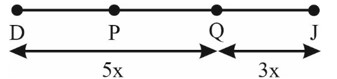
Let PQ = 4y,
PJ = 7y
QJ = 7y – 4y = 3x
3y = 3x
y= x
PQ = 4x and PJ =7x
Required ratio =
= &nb
Upvote