
Quantitative Aptitude Prep Tips for MBA
Get insights from 224 questions on Quantitative Aptitude Prep Tips for MBA, answered by students, alumni, and experts. You may also ask and answer any question you like about Quantitative Aptitude Prep Tips for MBA
- 224
Questions
- 0
Discussions
- 0
Active Users
- 9
Followers
Have a question about Quantitative Aptitude Prep Tips for MBA? Ask our experts
Keep it short & simple. Type complete word. Avoid abusive language.
In f (a) = a2 – 2ax + y can be factorised as (a – x) (a – y) then find the value of f (4) where x and y are positive real numbers.
In f (a) = a2 – 2ax + y can be factorised as (a – x) (a – y) then find the value of f (4) where x and y are positive real numbers.
f (a) = a2 – 2ax + y
f (x) = x2 – 2x2 + y = 0
– x2 + y =0
y = x2 ………. (1)
f (y) = y2 – 2xy + y = 0
y2 – 2xy + x2 = 0
(y – x)2 = 0
y – x = 0
y =
 Upvote

A vistara airline has a free luggage allowance up to a certain kg and if there is extra luggage, it charged at constant rate per kg. The total luggage charge paid by M and S is Rs. 1050. If both M and S has carried twice the luggage they actually did then charge would be Rs. 2400 and Rs. 900 respectively. Find the luggage charge paid by M (in Rs.).
A vistara airline has a free luggage allowance up to a certain kg and if there is extra luggage, it charged at constant rate per kg. The total luggage charge paid by M and S is Rs. 1050. If both M and S has carried twice the luggage they actually did then charge would be Rs. 2400 and Rs. 900 respectively. Find the luggage charge paid by M (in Rs.).
Let the airline has a free luggage allowance →’f’ kg
Luggage by M →m kg
Luggage by S →s kg
Rate charger beyond f kg →’e’/kg
Extra luggage of m = (m – f) kg
Extra luggage of s = (s – f) kg
ATQ
e (2m – f) = 2400 ______equation 1
e (2s – f) = 900 ______equation 2
add 1 and 2
e (m + s –f ) = 1650
Also, e
Upvote Which of the following values of ‘x’ satisfy the inequality x(x – 6) > 2x – 12?
Which of the following values of ‘x’ satisfy the inequality x(x – 6) > 2x – 12?
x (x – 6) > 2x – 12
x2 – 6x > 2x – 12
x2 – 8x > 12x > 0
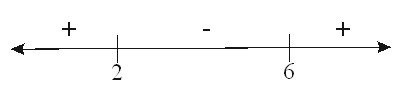
(x – 2) (x – 6) > 0
x < 2 or x >6
 Upvote
Given equation is
x2 – 25 <5
–5 < x2 – 25 < 5
20 < x2 < 30
< x <
Hence x = 5
x = 5
Upvote For all even numbers ‘n’ f(n) is the sum of the squares of all even natural numbers less than or equal to ‘n’ If for some ‘n’ f(n) = 51 × n, what is the value of n?
For all even numbers ‘n’ f(n) is the sum of the squares of all even natural numbers less than or equal to ‘n’ If for some ‘n’ f(n) = 51 × n, what is the value of n?
Sum of square of even natural number n = 22 + 42 + 62 + ……………. +n2
= 22 [12 + 22+ 32+ ……………+ (n/2)2]
(n+1) (n+2) = 51×6
n2 + 3n +2 = 306
(n–16) (n+19) = 0
n=16
Upvote A trader sells wheat at Rs. x/kg. A shopkeeper cons a trader into selling him 10 percent more wheat than what he is paying for. Later the shopkeeper uses faulty balance and gives a customer 10 percent less wheat what is paying for. If the shopkeeper also sells the wheat at Rs. x/kg what is the overall profit percentage of the shopkeeper in whole transactions?
A trader sells wheat at Rs. x/kg. A shopkeeper cons a trader into selling him 10 percent more wheat than what he is paying for. Later the shopkeeper uses faulty balance and gives a customer 10 percent less wheat what is paying for. If the shopkeeper also sells the wheat at Rs. x/kg what is the overall profit percentage of the shopkeeper in whole transactions?
CP of wheat be Rs.100/kg So, when shopkeeper pays for 1kg wheat, he get 1.1kg of wheat.
CP of shopkeeper is Rs.
While selling, he sells 10% less
So, 5p = Rs.
Profit percent =
=22.22percent
Upvote A train covers half the distance with a speed of 150km/hr. The remaining part of the distance was covered with a speed of 80 km/hr for half of the time and with the speed of 120km/hr for the other half of the time. For the whole journey, calculate the average distance (in km) covered by the train in one hour.
A train covers half the distance with a speed of 150km/hr. The remaining part of the distance was covered with a speed of 80 km/hr for half of the time and with the speed of 120km/hr for the other half of the time. For the whole journey, calculate the average distance (in km) covered by the train in one hour.
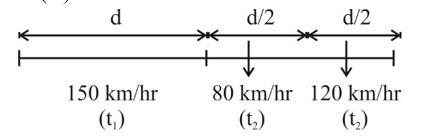
So, d= 150t1
t1 =
d = (80+120) t2
t2 =
Total time = t1 + 2t2
= +
=
Average speed = = 120km/hr.
Average distance covered in one hour is same as average speed.
Upvote Aman takes 40 hours to paint four walls and ceiling of a room of volume 2800 cubic feet. The ceiling height of the room is 28 feet. If Aman painted at a constant rate of 0.125sq. feet per minute, then how long it will take him to paint four walls.
Aman takes 40 hours to paint four walls and ceiling of a room of volume 2800 cubic feet. The ceiling height of the room is 28 feet. If Aman painted at a constant rate of 0.125sq. feet per minute, then how long it will take him to paint four walls.
Total volume = 2800 cubic feet
Area of ceiling = 2800/28 = 100sqfeet
Total time taken = = 800min
= 13hr 20min
Time taken to paint four walls= 40 – 13× = 26hr 40min
Upvote Let us find the pattern
104 – 21 = 9979
106 – 21 = 999979
108 – 21 = 99999979
. . .
. . .
. &
Upvote