
Some Basic Concepts of Chemistry
Get insights from 131 questions on Some Basic Concepts of Chemistry, answered by students, alumni, and experts. You may also ask and answer any question you like about Some Basic Concepts of Chemistry
- 131
Questions
- 0
Discussions
- 0
Active Users
- 0
Followers
Have a question about Some Basic Concepts of Chemistry? Ask our experts
Keep it short & simple. Type complete word. Avoid abusive language.
1.14. What is the S.I. unit of mass? How is it defined?
1.14. What is the S.I. unit of mass? How is it defined?
1.14. S.I. unit of mass is kilogram (kg).
It is defined as the mass of platinum-iridium block stored at international bureau of weights and measures in France.
 Upvote

1.13. Pressure is determined as force per unit area of the surface. The S.I. unit of pressure, pascal, is as shown below:
1 Pa = 1 Nm-2.
If mass of air at sea level is 1034 g cm-2, calculate the pressure in pascal.
1.13. Pressure is determined as force per unit area of the surface. The S.I. unit of pressure, pascal, is as shown below:
1 Pa = 1 Nm-2.
If mass of air at sea level is 1034 g cm-2, calculate the pressure in pascal.
1.13. Pressure= Force/Area
But weight = m x g, where m = mass (in kg) and g = 9.8 m/s2
Therefore, Pressure = 1034 g cm-2 x 9.8 m/s2
= 1034 x 10-3 kg x (100 m)2 x 9.8 m/s2
= 101332 Pa
= 1.01332 x 10⁵ Pa
Upvote 1.12. If the density of methanol is 0.793 kg L -1, what is its volume needed for making 2.5 L of its 0.25 M solution?
1.12. If the density of methanol is 0.793 kg L -1, what is its volume needed for making 2.5 L of its 0.25 M solution?
1.12. Density of methanol = 0.793 kg/L, molar mass of methanol (CH3OH) = 32g/mol = 0.032 kg/mol
V1 =? , V2 = 2.5 L, M2 = 0.25 M
We can apply the formula of
M1V1 = M2V2
Or V1 = M2V2/M1
Substituting M1 = density / molar mass, we get
M1 = 0.793/0.032 = 24.78
V1 = 0.25 x 2.5 / 24.78 = 0.02522 L = 25.22 mL
Upvote 1.11. What is the concentration of sugar (C12H22O11) in mol L -1 if its 20 g are dissolved in enough water to make a final volume up to 2 L?
1.11. What is the concentration of sugar (C12H22O11) in mol L -1 if its 20 g are dissolved in enough water to make a final volume up to 2 L?
1.11. Molar mass of sugar = (12 x 12) + (22 x 1) + (11 x 16) =342 g/mol
No. of moles in 352 g of sugar = 1 mol
No. of moles in 20 g = 20 x 1/352 = 0.0585 mol
Therefore, molar concentration = moles of solute / volume of solution in L = 0.0585 / 2 = 0.0293 mol/L
Upvote 1.10. In three moles of ethane (C2H6), calculate the following:
(i) Number of moles of carbon atoms
(ii) Number of moles of hydrogen atoms
(iii) Number of molecules of ethane
1.10. In three moles of ethane (C2H6), calculate the following:
(i) Number of moles of carbon atoms
(ii) Number of moles of hydrogen atoms
(iii) Number of molecules of ethane
1.10. (i) 1 mole of C2H6 contains 2 moles of carbon atoms
Therefore, no of moles of C atoms in 3 moles of C2H6 = 6 moles
(ii) 1 mole of C2H6 contains 6 moles of hydrogen atoms
Therefore, no of moles of H atoms in 3 moles of C2H6 =
Upvote 1.9. Calculate the atomic mass (average) of chlorine using the following data:
% Natural Abundance
Molar Mass
35Cl
75.77
34.9689
37Cl
24.23
36.9659
1.9. Calculate the atomic mass (average) of chlorine using the following data:
|
|
% Natural Abundance |
Molar Mass |
|
35Cl |
75.77 |
34.9689 |
|
37Cl |
24.23 |
36.9659 |
1.9. Average atomic mass = (Fractional abundance of 35Cl x molar mass of 35Cl) + (Fractional abundance of 37Cl x molar mass of 37Cl)
= (75.77/100 x 34.9689) + (24.23/100 x 36.9659)
= 26.4959 + 8.9568
= 35.4527
Upvote 1.8. Determine the molecular formula of an oxide of iron in which the mass percent of iron and oxygen are 69.9 and 30.1 respectively.
1.8. Determine the molecular formula of an oxide of iron in which the mass percent of iron and oxygen are 69.9 and 30.1 respectively.
1.8. Mass percentage of Fe = 69.9%
Mass percentage of O = 30.1%
 Upvote
1.7. How much copper can be obtained from 100 g of copper sulphate (CuSO4)? (Atomic mass of Cu= 63.5 amu).
1.7. How much copper can be obtained from 100 g of copper sulphate (CuSO4)? (Atomic mass of Cu= 63.5 amu).
1.7. 1 mole of CuSO4 contains 1 mole (1 g atom) of Cu
Molar mass of CuSO4= 63.5 + 32 + (4 x 16) = 159.5 g mol-1
Thus, Cu that can be obtained from 159.5 g of CuSO4 = 63.5 g
∴ Cu that can be obtained from 100 g of CuSO4 =63.5/159.5 * 100 = 39.81g
Upvote 1.6. Calculate the concentration of nitric acid in moles per litre in a sample which has a density 1.41 g mL-1 and the mass percent of nitric acid in it is being 69%.
1.6. Calculate the concentration of nitric acid in moles per litre in a sample which has a density 1.41 g mL-1 and the mass percent of nitric acid in it is being 69%.
1.6. A mass percent of 69% means that 100 g of nitric acid solution contains 69 g of nitric acid by mass.
Molar mass of nitric acid HNO3= 1 + 14 + (3x16) = 63 gmol-1
 Upvote
1.5. Calculate the mass of sodium acetate (CH3COONa) required to make 500 mL of 0.375 molar aqueous solution. Molar mass of sodium acetate is 82.0245 g mol-1.
1.5. Calculate the mass of sodium acetate (CH3COONa) required to make 500 mL of 0.375 molar aqueous solution. Molar mass of sodium acetate is 82.0245 g mol-1.
1.5
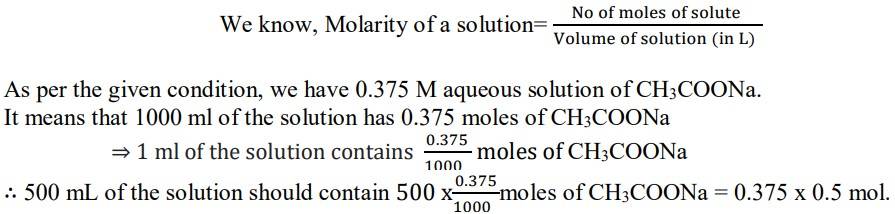
Since the molar mass of sodium acetate is 82.0245 g mol-1.
⇒ 1 mol of CH3COONa has a mass = 82.0245 g
∴Mass of sodium acetate (CH3COONa) required to make 500 ml of 0.375 molar aqueous solution
= 0.375 x 0.5 mol x 82.0245 g mol-1
= 15.3795 g = 15.380 g
Upvote