
The d and f Block Elements
Get insights from 101 questions on The d and f Block Elements, answered by students, alumni, and experts. You may also ask and answer any question you like about The d and f Block Elements
- 101
Questions
- 0
Discussions
- 0
Active Users
- 0
Followers
Have a question about The d and f Block Elements? Ask our experts
Keep it short & simple. Type complete word. Avoid abusive language.
66. Match the compounds/elements given in Column I with uses given in Column II
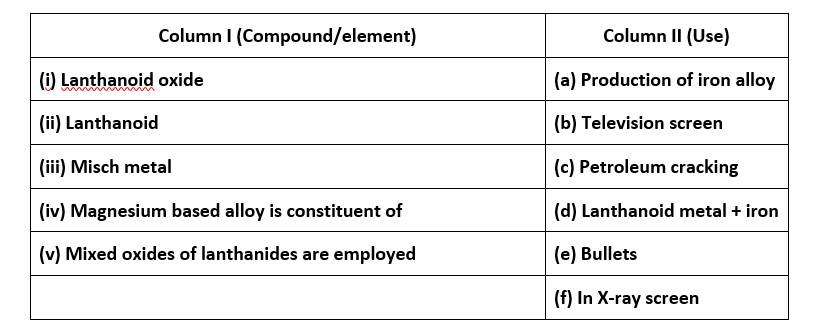
66. Match the compounds/elements given in Column I with uses given in Column II
66. (i) - (b); (ii)- (a); (iii)- (d); (iv)- (e); (v)- (c)
 Upvote

<p><strong>66. Match the compounds/elements given in Column I with uses given in Column II</strong></p>
65. Match the catalysts given in Column I with the processes given in Column II.
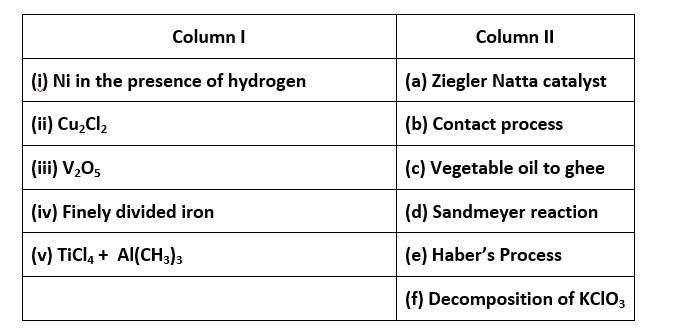
65. Match the catalysts given in Column I with the processes given in Column II.
65. (i) - (c); (ii)- (d); (iii)- (b); (iv)- (e); (v)- (a)
Upvote 64. Assertion (A): The highest oxidation state of osmium is +8.
Reason (R): Osmium is a 5d-block element.
64. Assertion (A): The highest oxidation state of osmium is +8.
Reason (R): Osmium is a 5d-block element.
64. Osmium has the capacity to expands its octet by utilising all the electrons from its 6s and 5d orbitals this results it to attain an oxidation state of +8.
Both the statements assertion and reason are correct but reason is not the correct explanation of assertion. The correct option is B.
Upvote 63. Assertion (A): Cu cannot liberate hydrogen from acids .
Reason (R): because it has positive electrode potential.
63. Assertion (A): Cu cannot liberate hydrogen from acids .
Reason (R): because it has positive electrode potential.
63. Cu lies below hydrogen in electrochemical series and has positive electrode potential. hence cannot liberate hydrogen from acids.
Both the statements assertion and reason are correct and reason is the correct explanation of assertion.
Upvote 62. Assertion (A): Actinoids form relatively less stable complexes as compared to lanthanoids.
Reason (R): Actinoids can utilize their 5d orbitals along with 6d orbitals in bonding but lanthanoids do not use their 4f orbital for bonding.
62. Assertion (A): Actinoids form relatively less stable complexes as compared to lanthanoids.
Reason (R): Actinoids can utilize their 5d orbitals along with 6d orbitals in bonding but lanthanoids do not use their 4f orbital for bonding.
62. Actinoids are more reactive than lanthanoids as they involve their 5d-orbital in the bond formation process while due to effectively shielded and greater nuclear charge 4f-orbitals are not available for bonding. Thus, lanthanoids comparatively form less complexes than actinoids.
Assert
Upvote 61 Assertion (A): Separation of Zr and Hf is difficult.
Reason (R): Because Zr and Hf lie in the same group of the periodic table.
61 Assertion (A): Separation of Zr and Hf is difficult.
Reason (R): Because Zr and Hf lie in the same group of the periodic table.
61. Although Zr and Hf lie in same group but As an effect of lanthanide contraction, zirconium and hafnium have similar radius of 160pm and 159 pm respectively. Due to this similarity in their size, they show similar physical and chemical properties. As a result, Zr and Hf are difficult to separate.
Upvote 60. Assertion (A): Cu2+ iodide is not known.
Reason (R): Cu2+ oxidises I to iodine.
60. Assertion (A): Cu2+ iodide is not known.
Reason (R): Cu2+ oxidises I to iodine.
60. All halogens combine with copper to form copper halides except iodine. The reason behind this is that Cu2+ oxidises iodide (-1) to iodine (0). Therefore, Cu2+ iodide does not exist .Both the statements assertion and reason are correct and reason is the correct explanation of ass
Upvote 59. Although +3 is the characteristic oxidation state for lanthanide but cerium also shows +4 oxidation state because
(A) It has variable ionization enthalpy
(B) It has a tendency to attain noble gas configuration
(C) It has a tendency to attain f? configuration
(D) It resembles Pb4+
59. Although +3 is the characteristic oxidation state for lanthanide but cerium also shows +4 oxidation state because
(A) It has variable ionization enthalpy
(B) It has a tendency to attain noble gas configuration
(C) It has a tendency to attain f? configuration
(D) It resembles Pb4+
59. (B) and (C)
Electronic configuration of cerium:
Ce - 4f1 5d1 6s2
Ce4+? 4f0 5d0 6s0
Lead has the tendency to lose its four outer electrons to attain Noble gas configuration and this removal of electrons corresponds to the f? configuration and cause it to be stable
Upvote 58. Which of the following will not act as oxidizing agents?
(A) CrO3
(B) MoO3
(C) WO3
(D) CrO42−
58. Which of the following will not act as oxidizing agents?
(A) CrO3
(B) MoO3
(C) WO3
(D) CrO42−
58. (B) and (C)
A compound act as oxidising agent when it's central atom is reduced to its lower oxidation state. This occurs only when the lower oxidation state of metal is more stable than the higher oxidation states.
In metal WO3 and CrO42- , both W and Cr are stable in their
Upvote