
The d and f Block Elements
Get insights from 101 questions on The d and f Block Elements, answered by students, alumni, and experts. You may also ask and answer any question you like about The d and f Block Elements
- 101
Questions
- 0
Discussions
- 0
Active Users
- 0
Followers
Have a question about The d and f Block Elements? Ask our experts
Keep it short & simple. Type complete word. Avoid abusive language.
The ‘f’ orbitals are half and completely filled, respectively in lanthanide ions
[Given: Atomic no. Eu, 63; Sm, 62; Tm, 69; Tb, 65; Yb, 70; Dy, 66]
The ‘f’ orbitals are half and completely filled, respectively in lanthanide ions
[Given: Atomic no. Eu, 63; Sm, 62; Tm, 69; Tb, 65; Yb, 70; Dy, 66]
Electronic configuration of the given ions is :
Hence, Eu2+ and Tb4+ have half | filled f-orbitals and Yb2+ have completely filled f-orbitals.
 Upvote

In 3d series, the metal having the highest M2+ / M standard electrode potential is
In 3d series, the metal having the highest M2+ / M standard electrode potential is
In 3d-series, all metals except Cu have negative value of
Upvote 71. Match the properties given in Column I with the medals given in Column II.
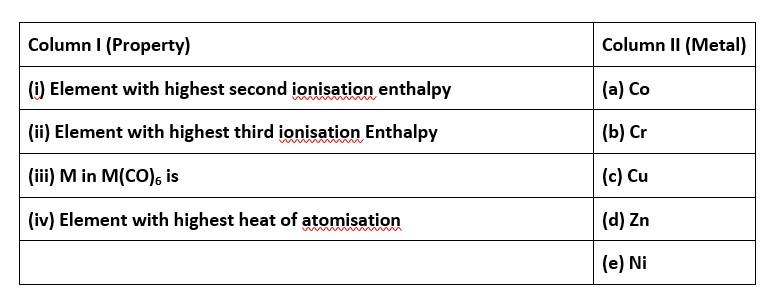
71. Match the properties given in Column I with the medals given in Column II.
71. (i) - (c); (ii)- (d); (iii)- (b); (iv)- (e)
Upvote <p><strong>71. Match the properties given in Column I with the medals given in Column II. </strong></p>
70. Match the property given in Column I with the element given in Column II.
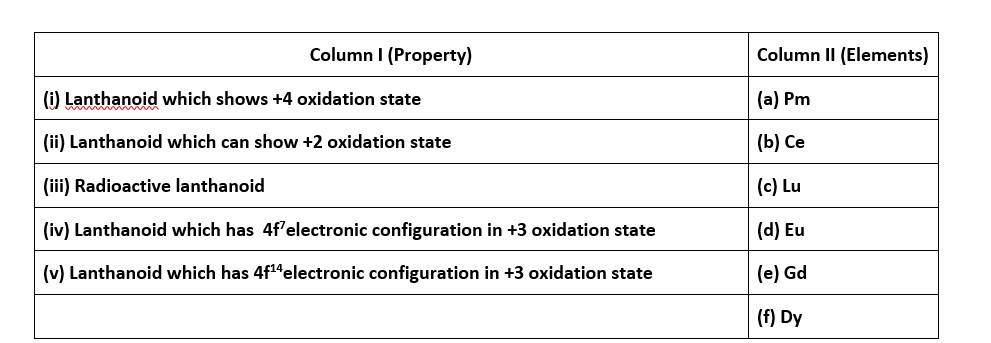
70. Match the property given in Column I with the element given in Column II.
70. (i) - (b); (ii)- (d); (iii)- (a); (iv)- (e); (v)- (c)
Upvote <p><strong>70. Match the property given in Column I with the element given in Column II.</strong></p>
<p><strong>70. Match the property given in Column I with the element given in Column II.</strong></p>
69. Match the solutions given in Column I and the colours given in Column II.
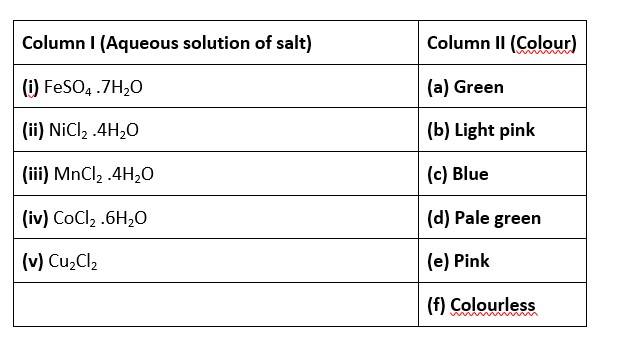
69. Match the solutions given in Column I and the colours given in Column II.
69. (i) - (d); (ii)- (a); (iii)- (b); (iv)- (e); (v)- (f)
Upvote 68. Match the statements given in Column I with the oxidation states given in Column II.
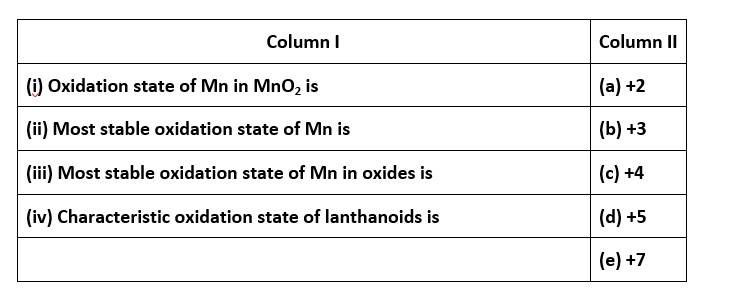
68. Match the statements given in Column I with the oxidation states given in Column II.
68. (i) - (c); (ii)- (a); (iii)- (e); (iv)- (b)
Upvote 67. Match the properties given in Column I with the metals given in Column II.
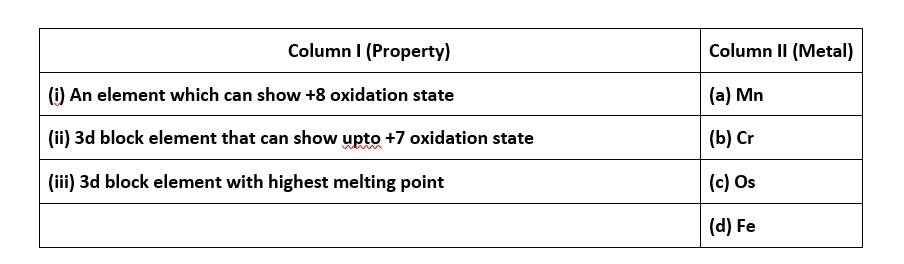
67. Match the properties given in Column I with the metals given in Column II.