
The d and f Block Elements
Get insights from 101 questions on The d and f Block Elements, answered by students, alumni, and experts. You may also ask and answer any question you like about The d and f Block Elements
- 101
Questions
- 0
Discussions
- 0
Active Users
- 0
Followers
Have a question about The d and f Block Elements? Ask our experts
Keep it short & simple. Type complete word. Avoid abusive language.
37. When KMnO4 solution is added to oxalic acid solution, the decolourisation is slow in the beginning but becomes instantaneous after some time because
(A) CO2 is formed as the product
(B) Reaction is exothermic
(C) MnO4 catalyses the reaction
(D) Mn2+ acts as auto catalyst
37. When KMnO4 solution is added to oxalic acid solution, the decolourisation is slow in the beginning but becomes instantaneous after some time because
(A) CO2 is formed as the product
(B) Reaction is exothermic
(C) MnO4 catalyses the reaction
(D) Mn2+ acts as auto catalyst
37. (D) Mn2+ acts as auto catalyst
Mn2+ formed in the reaction acts as an autocatalyst. Auto catalyst is a compound that is one of the products that are formed in the reaction itself catalyses the reaction.
Reaction: 2MnO4- + 16H+ + 5C2O42- → 2Mn2 +&n
 Upvote

36. Which of the following reactions are disproportionation reactions?
i. Cu+→ Cu2++ Cu
ii. 3MnO4− + 4H+→2MnO4− + MnO2 + 2H2O
iii. 2KMnO4→K2MnO4 + MnO2 + O2
iii. 2MnO4− + 3Mn2+ + 2H2O → 5MnO2 + 4H+
(A) i,ii
(B) i,ii,iii
(C) ii,iii,iv
(D) i,iv
36. Which of the following reactions are disproportionation reactions?
i. Cu+→ Cu2++ Cu
ii. 3MnO4− + 4H+→2MnO4− + MnO2 + 2H2O
iii. 2KMnO4→K2MnO4 + MnO2 + O2
iii. 2MnO4− + 3Mn2+ + 2H2O → 5MnO2 + 4H+
(A) i,ii
(B) i,ii,iii
(C) ii,iii,iv
(D) i,iv
36. (A)i, ii
Disproportionation/redox reaction is a reaction in which one compound is oxidised as well as reduced at the same time.
(A) Cu+ ? Cu2+ + Cu
( + 1) ( + 2) (0)
(B) 3MnO4-
Upvote 35. Which of the following oxidation states is common for all lanthanides?
(A) +2
(B) +3
(C) +4
(D) +5
35. Which of the following oxidation states is common for all lanthanides?
(A) +2
(B) +3
(C) +4
(D) +5
35. (B)+3
Out of all +3 is the most common oxidation state for all the lanthanide elements.
Upvote 34. The magnetic nature of elements depends on the presence of unpaired electrons. Identify the configuration of the transition element, which shows the highest magnetic moment.
(A) 3d7
(B) 3d5
(C) 3d8
(D) 3d2
34. The magnetic nature of elements depends on the presence of unpaired electrons. Identify the configuration of the transition element, which shows the highest magnetic moment.
(A) 3d7
(B) 3d5
(C) 3d8
(D) 3d2
34. (B) 3d5
Magnetic moment of an electron/dipole moment is caused by its intrinsic properties of spin and electric charge. It depends upon the number of unpaired electrons in its valence shell. The more the number of unpaired electrons, the greater will be the value of magnetic moment.
3d7 =&nb
Upvote 33. In addition to a small amount of KMnO4 to concentrate H2SO4, a green oily compound is obtained which is highly explosive in nature. Identify the compound from the following:
(A) Mn2O7
(B) MnO2
(C) MnSO4
(D) Mn2O3
33. In addition to a small amount of KMnO4 to concentrate H2SO4, a green oily compound is obtained which is highly explosive in nature. Identify the compound from the following:
(A) Mn2O7
(B) MnO2
(C) MnSO4
(D) Mn2O3
33. (A) Mn2O7
2KMnO4 + 2H2SO4 (conc.) → Mn2O7 + 2KHSO4 + H2O
Manganese heptoxide is an acid anhydride of permanganic acid ( HMnO4). It is a dangerous oxidiser, volatile and highly reactive liquid.
Upvote 32. Generally, transition elements form coloured salts due to the presence of unpaired electrons. Which of the following compounds will be coloured in solid-state?
(A) Ag2SO4
(B) CuF2
(C) ZnF2
(D) Cu2Cl2
32. Generally, transition elements form coloured salts due to the presence of unpaired electrons. Which of the following compounds will be coloured in solid-state?
(A) Ag2SO4
(B) CuF2
(C) ZnF2
(D) Cu2Cl2
32. (B) CuF2
(A) Ag2SO4 (Ag+ )→ 5d106s0
(B) CuF2 (Cu2+ )→ 3d94s0
(C) ZnF2 (Zn2+)→ 3d104s0
(D) Cu2Cl2 (Cu+)→ 3d106s0
Unpaired electrons present in any compound impart colour to the salt of transition metal. Only CuF2 has u
Upvote 31. Metallic radii of some transition elements are given below. Which of these elements will have the highest density?
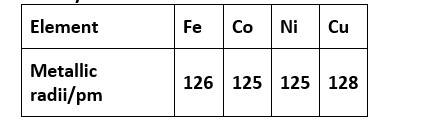
(A) Fe
(B) Ni
(C) Co
(D) Cu
31. Metallic radii of some transition elements are given below. Which of these elements will have the highest density?

(A) Fe
(B) Ni
(C) Co
(D) Cu
31. (D) Cu
Density is mass by volume. As we move from left to right for a long period, the atomic radii decrease. Hence, volume decreases. Also, an increase in atomic masses is observed.
So overall the density increases out of the above option from iron to copper, copper will have the high
Upvote 30. The electronic configuration of Cu(II) is 3d9 whereas that of Cu(I)) is 3d10. Which of the following is correct?
(A) Cu(II) is more stable .
(B) Cu(II) is less stable
(C) Cu(I) and Cu(II) are equally stable
(D) Stability of Cu(II) and Cu(I) depends on the nature of copper salts.
30. The electronic configuration of Cu(II) is 3d9 whereas that of Cu(I)) is 3d10. Which of the following is correct?
(A) Cu(II) is more stable .
(B) Cu(II) is less stable
(C) Cu(I) and Cu(II) are equally stable
(D) Stability of Cu(II) and Cu(I) depends on the nature of copper salts.
30. (A) Cu (II) is more stable .
Electronic configuration of Cuis [Ar] 3d10 4s1
Cu (I) - [Ar] 3d10 4s0
Cu (II)- [Ar] 3d9 4s0
Despite the fact that Cu (I) has fully filled 3d-orbital but Cu (II) is more stable than Cu (I) due to the greater effective nuclear charge of
Upvote 29. Electronic configuration of a transition element X in +3 oxidation state is [Ar]3d5. What is its atomic number?
(A) 25
(B) 26
(C) 27
(D) 24
29. Electronic configuration of a transition element X in +3 oxidation state is [Ar]3d5. What is its atomic number?
(A) 25
(B) 26
(C) 27
(D) 24
29. (B) 26
Positive oxidation states indicate the loss of electrons from the atom. If X is in +3 oxidation state, then three electrons have been removed from it. Find the atomic number of the parent atom, we will add three in the given electronic number. i.e.
X3+ (Z = 23) = [Ar
Upvote 28. Reactivity of transition elements decreases almost regularly from Sc to Cu. Explain.
28. Reactivity of transition elements decreases almost regularly from Sc to Cu. Explain.
28. Ionisation enthalpies are the main factor that influence the reactivity of transition elements. Higher the ionisation enthalpy, lesser is the reacting of the transition element.
When we move along the period from Sc to Cu, a regular increase in the ionisation enthalpy is observed which
Upvote