
Three Dimensional Geometry
Get insights from 211 questions on Three Dimensional Geometry, answered by students, alumni, and experts. You may also ask and answer any question you like about Three Dimensional Geometry
- 211
Questions
- 0
Discussions
- 0
Active Users
- 0
Followers
Have a question about Three Dimensional Geometry? Ask our experts
Keep it short & simple. Type complete word. Avoid abusive language.
Let the plane 2x + 3y + z + 20 = 0 be rotated through a right angle about its line of intersection with the plane x – 3y + 5z = 8. If the mirror image of the point in the rotated plane in B(a, b, c), then:
Let the plane 2x + 3y + z + 20 = 0 be rotated through a right angle about its line of intersection with the plane x – 3y + 5z = 8. If the mirror image of the point in the rotated plane in B(a, b, c), then:
Consider the equation of plane,
 Plane P is perpendicular to 2x + 3y + z + 20 = 0
So,
0
P : 9x – 18y + 36z – 36 = 0
Or P : x – 2y + 4z = 4
If image of
In plane P is (a, b, c) then
and
clearly
So, a : b : c =
 Upvote

Let Q be the mirror image of the point P(1, 2, 1) with respect to the plane x + 2y +2z = 16. Let T be a plane passing through the point Q and contains the line Then, which of the following points lies on T?
Let Q be the mirror image of the point P(1, 2, 1) with respect to the plane x + 2y +2z = 16. Let T be a plane passing through the point Q and contains the line Then, which of the following points lies on T?
(x, y, z) = (3, 6, 5)
now point Q and line both lies in the plane.
So, equation of plane is
a
=> 2x – z = 1
option (B) satisfies.
Upvote The distance of the origin from the centroid of the triangle whose two sides have the equations x – 2y + 1 = 0 and 2x – y – 1 = 0 and whose orthocenter is
The distance of the origin from the centroid of the triangle whose two sides have the equations x – 2y + 1 = 0 and 2x – y – 1 = 0 and whose orthocenter is
Let AB
AC
So vertex A = (1, 1)
altitude from B is perpendicular to AC and passing through
orthocentre.
So, BH = x + 2y – 7 = 0
CH = 2x + y – 7 = 0
now solve AB & BH to get B (3, 2) similarly CH and AC to get C (2, 3) so centroid is at (2, 2)
Upvote Let lie on the plane px – qy + z = 5, for some The shortest distance of the plane form the origin is:
Let lie on the plane px – qy + z = 5, for some The shortest distance of the plane form the origin is:
Line to the normal
=>3p + 2q – 1 = 0
lies in the plane 2p + q = 8
From here p = 15, q = -22
Equation of plane 15x – 22y + z – 5 = 0
Distance from origin =
Upvote Let Q be the mirror image of the point P(1, 2, 1) with respect to the plane x + 2y +2z = 16. Let T be a plane passing through the point Q and contains the line Then, which of the following points lies on T?
Let Q be the mirror image of the point P(1, 2, 1) with respect to the plane x + 2y +2z = 16. Let T be a plane passing through the point Q and contains the line Then, which of the following points lies on T?
(x, y, z) = (3, 6, 5)
now point Q and line both lies in the plane.
So, equation of plane is
->2x – z = 1
option (B) satisfies.
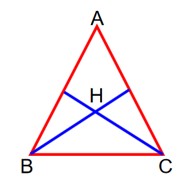
Upvote The distance of the origin from the centroid of the triangle whose two sides have the equations x – 2y + 1 = 0 and 2x – y – 1 = 0 and whose orthocenter is
The distance of the origin from the centroid of the triangle whose two sides have the equations x – 2y + 1 = 0 and 2x – y – 1 = 0 and whose orthocenter is
Let AB
AC
So vertex A = (1, 1)
altitude from B is perpendicular to AC and passing through
orthocentre.
So, BH = x + 2y – 7 = 0
CH = 2x + y – 7 = 0
now solve AB & BH to get B (3, 2) similarly CH and AC to get C (2, 3) so centroid is at (2, 2)
Upvote Let lie on the plane px – qy + z = 5, for some The shortest distance of the plane form the origin is:
Let lie on the plane px – qy + z = 5, for some The shortest distance of the plane form the origin is:
Line to the normal
->3p + 2q – 1 = 0
lies in the plane 2p + q = 8
From here p = 15, q = -22
Equation of plane 15x – 22y + z – 5 = 0
Distance from origin =
Upvote The acute angle between the planes P1 and P2, when P1 and P2 are the planes passing through the intersection of the planes 5x + 8y + 13z – 29 = 0 and 8x – 7y + z – 20 = 0 and the points (2, 1, 3) and (0, 1, 2), respectively, is
The acute angle between the planes P1 and P2, when P1 and P2 are the planes passing through the intersection of the planes 5x + 8y + 13z – 29 = 0 and 8x – 7y + z – 20 = 0 and the points (2, 1, 3) and (0, 1, 2), respectively, is
P1 passing (2, 1, 3)
(10 + 8 + 39 – 29) +
2X – Y + Z – 6 = 0 ….(i)
For P2 passes (0, 1, 2)
Acute angle between the planes
Upvote If two distinct points Q, R lie on the line of intersection of the planes -x + 2y – z = 0 and 3x - 5y + 2z = 0 and PQ = PR = where the point P is (1, -2, 3), then the area of the triangle PQR is equal to
If two distinct points Q, R lie on the line of intersection of the planes -x + 2y – z = 0 and 3x - 5y + 2z = 0 and PQ = PR = where the point P is (1, -2, 3), then the area of the triangle PQR is equal to
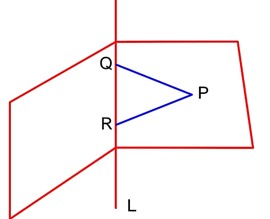
Let vector along L is
=
Area of
Upvote