

Three Dimensional Geometry
Get insights from 211 questions on Three Dimensional Geometry, answered by students, alumni, and experts. You may also ask and answer any question you like about Three Dimensional Geometry
Follow Ask QuestionQuestions
Discussions
Active Users
Followers
New answer posted
a year agoContributor-Level 10
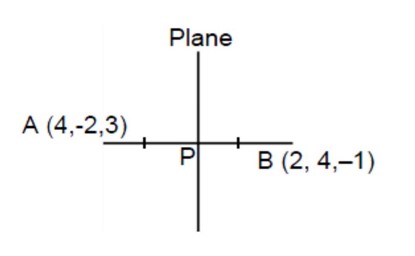
Mid point P = (3,1,1)
Normal of plane is along the line AB.
D.R.'s of normal = 4-2, -2-4, 3-1 (-1) = 2, -6, 4
= 1, -3, 2
Plane -> 1 (x-3) - 3 (y-1) + 2 (z-1) = 0
=> x - 3y + 2z - 2 = 0
New answer posted
a year agoContributor-Level 10
Equation of
AB = r = (î + j) + λ (3j - 3k)
Let coordinates of M
= (1, (1 + 3λ), -3λ).
PM = -3î + (3λ - 1)j - 3 (λ + 1)k
AB = 3j - 3k
? PM ⊥ AB ⇒ PM · AB = 0
⇒ 3 (3λ - 1) + 9 (λ + 1) = 0
⇒ λ = -1/3
∴ M = (1,0,1)
Clearly M lies on 2x + y - z = 1.
New answer posted
a year agoContributor-Level 10
r = î (1 + 12l) + j (-1) + k (l)
r = î (2 + m) + j (m - 1) + k (-m)
For intersection
1 + 2l = 2 + m
-1 = m - 1
l = -m
from (ii) m = 0
from (iii) l = 0
These values of m and l do not satisfy equation (1).
Hence the two lines do not intersect for any values of l and m.
New answer posted
a year agoContributor-Level 9
Normal to plane is n= (-4i+5j+7k).
Plane: -4 (x-3)+5 (y-1)+7 (z-1)=0 ⇒ -4x+5y+7z=0.
Passes through (α, -3,5) ⇒ -4α-15+35=0 ⇒ α=5.
New answer posted
a year agoContributor-Level 10
Two points on the line (say) x/3 = y/2, z=1 are (0,0,1) and (3,2,1)
So dr's of the line is (3,2,0)
Line passing through (1,2,1), parallel to L and coplanar with given plane is r = i+2j+k + t (3i+2j), t∈R (-2,0,1) satisfies the line (for t=-1)
⇒ (-2,0,1) lies on given plane.
Answer of the question is (B)
We can check other options by finding equation of plane
Equation plane: |x-1, y-2, z-1; 1+2, 2-0, 1-1; 2+2, 1-0, 2-1| = 0
⇒ 2 (x-1)-3 (y-2)-5 (z-1)=0
⇒ 2x-3y-5z+9=0
New answer posted
a year agoNew answer posted
a year agoContributor-Level 9
L: x/1=y/0=z/-1. Let a point on L be (r,0, -r).
Direction ratio of PN is (r-1, -2, -r+1).
PN is perpendicular to L, so (r-1) (1)+ (-2) (0)+ (-r+1) (-1)=0 ⇒ 2r-2=0 ⇒ r=1. N (1,0, -1).
Let Q be (s,0, -s). Direction ratio of PQ is (s-1, -2, -s+1).
PQ is parallel to plane x+y+2z=0, so normal to plane is perp to PQ.
(s-1) (1)+ (-2) (1)+ (-s+1) (2)=0 ⇒ s-1-2-2s+2=0 ⇒ -s-1=0 ⇒ s=-1. Q (-1,0,1).
PN = (0, -2,0). PQ= (-2, -2,2).
cosα = |PN.PQ|/|PN|PQ| = 4/ (2√12) = 1/√3.
Taking an Exam? Selecting a College?
Get authentic answers from experts, students and alumni that you won't find anywhere else
Sign Up on ShikshaOn Shiksha, get access to
- 67k Colleges
- 1.2k Exams
- 718k Reviews
- 1850k Answers