
Chemical Kinetics
Get insights from 145 questions on Chemical Kinetics, answered by students, alumni, and experts. You may also ask and answer any question you like about Chemical Kinetics
- 145
Questions
- 0
Discussions
- 0
Active Users
- 0
Followers
Have a question about Chemical Kinetics? Ask our experts
Keep it short & simple. Type complete word. Avoid abusive language.
If the activation energy of a reaction is 80.9 kJ mol-1, the fraction of molecules at 700K, having enough energy to react to form products, is e-x. The value of x is………. (Rounded-off to the nearest integer).
[use R = 8.31 J K-1 mol-1]
If the activation energy of a reaction is 80.9 kJ mol-1, the fraction of molecules at 700K, having enough energy to react to form products, is e-x. The value of x is………. (Rounded-off to the nearest integer).
[use R = 8.31 J K-1 mol-1]
Fraction of molecules having enough energy to form product =
Fraction of molecules having enough energy to form product =
So, x = 14
 Upvote

Sucrose hydrolyses in acid solution into glucose and fructose following first order rate law with a half – life of 3.33 h at 25°C. After 9h, the fraction of sucrose remaining is f. The value of log10 <!-- [if gte mso 9]><xml>
[Assume: In 10 = 2.303, In2 = 0.693]
Sucrose hydrolyses in acid solution into glucose and fructose following first order rate law with a half – life of 3.33 h at 25°C. After 9h, the fraction of sucrose remaining is f. The value of log10 <!-- [if gte mso 9]><xml>
[Assume: In 10 = 2.303, In2 = 0.693]
For the reaction aA + bB->cC + dD, the plot of log K vs is given below:
This temperature at which the rate constant of the reaction is 10-4 s-1 is----------K.
(Rounded – off to the nearest integer)
[Given : The rate constant of the reaction is 10-5 s-1 at 500 K]
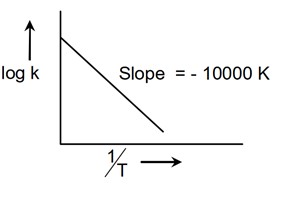
For the reaction aA + bB->cC + dD, the plot of log K vs is given below:
This temperature at which the rate constant of the reaction is 10-4 s-1 is----------K.
(Rounded – off to the nearest integer)
[Given : The rate constant of the reaction is 10-5 s-1 at 500 K]
(at 500 K temperature)
Upvote For the reaction A -> B, the rate constant K(in s-1) is givne by
The energy of activation in KJ mol-1 is ______. (Nearest integer)
[Given : R = 8.314 J K-1 mol-1]
For the reaction A -> B, the rate constant K(in s-1) is givne by
The energy of activation in KJ mol-1 is ______. (Nearest integer)
[Given : R = 8.314 J K-1 mol-1]
log k = 20.35 -
Comparing with,
= 47.29 kJ/mole
Ans. = 47
Upvote At 345 K, the half life for the decomposition of a sample of a gaseous compound initially at 55.5 kPa was 340s. When the pressure was 27.8 kPa., the half life was found to be 170s. The order of the reaction is ________. [integer answer]
At 345 K, the half life for the decomposition of a sample of a gaseous compound initially at 55.5 kPa was 340s. When the pressure was 27.8 kPa., the half life was found to be 170s. The order of the reaction is ________. [integer answer]
t1/2 = 340 sec P0 = 55.5 kPa
t1/2 = 170 sec P0 = 27.8 kPa
zero order reaction
Upvote [A] -> [B]
Reactant Product
If formation of compound [B] follows the first order of kinetics and after 70 minutes the concentration of [A] was found to be half of its initial concentration. Then the rate constant of the reaction is x × 10-6 s-1. The value of x is___________. (Nearest Integer)
[A] -> [B]
Reactant Product
If formation of compound [B] follows the first order of kinetics and after 70 minutes the concentration of [A] was found to be half of its initial concentration. Then the rate constant of the reaction is x × 10-6 s-1. The value of x is___________. (Nearest Integer)
For a given chemical reaction
<!-- [if gte mso 9]><xml>
Concentration of C charges form 10 mmol dm-3 to 20 mmol dm-3 in 10 second. Rate of appearance of D is 1.5 times the rate of disappearance of B which is twice the rate of disappearance A. The rate of appearance of D has been experimentally determined to be 9 mmol dm-3 s-1. Therefore the rate of reaction is_____________mmol dm-3 s-1 (Nearest Integer)