Chemistry

Get insights from 6.9k questions on Chemistry, answered by students, alumni, and experts. You may also ask and answer any question you like about Chemistry

Follow Ask Question
6.9k

Questions

0

Discussions

22

Active Users

0

Followers

New answer posted

a year ago

0 Follower 2 Views

V
Vishal Baghel

Contributor-Level 10

N i C l 2 + N a C N → O . A . s t r o n g [ N i ( C N ) 6 ] 2 −

Complex has Ni4+ and strong ligand, hence following are the metal ion electronic configuration

Change of unpaired electron = 2

New answer posted

a year ago

0 Follower 4 Views

V
Vishal Baghel

Contributor-Level 10

Wt of Cl- in 100 ml = 1.8 * 10-3 gm

Mol. of Cl- in 100 ml = 1 . 8 * 1 0 − 3 3 5 . 5 = 0 . 0 5 0 7 * 1 0 − 3 m o l e  

∴ [ C l − ] = 0 . 0 5 0 7 * 1 0 − 3 * 1 0 0 0 1 0 0 = 5 . 0 7 * 1 0 − 4 M   

i.e. 0.507 milli mole in one lit required in one hr.

Coagulation value = (millimole/lit) required in one hr = 0.507

= 1 (the nearest integer)

New answer posted

a year ago

0 Follower 5 Views

V
Vishal Baghel

Contributor-Level 10

Here, λ = h 2 * m * e V = 6 . 6 3 * 1 0 − 3 4 2 * 1 . 6 * 1 0 − 1 9 * 4 0 0 0 0 * 9 . 1 * 1 0 − 3 1 m  

∴ λ = 0 . 6 1 4 * 1 0 − 1 1 m  

λ = 6 . 1 4 * 1 0 − 1 2 m [the nearest integer = 6]

New answer posted

a year ago

0 Follower 2 Views

V
Vishal Baghel

Contributor-Level 10

From   Δ H = Δ G + T Δ S ∴ Δ S = Δ H − Δ G T

∴ Δ S = [ 5 1 . 4 − ( − 4 9 . 4 ) 3 0 0 ] * 1 0 0 0 J K − 1 m o l − 1 = 3 3 6 J K − 1 m o l − 1

New answer posted

a year ago

0 Follower 3 Views

V
Vishal Baghel

Contributor-Level 10

0.15 gm (organic compounds) → A g N O 3 A g B r ( s )

↓                                                                    

0.2397 gm

Weight of Br in AgBr = ( 8 0 1 8 8 * 0 . 2 3 9 7 ) = 0 . 1 0 2 g m

% Br in compound = 0 . 1 0 2 * 1 0 0 0 . 1 5 = 6 8 %

New question posted

a year ago

0 Follower 1 View

New answer posted

a year ago

0 Follower 6 Views

V
Vishal Baghel

Contributor-Level 10

Total wt = 4gm = WNaOH + W N a 2 C O 3  

Let us suppose moles are 'm' for each.

4 = 40m + 106m

∴ m = ( 4 1 4 6 ) moles of NaOH and Na2CO3 each .

∴ Mass of NaOH (x gm) = 4 1 4 6 * 4 0 = 1 . 0 9 5 ≈ 1 . 0

New answer posted

a year ago

0 Follower 2 Views

V
Vishal Baghel

Contributor-Level 10

Due to the larger acid dissociation constant (Ka) sulphuric acid acts as an acid and HNO3 acts as a base.

New answer posted

a year ago

0 Follower 2 Views

V
Vishal Baghel

Contributor-Level 10

[ C l − ] = 1 0 − 1 M

[ C r O 4 − − ] = 1 0 − 3 M

for AgCl ppt1, [ A g + ] r e q = 1 . 7 * 1 0 − 1 0 1 0 − 1 M  

For Ag2CrO4ppt2, [ A g + ] r e q = 1 . 9 * 1 0 − 1 2 1 0 − 3 M

[ A g + ] r e q = 4 . 3 * 1 0 − 5 M

Being lower concentration of [Ag+] in case of AgCl, it will precipitate first.
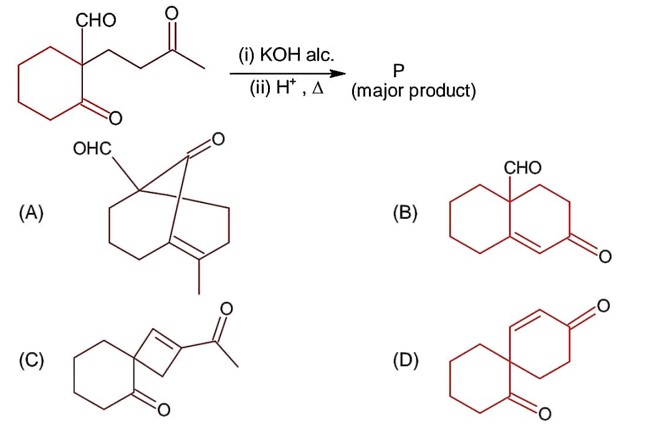
 

New answer posted

a year ago

0 Follower 56 Views

V
Vishal Baghel

Contributor-Level 10

Kindly consider the following figure

Get authentic answers from experts, students and alumni that you won't find anywhere else

Sign Up on Shiksha

On Shiksha, get access to

  • 67k Colleges
  • 1.2k Exams
  • 716k Reviews
  • 1850k Answers

Share Your College Life Experience

×

This website uses Cookies and related technologies for the site to function correctly and securely, improve & personalise your browsing experience, analyse traffic, and support our marketing efforts and serve the Core Purpose. By continuing to browse the site, you agree to Privacy Policy and Cookie Policy.