Chemistry

Get insights from 6.9k questions on Chemistry, answered by students, alumni, and experts. You may also ask and answer any question you like about Chemistry

Follow Ask Question
6.9k

Questions

0

Discussions

22

Active Users

0

Followers

New answer posted

a year ago

0 Follower 1 View

A
alok kumar singh

Contributor-Level 10

Both statement are correct for the glass body heating, but reason is not correct explanation during heating process of glass, constituents unit rupture of glass body and gives the edge smoothness.

New answer posted

a year ago
0 Follower 1 View

A
alok kumar singh

Contributor-Level 10

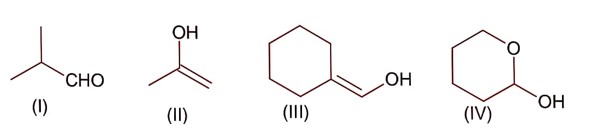
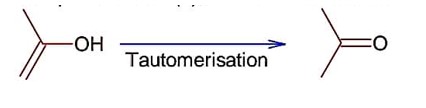
All structure can produce -CHO functional group which gives +ve test of Tollen's reagent except structure (II), because if forms ketonic group after tautomerisation
 

New answer posted

a year ago

0 Follower 4 Views

A
alok kumar singh

Contributor-Level 10

X → H 2 S O 4 C o n c Brown fumes + Brown ring test with FeSO4/H2SO4

x → H C l H 2 S Y ( p p t ) → H N O 3 C o n c d i s s o l v e d → N H 4 O H Deep blue colour solution

In cation analysis of Cu+ ions, precipitate formed is CuS on treating with H2S and HCl which dissolved in HNO3 and produced blue colour complex solution [ C u ( N H 3 ) 4 ] + + in NH4OH. Brown fumes and brown ring performance given by nitrate sample. Hence salt is Cu (NO3)2.
New answer posted

a year ago

0 Follower 40 Views

A
alok kumar singh

Contributor-Level 10

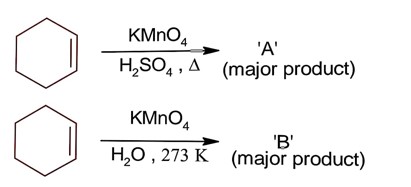
Kindly go through the solution


New answer posted

a year ago

0 Follower 2 Views

A
alok kumar singh

Contributor-Level 10

In B r O 4 − , B r   has +7 O.S, therefore it only acts as a oxidizing reagent, does not undergo disproportionation reaction

New answer posted

a year ago

0 Follower 5 Views

V
Vishal Baghel

Contributor-Level 10

6 O H − + C l − → C l O 3 − + 3 H 2 O + 6 e −

Mole of  C l O 3 −     o r     K C l O 3 = 1 0 1 2 2 . 6 = 0 . 8 4 5 6   m o l

1 mole of C l O 3 −  or KClO3 produced by 6 faraday (F).

∴ 0 . 0 8 4 5 6 mole of C l O 3 − or KClO3 produced by (6 * 0.08156) F

l * t F = 6 * 0 . 8 1 5 6

l = 6 * 0 . 0 8 1 5 6 * 9 6 5 0 0 0 1 0 * 6 0 * 6 0 A = 1 . 3 1 1 A ≈ 1 A


New answer posted

a year ago

0 Follower 2 Views

V
Vishal Baghel

Contributor-Level 10

P C l 5 ( g ) → P C l 3 ( g ) + C l 2 ( g ) (first order reaction)

K = 2 . 3 0 3 1 2 0 l o g ( 5 0 1 0 )      

∴ K = 2 . 3 0 3 * l o g 5 1 2 0 m i n = 2 . 3 0 3 * 0 . 6 9 8 9 1 2 0 = 0.0134 min-1

Rate constant at 300K = 1.34 * 10-2min-1 [the nearest integer = 1.0]

New question posted

a year ago

0 Follower 1 View

New answer posted

a year ago

0 Follower 7 Views

V
Vishal Baghel

Contributor-Level 10

Total pressure of mixture =   P T o t a l = X A * P A o + X B * P B o = 9 0 * 0 . 6 + 1 5 * 0 . 4 = 6 0 m m

Mole fraction of B in vapour phase, ( X B ' ) = X B * P B o P T o t a l

∴ X B ' = 0 . 4 * 1 5 6 0 = 0 . 1 = 1 * 1 0 − 1  

New answer posted

a year ago

0 Follower 2 Views

V
Vishal Baghel

Contributor-Level 10

In fcc structure of diamond four C present in fcc lattice and other four C present in tetrahedral voids where 50% of tetrahedral voids are occupied. Hence number of carbon atoms present per unit cell of diamond is 8.

Get authentic answers from experts, students and alumni that you won't find anywhere else

Sign Up on Shiksha

On Shiksha, get access to

  • 67k Colleges
  • 1.2k Exams
  • 716k Reviews
  • 1850k Answers

Share Your College Life Experience

×
×

This website uses Cookies and related technologies for the site to function correctly and securely, improve & personalise your browsing experience, analyse traffic, and support our marketing efforts and serve the Core Purpose. By continuing to browse the site, you agree to Privacy Policy and Cookie Policy.