

Chemistry
Get insights from 6.9k questions on Chemistry, answered by students, alumni, and experts. You may also ask and answer any question you like about Chemistry
Follow Ask QuestionQuestions
Discussions
Active Users
Followers
New answer posted
a year agoContributor-Level 10
This is a short answer type question as classified in NCERT Exemplar
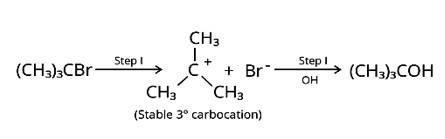
The SN1 mechanism advances through the production of carbocation. The breakage of the C-halogen bond occurs during this phase. The solution of the halide ions is done with the protons of the protic solvent as a result. In this approach, polar solvents aid in the ionisation process by solvating the ions and stabilising them.
New answer posted
a year agoContributor-Level 10
This is a short answer type question as classified in NCERT Exemplar
RMgX+H2O→RH+Mg (OH)X
Because the Grignard reagents are very reactive in nature, even residues of moisture must be avoided. Even minute amounts of water can cause these reagents to generate hydrocarbons.
New answer posted
a year agoContributor-Level 10
This is a short answer type question as classified in NCERT Exemplar
In nature, allyl chloride becomes very reactive due to the production of carbocation, which is extremely stable due to resonance. Due to carbocation, there will be no such stability in the case of n-propyl chloride.

New answer posted
a year ago
Contributor-Level 10
This is a short answer type question as classified in NCERT Exemplar
Due to the resonance stabilisation of the benzyl ring, compound (B) would conduct the SN1 reaction faster than compound (A). The carbocation C6H5CH2Cl+ is very stable when the -Cl from the ring is cleaved, and it is driven to carry out the SN1 reaction.

New answer posted
a year agoContributor-Level 10
This is a short answer type question as classified in NCERT Exemplar
Phenol will not react with HCl in the presence of ZnCl2. This is owing to the presence of partial double bond properties between the benzene ring and O, which will result in resonance between the benzene ring and the OH - group. As a result, no aryl halide will be made.
New answer posted
a year agoContributor-Level 10
This is a short answer type question as classified in NCERT Exemplar
Nucleophilic substitutions occur when haloalkanes react with aqueous KOH. The tertiary halide 2-Bromo-2-methylpropane will react with aq. KOH the easiest of the compounds because the initial step involves cleavage of the alkyl and halide groups, resulting in the production of the extremely stable carbocation.
New answer posted
a year agoContributor-Level 10
This is a short answer type question as classified in NCERT Exemplar
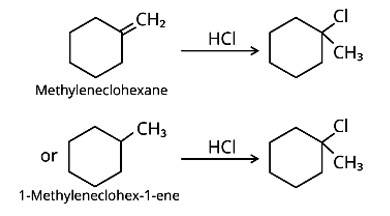
Methylenecyclohexane and 1-methylcyclohex-1-ene are two chemicals that can produce 1-chloro-1-methylcyclohexane.
New answer posted
a year agoContributor-Level 10
This is a short answer type question as classified in NCERT Exemplar
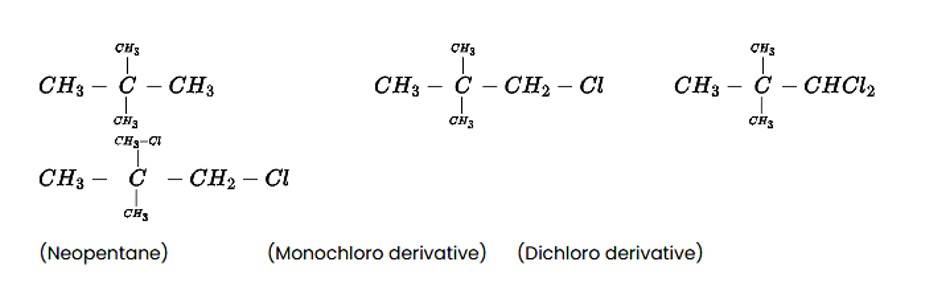
The alkane C5H12 is a hydrocarbon with a molecular mass of 72gmol?1. On photo-chlorination, the tert-isomer of pentane yields a single monochloro derivative and two dichloro derivatives. The following is the structure of the alkane and its chloride derivatives.
New answer posted
a year agoContributor-Level 10
This is a short answer type question as classified in NCERT Exemplar
The IUPAC name for this compound is 1-Bromo-2,2-dimethylpropane

New answer posted
a year ago
Contributor-Level 10
This is a short answer type question as classified in NCERT Exemplar
Because both methyl groups and chlorine atoms are symmetrically positioned at para-positions in compound (II), these molecules fit better in the crystal lattice than other isomers, and hence have the greatest melting point.
Taking an Exam? Selecting a College?
Get authentic answers from experts, students and alumni that you won't find anywhere else
Sign Up on ShikshaOn Shiksha, get access to
- 67k Colleges
- 1.2k Exams
- 717k Reviews
- 1850k Answers