

Chemistry
Get insights from 6.9k questions on Chemistry, answered by students, alumni, and experts. You may also ask and answer any question you like about Chemistry
Follow Ask QuestionQuestions
Discussions
Active Users
Followers
New answer posted
a year agoContributor-Level 10
This is a short answer type question as classified in NCERT Exemplar
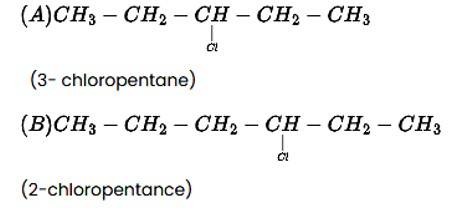
The addition reaction of the alkene produces two products, as indicated below.
CH3−CH2−CH=CH−CH3 + HCl→ A + B
New answer posted
a year agoContributor-Level 10
This is a short answer type question as classified in NCERT Exemplar
When an arene is treated with Cl2 in the presence of FeCl3, the electrophilic addition reaction chlorinates the arene to produce aryl chloride. As a result, the chemical provided is C6H5-CH3, often known as toluene. o-chlorotoluene and p-chlorotoluene are the results of electrophilic substitution chlorination.

New answer posted
a year agoContributor-Level 10
This is a short answer type question as classified in NCERT Exemplar
(i) Because the rate of reaction of compound 'A' with aqueous KOH is solely dependent on the concentration of 'A, ' the reaction mechanism is SN1and 'A' is 2-Bromo-2-methylpropane (tertiary bromide).
'B', on the other hand, is an isomer of 'A' and is optically active. As a result, 'B' has to be 2-Bromobutane. Because the rate of reaction of 'B' with aqueous KOH is determined by its concentration, the reaction mechanism is SN2.
(ii) Compound 'B' will have an inverted conformation as a result of the SN2 reaction, resulting in an inverted product.
Structure 'A' i

New answer posted
a year agoContributor-Level 10
This is a short answer type question as classified in NCERT Exemplar
(i) 1-Bromobut-2-ene: It is a primary halide.
(ii) 4-Bromopent-2-ene: Here Bromine is attached to the secondary carbon. Hence, it is a secondary halide.
(iii) 2-Bromo-2-methylpropane: Here Bromine is attached to the tertiary carbon. Hence, it is a tertiary halide.
New answer posted
a year ago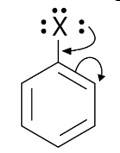
Contributor-Level 10
This is a short answer type question as classified in NCERT Exemplar
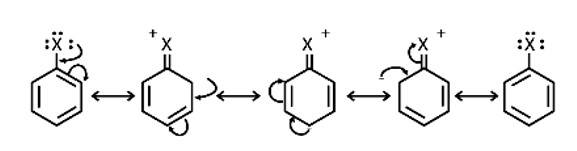
Because electron density is higher at ortho and para locations, the functional groups contained in these compounds are ortho-para directed.
New answer posted
a year agoContributor-Level 10
The NCERT Exemplar questions go beyond the textbook questions as they are designed to be more challenging and conceptually advanced. Practicing the NCERT exemplar provides a better understanding of complex topics like conductance and electrochemical cells. It also helps in better preparation for the entrance exams. The exemplar often involves multi-concept, application-based, and analytical problems.
New answer posted
a year agoContributor-Level 10
This is a short answer type question as classified in NCERT Exemplar
Because energy is required to overcome the attractions between the haloalkane molecules as well as to break the hydrogen bonds between water molecules in order to dissolve a haloalkane in water, haloalkanes are only weakly soluble in water. New attractions between the haloalkane and the water molecules, on the other hand, release less energy since they are weaker than the water's initial hydrogen bonds.
New answer posted
a year agoContributor-Level 10
This is a short answer type question as classified in NCERT Exemplar
This addition reaction is carried out in accordance with Markovnikoff's rule, which states that in a double bond, the hydrogen from the hydrogen halide is added to the carbon atom with the most hydrogen atoms attached to it, while the halogen atom is attached to the carbon atom with the fewest hydrogens attached to it. The main product in the combination will be the molecule that follows this guideline. As a result, the molecule (B) will be the reaction's main product.
New answer posted
a year agoContributor-Level 10
A salt bridge in a galvanic cell maintains electrical neutrality by allowing the ions to flow between the two half-cells. It ensures the continuous flow without participating in the reaction. The salt bridge prevents the charges accumulation as such an accumulation can halt the electrochemical reaction by stopping the flow of electrons.
New answer posted
a year ago
Contributor-Level 10
This is a short answer type question as classified in NCERT Exemplar
(a) Br2 gas is produced when NaBr and H2SO4 are combined. Because of the stable molecule created as a result of resonance stabilisation, molecule
(b) Will not react with Br2 gas.
Taking an Exam? Selecting a College?
Get authentic answers from experts, students and alumni that you won't find anywhere else
Sign Up on ShikshaOn Shiksha, get access to
- 67k Colleges
- 1.2k Exams
- 717k Reviews
- 1850k Answers