

Chemistry
Get insights from 6.9k questions on Chemistry, answered by students, alumni, and experts. You may also ask and answer any question you like about Chemistry
Follow Ask QuestionQuestions
Discussions
Active Users
Followers
New answer posted
a year agoContributor-Level 10
This is a assertion and reason answer type question as classified in NCERT Exemplar
(ii) Assertion and reason both are wrong statements.
Correct assertion: Addition reaction of water to but-1-ene in acidic medium yields butan-2-o1.
Correct reason: Addition of water in acidic medium proceeds through the formation of secondary carbocation.
New answer posted
a year ago
Contributor-Level 10
This is a matching answer type question as classified in NCERT Exemplar
(i)- (d); (ii)- (a); (iii)- (f); (iv)- (e); (v)- (c); (vi)- (b)
New answer posted
a year ago
Contributor-Level 10
This is a matching answer type question as classified in NCERT Exemplar
(i)- (e) ; (ii)- (f) ; (iii)- (d) ; (iv)- (c); (v)- (a); (vi)- (b)
New answer posted
a year ago
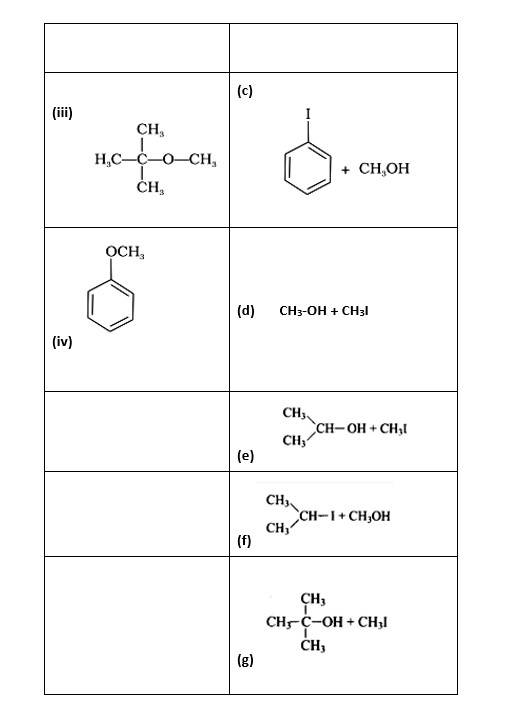
Contributor-Level 10
This is a matching answer type question as classified in NCERT Exemplar
(i)- (d) (ii)- (e); (iii)- (b); (iv)- (a)
New answer posted
a year ago
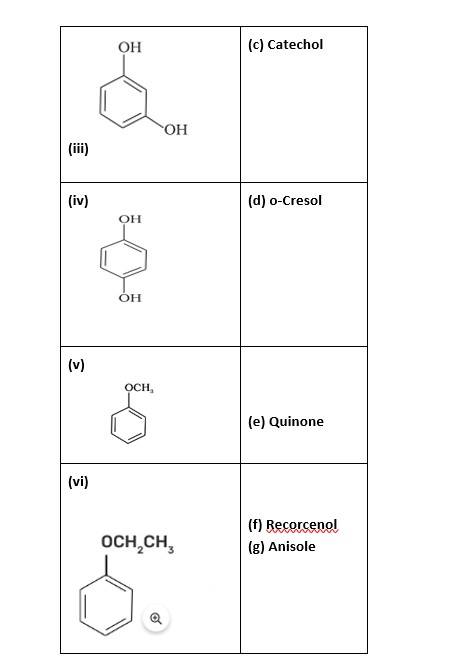
Contributor-Level 10
This is a matching answer type question as classified in NCERT Exemplar
(i)- (d); (ii)- (c); (iii)- (f); (iv)- (a); (v)- (g); (vi)- (b)
New answer posted
a year agoContributor-Level 10
This is a multiple choice answer as classified in NCERT Exemplar
II. C6H5—CH2—OH
III. C6H5—CH—OH
|
CH3
Benzylic alcohol are those alcohols which have phenyl group attached to the alpha carbon of alcohol.
R—CαH2—OH : Benzylic Alcohol
The compound II and III have phenyl group attached at the Cα of the alcohol and thence they are benzylic alcohols
New answer posted
a year agoContributor-Level 10
This is a multiple choice answer as classified in NCERT Exemplar
I. Br2/water
III. Neutral FeCl3
Phenol does not give the bromine water (Br2/water ) test whereas ethanol gives the bromine water.
Phenol on reaction with neutral FeCl3 forms a colored complex with Fe3+ ion whereas ethanol does not form the colored complex with neutral FeCl3.
New answer posted
a year agoContributor-Level 10
This is a multiple choice answer as classified in NCERT Exemplar
I. CrO3 in anhydrous medium.
II. Pyridinium chlorochromate.
III. Heat in the presence of Cu at 573K.
KMnO4 is a strong oxidising agent and oxidises the primary alcohol to ketone. Hence cannot be used as a reagent to oxidise primary alcohols to aldehydes.
New answer posted
a year agoContributor-Level 10
This is a multiple choice answer as classified in NCERT Exemplar
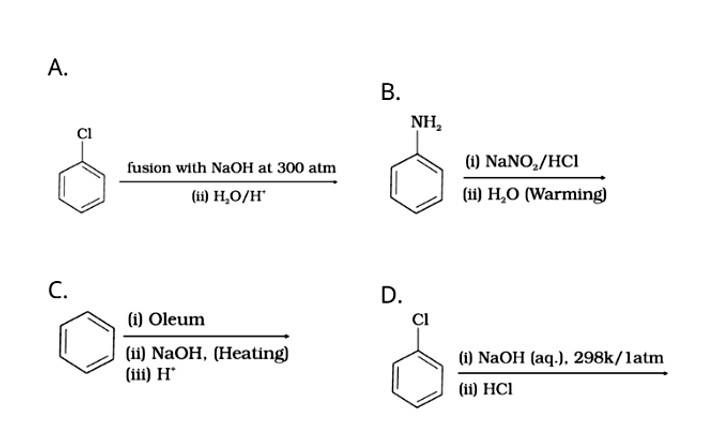
Phenol is prepared by:
Dow's process: The chlorobenzene on heating with NaOH, form sodium phenoxide which on hydrolysis with water of acid from phenol.
Diazotization of aniline: Aniline on reacting with nitrous acid at 0-5o C followed by hydrolysis with water form phenol.
Benzene undergoes sulphonation on reacting with oleum to form benzene sulphonic acid which on heating with sodium hydroxide forms sodium phenoxide and then phenol on hydrolysis.
The nucleophilic substitution of haloarenes such as chlorobenzene requires drastic conditions for conversion to phenol so chlorobenz
New answer posted
a year agoContributor-Level 10
This is a multiple choice answer as classified in NCERT Exemplar
I. H2/Pd
II. LiA1H4
III. NaBH4
Aldehydes and ketones are converted to alcohols by catalytic hydrogenation.The reagents used to convert the aldehydes to alcohol are by H2/Pd, lithium aluminium hydride (LiA1H4), and sodium borohydride (NaBH4).
Taking an Exam? Selecting a College?
Get authentic answers from experts, students and alumni that you won't find anywhere else
Sign Up on ShikshaOn Shiksha, get access to
- 67k Colleges
- 1.2k Exams
- 717k Reviews
- 1850k Answers